Stock Analysis · Raymond James Financial Inc (RJF)
Overview
Raymond James Financial is a diversified financial services company centered on wealth management. In simple terms, it helps individuals, families, businesses, and institutions manage money, invest assets, raise capital, trade securities, and use banking products. The company operates through a large network of financial advisors and also serves institutions such as corporations, municipalities, and asset managers.
Its business model is more diversified than a pure brokerage firm. The largest profit engine is the Private Client Group, which includes advisory accounts, brokerage services, financial planning, and fees tied to client assets. Beyond that, Raymond James earns meaningful revenue from capital markets activity, asset management and related fees, and banking operations such as net interest income and lending.
Based on recent annual reporting, the main revenue sources can be summarized approximately as follows:
- Private Client Group: about 55% to 60% of total revenues. This includes advisory fees, brokerage commissions, account and service fees, and interest-related income tied to client cash and margin balances.
- Capital Markets: about 20% to 25%. This segment covers investment banking, equity and fixed-income trading, institutional sales, and related services for corporate and institutional clients.
- Asset Management: about 10% to 15%. This mainly includes fees based on assets under management, administration, and sub-advisory activities.
- Bank and other activities: about 10% to 15%. This includes lending, deposit spreads, and other corporate or treasury-related income streams.
That mix matters for long-term analysis because it means Raymond James is not relying on a single source of activity. Wealth management provides recurring fee income, capital markets adds upside in stronger deal environments, and the bank contributes interest income.
Over the last five fiscal years, total revenue moved from just under $10 billion to nearly $16 billion, while net income also advanced. The broad pattern shows a company that has expanded meaningfully even though expenses and interest costs have also risen along the way, which is normal for a growing financial platform with banking exposure.
Key Figures
Metric Value Sector ⓘ Date Oct 17, 2026 Context Sector Financial Services Industry Asset Management Market Cap ⓘ $30.25B Beta ⓘ 0.95 P/E Ratio ⓘ 13.66 12.26 P/B Ratio ⓘ 2.46 1.23 FCF Yield ⓘ 7.51% 10.40% Dividend Yield ⓘ 1.35% 3.02% EBIT / EV ⓘ 14.43% 8.14% PEG ⓘ 0.78 Revenue Growth ⓘ 15.10% 9.35% RPS Growth (5Y CAGR) ⓘ 13.56% 12.19% EPS Growth (5Y CAGR) ⓘ 4.33% -9.53% BVPS Growth (5Y CAGR) ⓘ 11.58% 4.99% Margin Growth (5Y Trend) ⓘ 10.35% -3.86% FCF Growth (5Y CAGR) ⓘ -23.48% 4.81% DPS Growth (5Y CAGR) ⓘ 18.18% 8.79% ROIC (Latest) ⓘ 13.70% 9.49% ROE (Latest) ⓘ 18.33% 13.90% ROA (Latest) ⓘ 2.53% 1.55% ROIC (5Y Median) ⓘ 14.79% 7.86% ROE (5Y Median) ⓘ 17.70% 12.17% ROA (5Y Median) ⓘ 2.49% 1.30% Net Debt / EBIT (Latest) ⓘ -2.07 0.96 Net Debt / EBIT (5Y Median) ⓘ -1.50 0.73 Net Debt / EBITDA (Latest) ⓘ -1.94 0.92 Operating Margin (Latest) ⓘ 17.39% 22.30% Operating Margin (5Y Median) ⓘ 18.31% 24.63% Debt to Equity (Latest) ⓘ 41.73% 58.56% Profit Margin (Latest) ⓘ 15.13% 26.57% Free Cash Flow (Latest) ⓘ $2.27B 3Y Return ⓘ +61.73% +88.33% 12M Return (excl. last month) ⓘ +1.66% +19.38% 6M Return ⓘ +1.73% +4.75% Price vs. 200-Day MA ⓘ -1.39% +3.50%
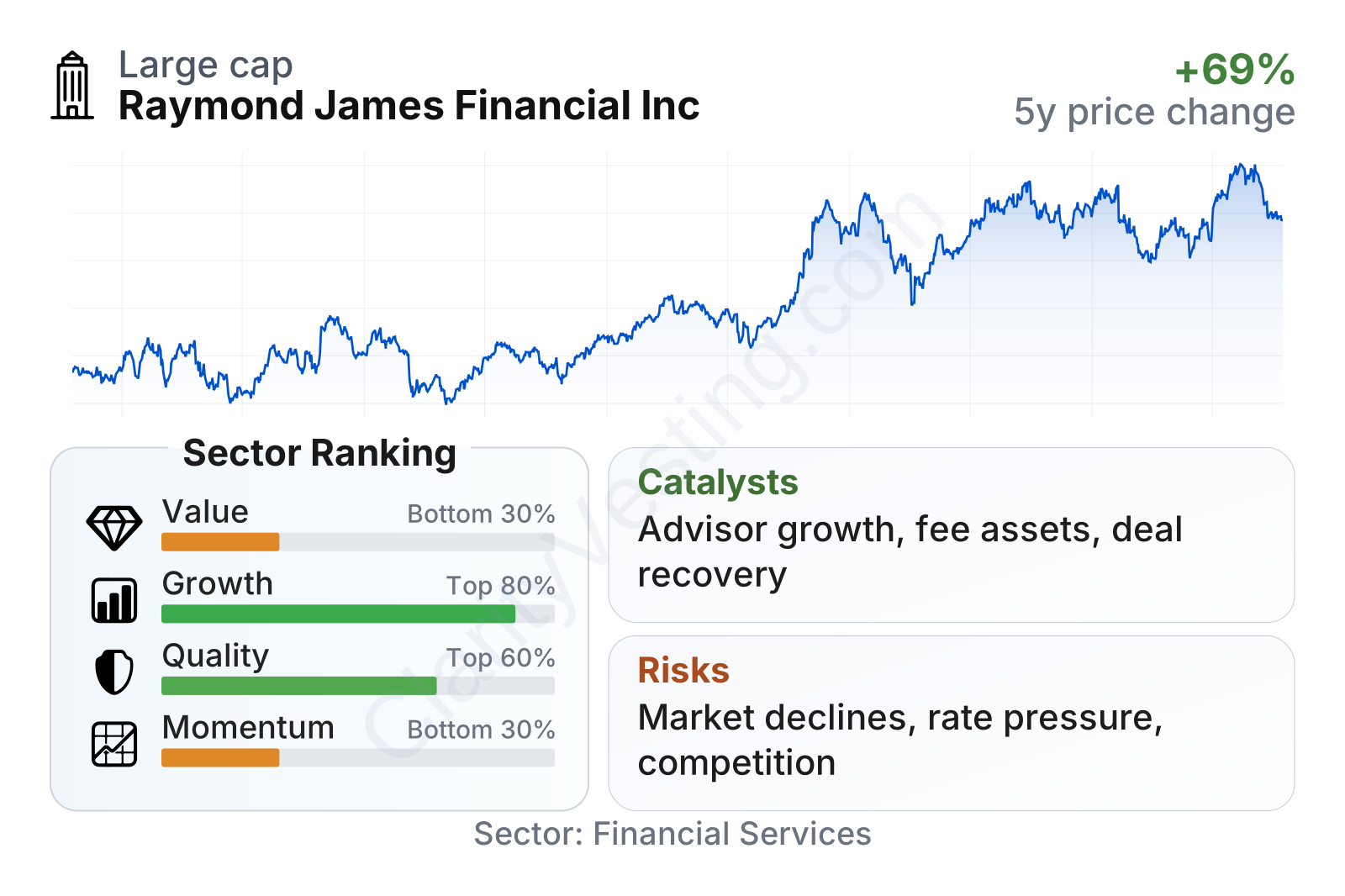
Raymond James sits in the large-cap range within financial services, with share-price volatility slightly below the broader market based on its beta near 0.9. The overall profile is mixed but understandable: growth and business quality rank better than much of the sector, while value and recent price momentum look less favorable. In other words, the market is assigning a premium to a company that has delivered above-median profitability and growth, but the stock is not screening as cheap relative to peers.
Growth
Raymond James operates in areas with long-term structural support. Wealth management continues to benefit from aging demographics, the ongoing need for retirement planning, and the steady migration of household savings into professionally managed accounts. That creates a favorable backdrop for firms that can attract advisors, gather client assets, and deepen relationships through banking and planning services.
The company’s strategy also makes sense for future expansion because it combines advisor recruitment, asset gathering, banking cross-sell, and selective acquisitions. This model can compound over time: more advisors can bring more client assets, which can lift advisory fees, cash balances, lending opportunities, and asset management revenues. The business is especially attractive when client assets rise both from market appreciation and from net new money.
Earnings per share rose strongly from 2021 through 2025 before easing in the latest trailing period. That softer recent reading does not erase the bigger picture: over five years, earnings growth remained positive and clearly better than the sector median. It suggests a company that has expanded profitably, even if quarterly or trailing results can fluctuate with interest rates, market conditions, and capital markets activity.
Book value per share has climbed steadily over the last several years, with five-year growth well ahead of the sector median. For a financial company, that is an important sign because it shows the underlying equity base has been building over time rather than standing still. It also helps explain why the market has often valued Raymond James above the sector’s typical price-to-book multiple.
A meaningful catalyst is the possibility of stronger capital markets activity if dealmaking, equity issuance, and advisory work continue to recover. Another is continued growth in fee-based client assets, which tends to be stickier and more recurring than transaction-driven revenue. The company has also continued to emphasize advisor recruiting and retention, which can support organic growth for years if execution remains solid.
Recent company updates have pointed to continued client asset growth, durable advisor-related activity, and healthy balance-sheet flexibility. Those factors do not remove cyclicality, but they support the case that Raymond James is positioned to keep expanding if market conditions remain constructive.
Risks
This article is for informational purposes only and does not constitute financial advice. Some content is AI-generated. See Disclaimer


