Stock Analysis · Rithm Capital Corp (RITM)
Overview
Rithm Capital Corp is a mortgage-focused real estate investment trust, or REIT. In simple terms, it makes money from housing-related finance rather than from owning traditional office buildings or shopping centers. Its activities include investing in mortgage servicing rights, originating and servicing residential mortgage loans through its Newrez platform, managing single-family rental and transitional lending assets, and operating an asset management business through Sculptor Capital.
This mix matters because Rithm is not a pure-play mortgage lender and not a plain landlord either. It sits across several parts of the housing finance chain: creating loans, servicing them, investing in mortgage-related assets, and earning management fees from third-party capital. That can create multiple income streams, but it also makes the business more complex than many other REITs.
Based on the company’s recent reporting structure and annual disclosures, the main revenue and earnings sources are best understood in this broad order:
- Origination and servicing through Newrez — the largest operating platform. This includes gain-on-sale income from newly originated mortgages, loan servicing fees, ancillary servicing income, and related activities tied to refinancing, purchase mortgages, and recapture of existing borrowers.
- Mortgage servicing rights and related investments — a major earnings driver. Mortgage servicing rights can become more valuable when interest rates stay higher for longer because homeowners refinance less often, extending the life of servicing cash flows.
- Asset management and fee income — increasingly important after the Sculptor transaction. This includes management fees, incentive income when applicable, and earnings from investment products managed for outside clients.
- Investment portfolios tied to real estate credit and rentals — smaller than the core mortgage platform but still meaningful. This can include single-family rental exposure, transitional lending, and other real estate-related credit investments.
Rithm does not present one simple revenue split that cleanly matches these categories in percentage terms across the whole enterprise, because fair-value marks, servicing economics, and segment reporting can move results materially from year to year. At a high level, the business is still centered on residential mortgage origination, servicing, and mortgage-related investing, with fee-based asset management becoming a more visible contributor.
The financial flow over the last several years shows how volatile this model can be. Revenue rebounded sharply in 2024 and expanded again in 2025, while net income remained positive but more uneven. Interest expense has been a major moving part, which is normal for a leveraged mortgage REIT, but it also explains why strong top-line recovery does not always translate into equally strong profitability.
Key Figures
| Metric | Value | Sector ⓘ |
|---|---|---|
| Date | Oct 17, 2026 | |
| Context | ||
| Sector | Real Estate | |
| Industry | REIT - Mortgage | |
| Market Cap ⓘ | $4.83B | |
| Beta ⓘ | 1.16 | |
Value (Cheapness) | ||
| P/E Ratio ⓘ | 14.67 | 17.38 |
| P/B Ratio ⓘ | 0.65 | 0.85 |
| FCF Yield ⓘ | -35.79% | 7.38% |
| Dividend Yield ⓘ | 11.98% | 4.85% |
| EBIT / EV ⓘ | 2.42% | 3.78% |
| PEG ⓘ | N/A | |
Growth (Business expansion) | ||
| Revenue Growth ⓘ | 9.70% | 5.30% |
| RPS Growth (5Y CAGR) ⓘ | 12.92% | 6.02% |
| EPS Growth (5Y CAGR) ⓘ | -4.71% | -11.37% |
| BVPS Growth (5Y CAGR) ⓘ | 4.53% | 0.45% |
| Margin Growth (5Y Trend) ⓘ | -28.53% | -0.22% |
| FCF Growth (5Y CAGR) ⓘ | N/A | 5.40% |
| DPS Growth (5Y CAGR) ⓘ | 4.98% | 5.02% |
Quality (Business durability) | ||
| ROIC (Latest) ⓘ | 1.46% | 5.69% |
| ROE (Latest) ⓘ | 6.03% | 7.56% |
| ROA (Latest) ⓘ | 0.93% | 2.85% |
| ROIC (5Y Median) ⓘ | 4.86% | 4.22% |
| ROE (5Y Median) ⓘ | 12.75% | 6.03% |
| ROA (5Y Median) ⓘ | 2.12% | 2.44% |
| Net Debt / EBIT (Latest) ⓘ | 37.78 | 7.59 |
| Net Debt / EBIT (5Y Median) ⓘ | 15.46 | 8.40 |
| Net Debt / EBITDA (Latest) ⓘ | 30.46 | 5.27 |
| Net Debt / Assets ⓘ | 71.27% | 37.76% |
| EBITDA / Interest ⓘ | 0.72 | 4.10 |
| Operating Margin (Latest) ⓘ | 18.04% | 35.29% |
| Operating Margin (5Y Median) ⓘ | 50.45% | 37.31% |
| Debt to Equity (Latest) ⓘ | 472.32% | 88.87% |
| Profit Margin (Latest) ⓘ | 10.78% | 19.61% |
| Free Cash Flow (Latest) ⓘ | -$1.73B | |
Momentum (Price trend) | ||
| 3Y Return ⓘ | +23.22% | +30.75% |
| 12M Return (excl. last month) ⓘ | -14.84% | +4.36% |
| 6M Return ⓘ | -9.56% | -2.52% |
| Price vs. 200-Day MA ⓘ | -6.52% | -2.34% |
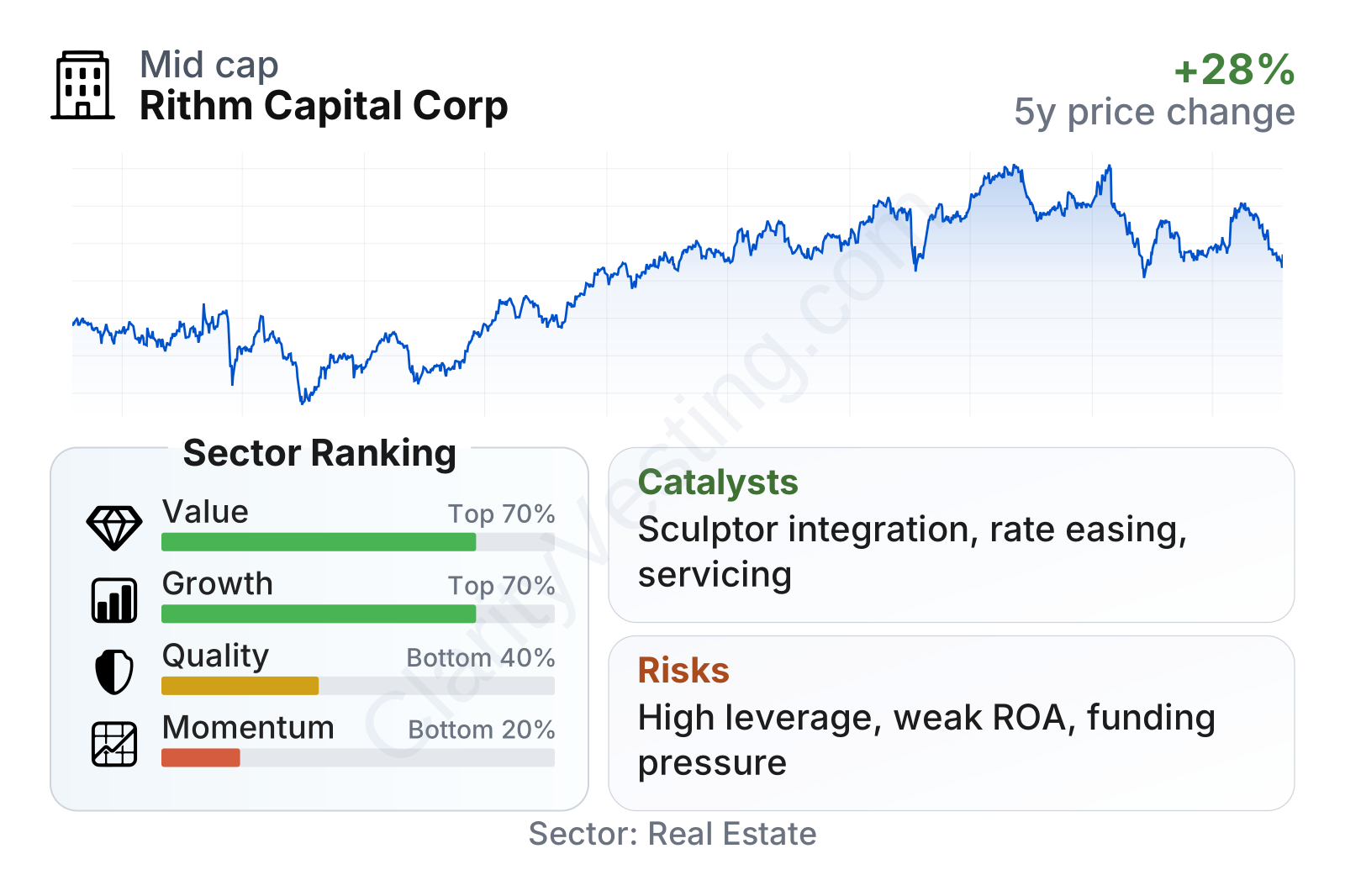
Rithm is a mid-sized mortgage REIT with a stock that has recovered meaningfully from the lows of 2022, but it has lost momentum more recently. On valuation, the shares trade below the sector median on both earnings and book value multiples, while the dividend yield remains well above sector norms. At the same time, quality measures are weaker than many peers: returns on assets and capital are relatively modest, leverage is elevated, and free cash flow is negative on a trailing basis. Growth indicators are somewhat better, especially in revenue-related measures and book value per share expansion over the last five years, which suggests the market is balancing decent business growth against a more demanding risk profile.
Growth
Rithm operates in a sector that should remain relevant for a long time because U.S. housing finance is enormous and recurring. People continue to buy homes, refinance, move, and make monthly mortgage payments in all rate environments, even if volumes shift between purchase activity and refinancing. That gives servicing businesses and mortgage platforms a durable reason to exist, although the profits can move sharply with interest rates.
The company’s strategy has a clear logic for future growth. It has been building a more integrated platform: originate loans, retain servicing exposure, recapture customers, and add fee-bearing businesses such as asset management. This is more resilient than relying on only one income source. In particular, mortgage servicing rights can offset some of the weakness that hits mortgage origination when rates rise, while origination can improve when rates fall and housing activity picks up.
Revenue per share fell materially between 2021 and 2023, then recovered strongly in 2024 and improved again in 2025. That pattern fits the broader mortgage cycle: pressure during the difficult rate shock period, followed by a rebound as the business mix and operating platform adapted. Over five years, revenue per share growth is still ahead of the sector median, which supports the idea that Rithm has been able to rebuild volume and earnings capacity after a tough period.
A notable catalyst is the expansion of the asset management side after the Sculptor Capital acquisition. This gives Rithm a business that is less directly tied to mortgage spreads and more dependent on fee income, client assets, and investment performance. If executed well, that can make the overall company less cyclical over time. Another potential catalyst is any stabilization or decline in interest rates, which could revive mortgage origination volumes and increase transaction activity across the housing market.
The dividend per share has been comparatively steady in recent years, hovering around a little above $1 per share annually after rising from 2021 levels. That stability is important because the cash distribution is a central part of how the market evaluates mortgage REITs. Even so, the current headline yield is influenced by a stock price that still trades below book value, so it reflects both income generation and market caution.
Recent company updates have also highlighted ongoing capital allocation, portfolio repositioning, and integration work across operating platforms. For a business like Rithm, these are meaningful because even moderate improvement in funding costs, servicing economics, or fee income can have an outsized effect on overall earnings.
Risks
This article is for informational purposes only and does not constitute financial advice. Some content is AI-generated. See Disclaimer


