Stock Analysis · Riot Platforms Inc (RIOT)
Overview
Riot Platforms Inc is a Bitcoin mining and digital infrastructure company. In simple terms, it runs large facilities filled with specialized computers that compete to validate transactions on the Bitcoin network. In return, Riot earns newly issued Bitcoin and transaction fees. The company has also expanded beyond pure mining by operating engineering and electrical infrastructure services and by developing large-scale power capacity that can support both mining and other data-center uses.
Its business model is closely tied to three things: the price of Bitcoin, the cost of electricity, and its ability to keep adding efficient computing power. Riot’s operations are centered in the United States, which matters because access to energy, grid connections, and large industrial sites is a major part of the business.
Based on recent company filings and disclosures, Riot’s revenue mix has become more diversified than many people assume, although Bitcoin mining still remains the core driver.
- Bitcoin mining — approximately 70% to 80% of revenue in the latest full year. This includes Bitcoin earned from self-mining operations, which are later recognized as revenue under accounting rules.
- Engineering and electrical services — approximately 20% to 30% of revenue. This mainly comes from Riot’s ESS Metron unit, which provides electrical products, design, and field services.
- Other revenue, including power-related and hosting activities — a small share. This can include curtailment-related economics, power strategy effects, and smaller ancillary activities depending on the period.
One important recent shift is scale. Riot has been building out a much larger power and data-center footprint, especially through its Corsicana site in Texas. That broadens the company’s identity from being only a Bitcoin miner to being an owner and developer of energy-intensive digital infrastructure.
Revenue has risen sharply over the last several years, but profitability has been highly uneven. The business generated much stronger sales in 2025 than in earlier years, yet expenses also expanded significantly, which shows how growth in this industry does not automatically translate into stable earnings.
The long-term pattern is clear: Riot has scaled revenue meaningfully since 2021, but margins have swung from positive to deeply negative and back again. That reflects a business where operating results can change fast with Bitcoin prices, mining difficulty, fleet efficiency, and major expansion spending.
Key Figures
| Metric | Value | Sector ⓘ |
|---|---|---|
| Date | Oct 03, 2026 | |
| Context | ||
| Sector | Financial Services | |
| Industry | Capital Markets | |
| Market Cap ⓘ | $7.56B | |
| Beta ⓘ | 3.83 | |
Value (Cheapness) | ||
| P/E Ratio ⓘ | N/A | 12.60 |
| P/B Ratio ⓘ | 3.11 | 1.23 |
| FCF Yield ⓘ | -11.67% | 10.16% |
| Dividend Yield ⓘ | N/A | 2.96% |
| EBIT / EV ⓘ | -6.16% | 7.77% |
| PEG ⓘ | N/A | |
Growth (Business expansion) | ||
| Revenue Growth ⓘ | 13.90% | 9.50% |
| RPS Growth (5Y CAGR) ⓘ | -4.47% | 12.10% |
| EPS Growth (5Y CAGR) ⓘ | -3.99% | -9.45% |
| BVPS Growth (5Y CAGR) ⓘ | -12.82% | 5.01% |
| Margin Growth (5Y Trend) ⓘ | N/A | -4.07% |
| FCF Growth (5Y CAGR) ⓘ | N/A | 4.96% |
| DPS Growth (5Y CAGR) ⓘ | N/A | 8.79% |
Quality (Business durability) | ||
| ROIC (Latest) ⓘ | -13.46% | 9.60% |
| ROE (Latest) ⓘ | -46.47% | 13.84% |
| ROA (Latest) ⓘ | -34.20% | 1.53% |
| ROIC (5Y Median) ⓘ | -8.40% | 7.86% |
| ROE (5Y Median) ⓘ | -3.26% | 12.20% |
| ROA (5Y Median) ⓘ | -2.94% | 1.29% |
| Net Debt / EBIT (Latest) ⓘ | N/A | 0.91 |
| Net Debt / EBIT (5Y Median) ⓘ | N/A | 0.74 |
| Net Debt / EBITDA (Latest) ⓘ | N/A | 0.97 |
| Operating Margin (Latest) ⓘ | -88.40% | 22.12% |
| Operating Margin (5Y Median) ⓘ | -61.79% | 24.39% |
| Debt to Equity (Latest) ⓘ | 12.74% | 60.37% |
| Profit Margin (Latest) ⓘ | -196.28% | 26.62% |
| Free Cash Flow (Latest) ⓘ | -$882.79M | |
Momentum (Price trend) | ||
| 3Y Return ⓘ | +98.48% | +89.23% |
| 12M Return (excl. last month) ⓘ | +29.29% | +17.35% |
| 6M Return ⓘ | +56.25% | +10.00% |
| Price vs. 200-Day MA ⓘ | +1.56% | +3.73% |
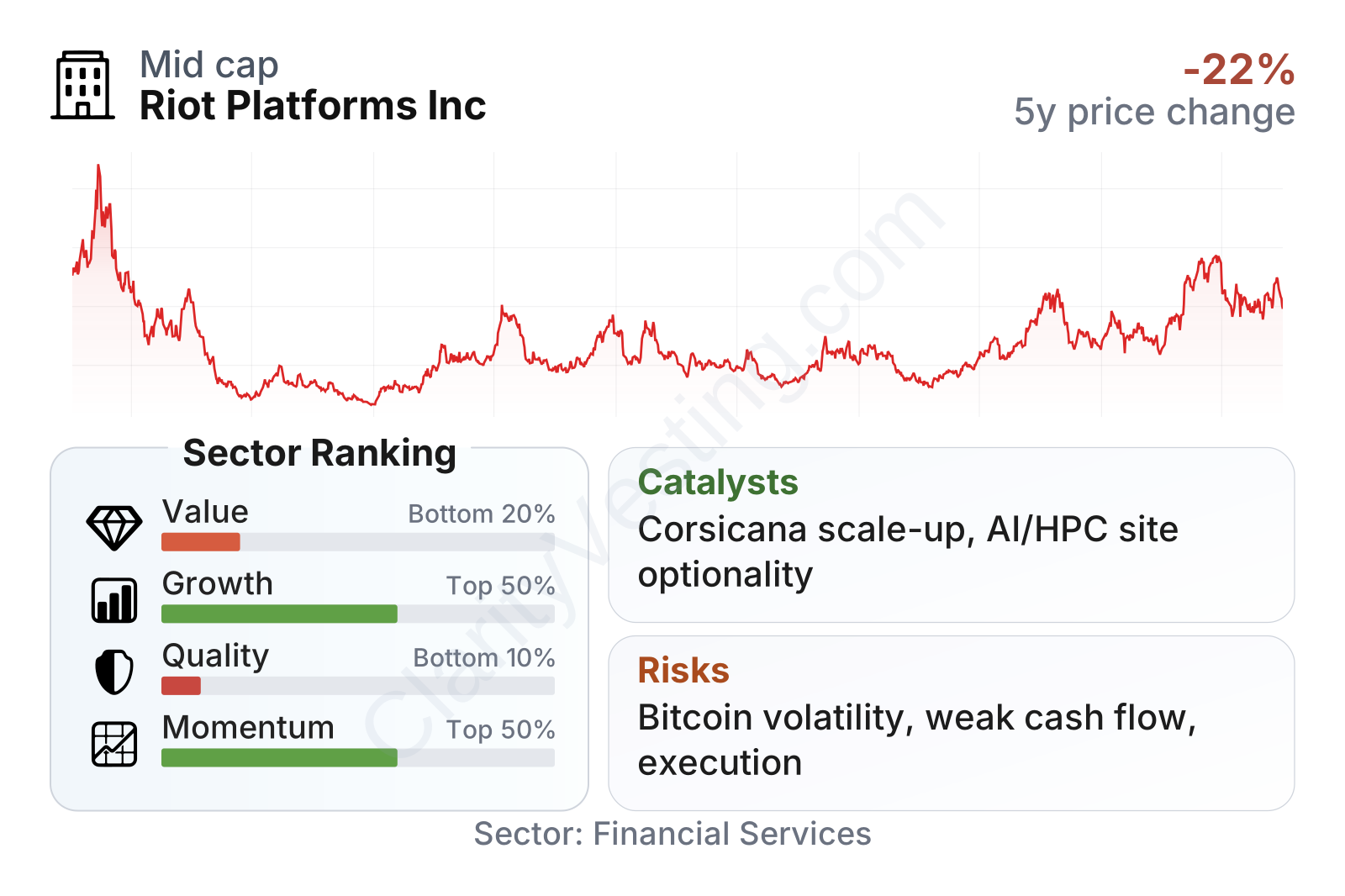
Riot is now a large publicly traded crypto infrastructure company, but its market behavior remains unusually volatile, with a beta far above the broader market. The factor profile is mixed: growth and price momentum look relatively solid versus the sector, while value and business quality rank weakly. That combination fits a company whose share price is heavily influenced by Bitcoin sentiment and expansion expectations, even though profitability and cash generation remain under pressure.
The balance sheet looks less burdened by debt than many companies in the broader financial sector, which is helpful in a cyclical industry. However, weak margins, negative free cash flow, and poor returns on capital show that Riot is still in a capital-intensive phase where scale has not yet produced consistent economic efficiency.
Growth
Riot operates in a sector that still has meaningful long-term growth potential, but it is not a simple one. Bitcoin mining can grow when Bitcoin adoption expands, when the Bitcoin price rises, and when a miner can add capacity faster or more efficiently than peers. At the same time, the industry becomes more competitive over time because more machines join the network, which increases mining difficulty.
Riot’s strategy for future growth is fairly logical on paper. It is trying to combine low-cost power access, large-scale site development, and ownership of critical infrastructure. That matters because mining is increasingly a scale business: the companies with cheaper electricity, stronger balance sheets, and room to deploy new machines tend to be better positioned during both bull and weak market periods.
A notable catalyst is the Corsicana development. Riot has described this site as a major expansion platform with very large power capacity. That creates two possible avenues for growth: more Bitcoin mining and, potentially, broader high-performance computing or AI-related data-center uses if management can attract the right partners or customers. That optionality is one of the more interesting parts of Riot’s current positioning.
Recent company updates have also highlighted increases in deployed hash rate and continuing infrastructure buildout. In this industry, hash rate is the rough equivalent of production capacity. More capacity can support revenue growth, but only if the added fleet remains competitive on energy efficiency and if Bitcoin economics cooperate.
Earnings per share show how uneven this business has been. Riot briefly moved into positive annual earnings in 2024, then slipped back into sizable losses afterward. That pattern suggests the company is still highly exposed to external swings rather than generating consistently durable profits from operations alone.
Book value per share has also trended unevenly and is lower than it was several years ago. For a capital-heavy company that regularly invests in land, buildings, electrical systems, and mining equipment, that matters. It suggests that expansion has not yet translated into steadily rising per-share net asset value.
One broader industry catalyst is that the market increasingly values access to power. Large loads connected to the grid are becoming more strategic, especially in Texas and other energy-rich regions. If Riot can turn its power footprint into a multi-use digital infrastructure platform rather than only a pure-play miner, its growth profile could become less dependent on Bitcoin alone.
Risks
This article is for informational purposes only and does not constitute financial advice. Some content is AI-generated. See Disclaimer