Stock Analysis · Transocean Ltd (RIG)
Overview
Transocean Ltd is an offshore drilling contractor. In simple terms, it owns and operates drilling rigs that energy companies use to drill oil and gas wells in deepwater and ultra-deepwater environments. The company does not usually sell oil or gas itself. Instead, it earns money by providing rigs, crews, and related drilling services to exploration and production companies.
Its business is concentrated in offshore contract drilling, with a particular focus on high-specification floaters such as drillships and semisubmersibles. That makes Transocean more specialized than many broader oilfield service companies. The company’s results depend heavily on dayrates, contract utilization, customer demand for offshore projects, and the cost of keeping its fleet ready for work.
Based on company disclosures, revenue is overwhelmingly generated by contract drilling services, with only limited contribution from reimbursable items and other ancillary activity.
- Offshore contract drilling services: about 95% to 99% of revenue. This includes dayrate revenue from ultra-deepwater drillships and harsh-environment semisubmersibles working under customer contracts.
- Reimbursable and other revenue: about 1% to 5% of revenue. This can include customer reimbursements and smaller service-related items tied to rig operations.
Geographically, Transocean’s fleet serves major offshore basins including the U.S. Gulf of Mexico, Brazil, the North Sea, and other international deepwater markets. The business model is asset-heavy and capital-intensive, so performance is driven less by volume in the usual consumer sense and more by fleet quality, contract coverage, and pricing power on each rig.
One notable financial pattern is that revenue has climbed meaningfully over the last several years, while profitability has remained under pressure because operating costs, depreciation, and financing costs still absorb a large share of the business. Gross profit has expanded as sales improved, but that has not yet translated into steady net earnings.
Key Figures
| Metric | Value | Sector ⓘ |
|---|---|---|
| Date | Oct 17, 2026 | |
| Context | ||
| Sector | Energy | |
| Industry | Oil & Gas Drilling | |
| Market Cap ⓘ | $6.31B | |
| Beta ⓘ | 1.41 | |
Value (Cheapness) | ||
| P/E Ratio ⓘ | N/A | 15.44 |
| P/B Ratio ⓘ | 0.80 | 1.73 |
| FCF Yield ⓘ | 14.33% | 8.20% |
| Dividend Yield ⓘ | N/A | 3.59% |
| EBIT / EV ⓘ | -9.92% | 7.46% |
| PEG ⓘ | 1.17 | |
Growth (Business expansion) | ||
| Revenue Growth ⓘ | -2.20% | 26.90% |
| RPS Growth (5Y CAGR) ⓘ | 0.73% | 6.90% |
| EPS Growth (5Y CAGR) ⓘ | N/A | -15.73% |
| BVPS Growth (5Y CAGR) ⓘ | -16.76% | 6.07% |
| Margin Growth (5Y Trend) ⓘ | N/A | 0.58% |
| FCF Growth (5Y CAGR) ⓘ | 14.28% | 1.86% |
| DPS Growth (5Y CAGR) ⓘ | N/A | 16.79% |
Quality (Business durability) | ||
| ROIC (Latest) ⓘ | 0.46% | 11.40% |
| ROA (Latest) ⓘ | -10.57% | 6.06% |
| ROIC (5Y Median) ⓘ | -0.72% | 10.30% |
| ROA (5Y Median) ⓘ | -3.02% | 5.42% |
| Net Debt / EBIT (Latest) ⓘ | N/A | 1.64 |
| Net Debt / EBIT (5Y Median) ⓘ | N/A | 1.83 |
| Net Debt / EBITDA (Latest) ⓘ | N/A | 1.08 |
| Net Debt / Assets ⓘ | 30.39% | 17.29% |
| EBITDA / Interest ⓘ | N/A | 9.64 |
| Operating Margin (Latest) ⓘ | -25.81% | 16.27% |
| Operating Margin (5Y Median) ⓘ | -4.57% | 20.39% |
| Debt to Equity (Latest) ⓘ | 61.16% | 54.76% |
| Profit Margin (Latest) ⓘ | -40.24% | 8.82% |
| Free Cash Flow (Latest) ⓘ | $904.00M | |
Momentum (Price trend) | ||
| 3Y Return ⓘ | -27.63% | +67.38% |
| 12M Return (excl. last month) ⓘ | +65.15% | +49.19% |
| 6M Return ⓘ | -9.56% | +7.07% |
| Price vs. 200-Day MA ⓘ | -2.79% | +9.56% |
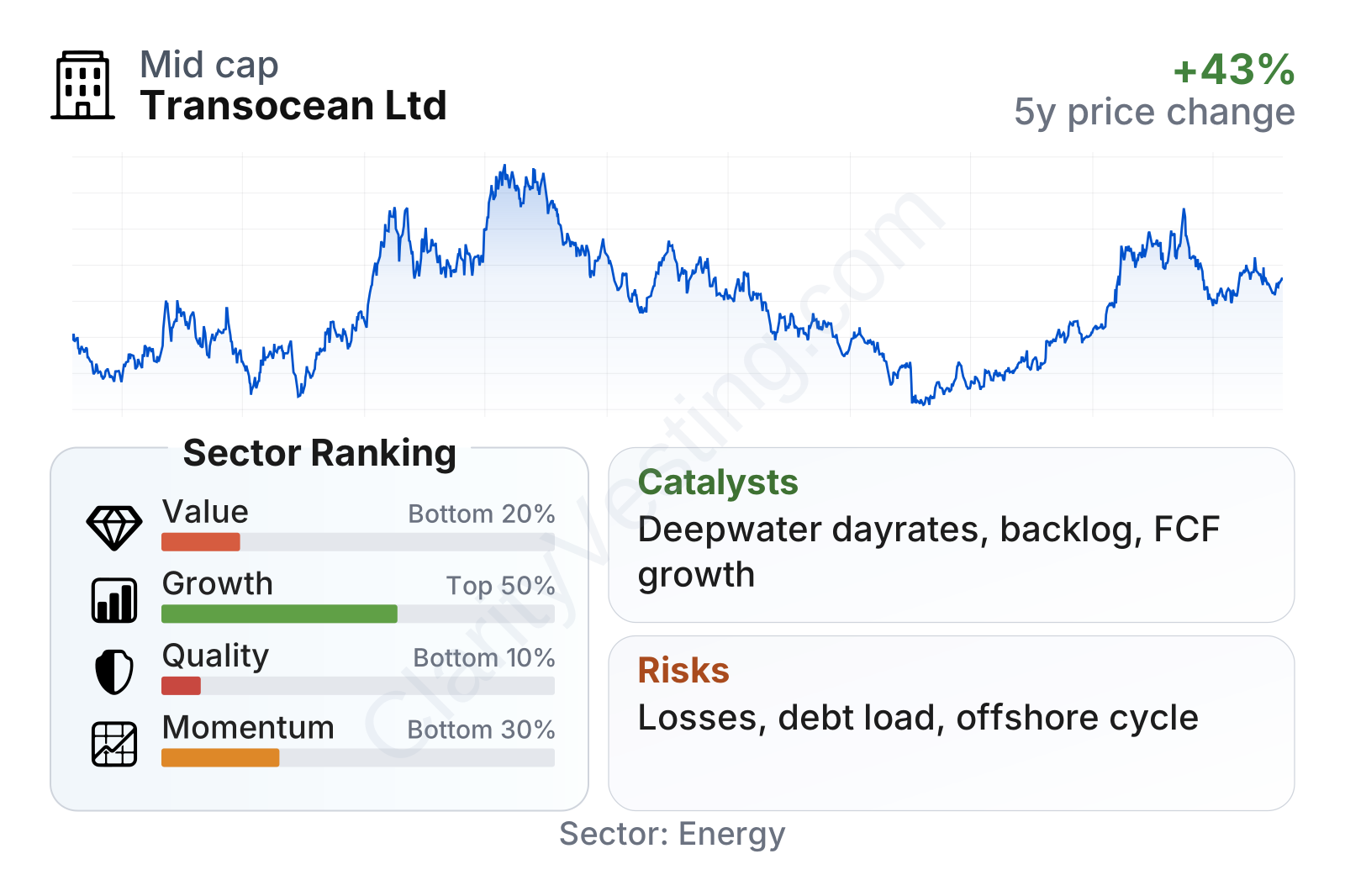
Transocean is a mid-sized energy company with a stock that has been very volatile over the last few years, which fits the cyclical and high-risk nature of offshore drilling. In the factor breakdown, the company ranks weakly on quality and value relative to much of the energy sector, while growth is closer to the middle of the pack. A notable positive is free cash flow, which has improved sharply and now stands above many sector peers, but that strength is offset by weak profitability and still-elevated leverage. Momentum has been mixed: there was a strong rebound over part of the last year, but the shorter-term trend has been less favorable.
Growth
Offshore drilling is part of a mature energy industry, but one segment of it is benefiting from a more constructive backdrop: deepwater and harsh-environment projects. Large offshore developments can remain attractive to oil companies when they offer long production lives and competitive economics over time. In recent years, major producers have continued to sanction selected offshore projects, especially in Brazil, the Gulf of Mexico, and parts of the North Sea. That creates an opening for owners of modern floating rigs.
Transocean’s strategy is logically aligned with that opportunity. The company has concentrated on high-specification deepwater assets rather than trying to compete across every type of drilling equipment. That focus matters because premium rigs tend to be the first to see stronger utilization and better contract pricing when offshore demand improves. Transocean has also emphasized backlog visibility, which is important in a business where each rig contract can shape results for several quarters or even years.
Revenue growth has clearly improved from the weaker period earlier in the cycle. Through 2024 and much of 2025, year-over-year growth was often in the double digits, showing that higher contract activity and pricing were feeding into the income statement. The latest reading turned slightly negative, which suggests the path upward is not smooth and can be affected by timing, downtime, and contract transitions. Even so, the broader trend over the last two years has been much better than the earlier phase of the recovery.
Cash generation is one of the most encouraging recent developments. Free cash flow moved from negative territory into strongly positive levels, reaching roughly $0.8 billion on a trailing basis in early 2026 and around $0.9 billion in the latest metrics snapshot. For a company with a heavy debt load and expensive assets, that shift is important because it improves financial flexibility and can support debt reduction, maintenance spending, and overall balance-sheet repair.
A major catalyst for future growth is continued tightening in the market for advanced offshore rigs. If dayrates remain firm and more rigs stay contracted, revenue can keep rising even without a large fleet expansion. Another catalyst is Transocean’s exposure to harsh-environment and ultra-deepwater niches, where supply is more limited than in some other drilling categories. Public company updates in 2026 also indicate the group remains active in contract awards and fleet positioning, reinforcing that commercial demand still exists for its core assets.
Risks
This article is for informational purposes only and does not constitute financial advice. Some content is AI-generated. See Disclaimer


