Stock Analysis · Richelieu Hardware Ltd (RHUHF)
Overview
Richelieu Hardware Ltd is a North American distributor and manufacturer focused on specialty hardware and related products. Its catalog is aimed mainly at kitchen and bathroom cabinet makers, furniture manufacturers, residential and commercial woodworkers, door and window manufacturers, and renovation professionals. In simple terms, the company sits between product makers and end users by supplying a very broad range of functional components used in homes, offices, and woodworking projects.
The business is built around a large product assortment, logistics, and close relationships with professional customers. Richelieu also operates an e-commerce platform and distribution network that helps small and mid-sized customers source parts quickly without having to deal with many separate suppliers.
Based on the company’s annual disclosures, revenue is primarily generated from hardware distribution, with North America overwhelmingly dominant geographically. The main sources of revenue can be summarized as follows:
- Manufacturers segment: approximately 75% to 80% of sales. This serves cabinet, furniture, door, window, and other industrial manufacturers that buy hardware, components, and finishing products for production.
- Retailers and renovation superstores segment: approximately 20% to 25% of sales. This includes hardware retailers, renovation chains, and other distribution channels selling to end customers or contractors.
- Product mix: the largest category is specialty hardware and accessories, complemented by decorative items, functional fittings, sliding systems, lighting, panels, moldings, and finishing products. The company does not break every subcategory into a precise percentage in a way that supports a reliable ranked split.
- Geographic mix: Canada and the United States account for nearly all revenue, with the U.S. representing a meaningful growth engine after years of acquisitions and branch expansion.
One notable financial pattern is that revenue has risen over the past several years, but profitability has become more compressed. That suggests Richelieu has maintained commercial momentum while operating in a tougher cost and pricing environment.
Key Figures
| Metric | Value | Sector ⓘ |
|---|---|---|
| Date | Nov 21, 2026 | |
| Context | ||
| Sector | Industrials | |
| Industry | Tools & Accessories | |
| Market Cap ⓘ | $1.45B | |
| Beta ⓘ | 0.84 | |
Value (Cheapness) | ||
| P/E Ratio ⓘ | 21.89 | 20.77 |
| P/B Ratio ⓘ | N/A | 3.20 |
| FCF Yield ⓘ | 7.03% | 4.98% |
| Dividend Yield ⓘ | 2.35% | 1.88% |
| EBIT / EV ⓘ | 6.33% | 6.24% |
| PEG ⓘ | N/A | |
Growth (Business expansion) | ||
| Revenue Growth ⓘ | 12.60% | 9.60% |
| RPS Growth (5Y CAGR) ⓘ | 8.55% | 7.69% |
| EPS Growth (5Y CAGR) ⓘ | -27.86% | -5.74% |
| BVPS Growth (5Y CAGR) ⓘ | 10.03% | 6.13% |
| Margin Growth (5Y Trend) ⓘ | -6.68% | 0.72% |
| FCF Growth (5Y CAGR) ⓘ | 20.43% | 11.01% |
| DPS Growth (5Y CAGR) ⓘ | 16.33% | 9.09% |
Quality (Business durability) | ||
| ROIC (Latest) ⓘ | 10.30% | 10.48% |
| ROA (Latest) ⓘ | 6.13% | 5.38% |
| ROIC (5Y Median) ⓘ | 13.27% | 9.45% |
| ROA (5Y Median) ⓘ | 8.58% | 4.91% |
| Net Debt / EBIT (Latest) ⓘ | 1.83 | 2.12 |
| Net Debt / EBIT (5Y Median) ⓘ | 1.02 | 2.28 |
| Net Debt / EBITDA (Latest) ⓘ | 1.19 | 1.42 |
| Net Debt / Assets ⓘ | 16.83% | 19.19% |
| EBITDA / Interest ⓘ | 16.95 | 10.09 |
| Operating Margin (Latest) ⓘ | 7.03% | 10.44% |
| Operating Margin (5Y Median) ⓘ | 9.48% | 10.29% |
| Debt to Equity (Latest) ⓘ | 34.76% | 66.48% |
| Profit Margin (Latest) ⓘ | 4.47% | 6.98% |
| Free Cash Flow (Latest) ⓘ | $102.13M | |
Momentum (Price trend) | ||
| 3Y Return ⓘ | -15.74% | +48.25% |
| 12M Return (excl. last month) ⓘ | +5.39% | +10.31% |
| 6M Return ⓘ | -7.01% | +0.15% |
| Price vs. 200-Day MA ⓘ | -3.61% | 0.00% |
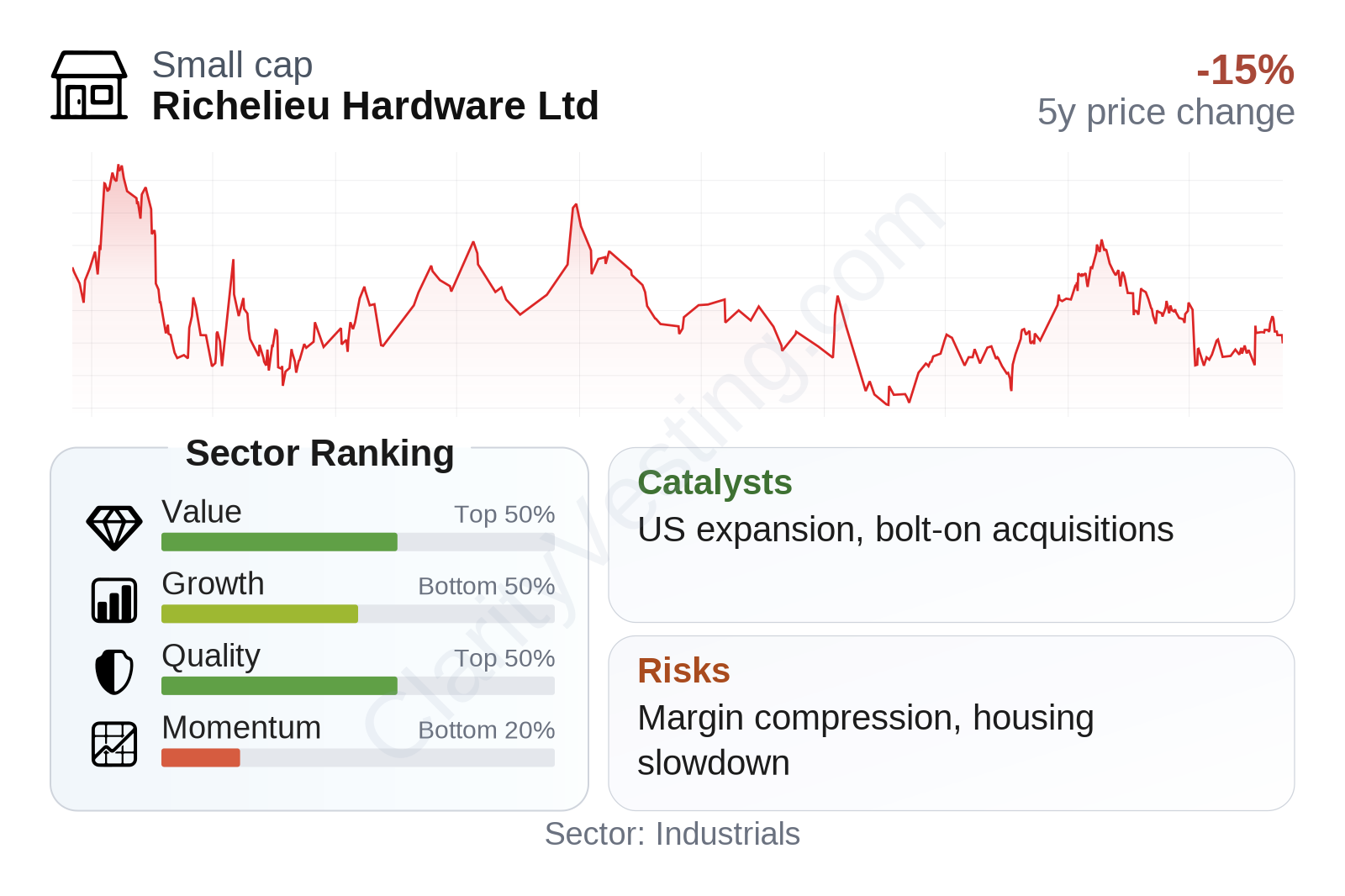
Richelieu is a small-to-mid-sized industrial distributor with a stock that has been less volatile than the broader market, as shown by a beta below 1. In valuation terms, its earnings multiple is close to the sector median rather than deeply discounted or richly stretched. On cash generation, the profile looks stronger: free cash flow yield is above the sector median, and dividend yield is also modestly higher. The mixed picture is that quality metrics remain solid overall, but growth and share-price momentum are less convincing than the better parts of the valuation and balance-sheet profile.
The stock price history also shows an uneven path rather than a straight upward trend. That fits the company’s recent operating pattern: a stable business with real cash generation, but one that has not escaped margin pressure or market caution.
Growth
Richelieu operates in a sector tied to long-term demand for residential renovation, cabinetry, furniture, and interior fittings. This is not a high-tech market, but it can still grow steadily because homes, offices, and commercial spaces constantly require upgrades, repairs, and new installations. Demand is also supported by the shift toward customization, better storage solutions, premium finishes, and specialized hardware in kitchens, closets, and workspaces.
The company’s strategy is fairly straightforward and sensible for long-term expansion. It combines organic growth through new products, branch density, and customer penetration with acquisitions that broaden geography and product range. This approach can work well in distribution because scale improves purchasing power, inventory depth, logistics efficiency, and customer convenience.
Revenue growth has been cyclical rather than linear. After a very strong post-pandemic period, growth slowed, briefly turned negative, and then recovered. More recently, year-over-year revenue growth has reaccelerated into the low-to-mid teens, which is a constructive sign. Over a five-year view, revenue per share has grown faster than the sector median, showing that the company has still expanded despite the softer middle period.
Cash generation has also recovered after a volatile stretch. Free cash flow moved from weak or negative territory to much healthier levels, and over five years it has compounded faster than the sector median. That matters because a distributor can report sales growth without creating much shareholder value if inventory and working capital absorb too much cash. Richelieu’s recent free cash flow trend suggests that this risk has improved, at least for now.
Potential catalysts include continued branch expansion in the United States, further acquisitions in fragmented niche categories, and a healthier renovation environment if interest-rate pressure on housing activity eases. The company has also highlighted ongoing product innovation and digital ordering tools, which can help deepen customer relationships and support repeat business.
Recent company communications have continued to point to acquisition activity and network expansion as important levers. For a business like Richelieu, that is significant because market share can build gradually as customers prefer distributors able to offer broad selection, dependable delivery, and technical support under one roof.
Risks
This article is for informational purposes only and does not constitute financial advice. Some content is AI-generated. See Disclaimer