Stock Analysis · Ryman Hospitality Properties Inc (RHP)
Overview
Ryman Hospitality Properties is a specialized real estate investment trust, or REIT, focused on large group-oriented hospitality assets. The company owns a small number of very large convention resort hotels under the Gaylord brand, plus entertainment venues tied to its Ole Red brand and other hospitality assets. Its business model is unusual within real estate: instead of owning many standard hotels, it concentrates on destination properties designed for meetings, conventions, corporate events, and leisure travel.
The biggest economic engine is its hospitality segment, which includes room revenue, food and beverage, meeting space rentals, resort fees, parking, and other on-property spending at Gaylord Opryland, Gaylord Palms, Gaylord Texan, Gaylord Rockies, and Gaylord National, along with related hotel operations. Based on recent company reporting, hospitality generates the vast majority of total revenue, while entertainment and other operations remain much smaller but strategically useful.
The main revenue sources can be summarized as follows:
- Hospitality operations: approximately 90% to 95% of revenue. This includes guest rooms, banquet and catering activity, food and beverage sales, meeting and convention business, resort services, and ancillary spending at its large convention hotels.
- Entertainment operations: approximately 5% to 10% of revenue. This includes Ole Red venues, attractions, and related entertainment-driven hospitality activity.
- Other revenue streams: a small remaining share, including property-related and miscellaneous items.
What makes Ryman different is not size alone, but concentration in premium group travel. Its resorts are built around convention demand that tends to be booked well in advance and can support higher spending per guest than a typical transient hotel model. That gives the company exposure to both business travel and leisure extensions, especially when large events bring thousands of attendees to a single property.
Revenue and operating profit have recovered strongly since the pandemic disruption, with total revenue rising from under $1.0 billion in 2021 to more than $2.3 billion in 2024, while operating income also improved sharply. That pattern suggests the core portfolio regained pricing power and occupancy momentum as group demand normalized.
Key Figures
| Metric | Value | Sector ⓘ |
|---|---|---|
| Date | Oct 17, 2026 | |
| Context | ||
| Sector | Real Estate | |
| Industry | REIT - Hotel & Motel | |
| Market Cap ⓘ | $8.65B | |
| Beta ⓘ | 1.23 | |
Value (Cheapness) | ||
| P/E Ratio ⓘ | 30.96 | 17.38 |
| P/B Ratio ⓘ | 32.68 | 0.85 |
| FCF Yield ⓘ | 3.18% | 7.38% |
| Dividend Yield ⓘ | 3.87% | 4.85% |
| EBIT / EV ⓘ | 4.56% | 3.78% |
| PEG ⓘ | 1.08 | |
Growth (Business expansion) | ||
| Revenue Growth ⓘ | 13.60% | 5.30% |
| RPS Growth (5Y CAGR) ⓘ | 23.01% | 6.02% |
| EPS Growth (5Y CAGR) ⓘ | 13.22% | -11.37% |
| BVPS Growth (5Y CAGR) ⓘ | N/A | 0.45% |
| Margin Growth (5Y Trend) ⓘ | 26.11% | -0.22% |
| FCF Growth (5Y CAGR) ⓘ | 20.22% | 5.40% |
| DPS Growth (5Y CAGR) ⓘ | 366.79% | 5.02% |
Quality (Business durability) | ||
| ROIC (Latest) ⓘ | 11.28% | 5.69% |
| ROE (Latest) ⓘ | 95.70% | 7.56% |
| ROA (Latest) ⓘ | 4.39% | 2.85% |
| ROIC (5Y Median) ⓘ | 11.13% | 4.22% |
| ROE (5Y Median) ⓘ | 99.19% | 6.03% |
| ROA (5Y Median) ⓘ | 4.27% | 2.44% |
| Net Debt / EBIT (Latest) ⓘ | 6.78 | 7.59 |
| Net Debt / EBIT (5Y Median) ⓘ | 7.00 | 8.40 |
| Net Debt / EBITDA (Latest) ⓘ | 4.39 | 5.27 |
| Net Debt / Assets ⓘ | 60.32% | 37.76% |
| EBITDA / Interest ⓘ | 3.32 | 4.10 |
| Operating Margin (Latest) ⓘ | 20.07% | 35.29% |
| Operating Margin (5Y Median) ⓘ | 19.24% | 37.31% |
| Debt to Equity (Latest) ⓘ | 552.25% | 88.87% |
| Profit Margin (Latest) ⓘ | 9.95% | 19.61% |
| Free Cash Flow (Latest) ⓘ | $274.66M | |
Momentum (Price trend) | ||
| 3Y Return ⓘ | +65.48% | +30.75% |
| 12M Return (excl. last month) ⓘ | +27.47% | +4.36% |
| 6M Return ⓘ | +26.49% | -2.52% |
| Price vs. 200-Day MA ⓘ | +14.44% | -2.34% |
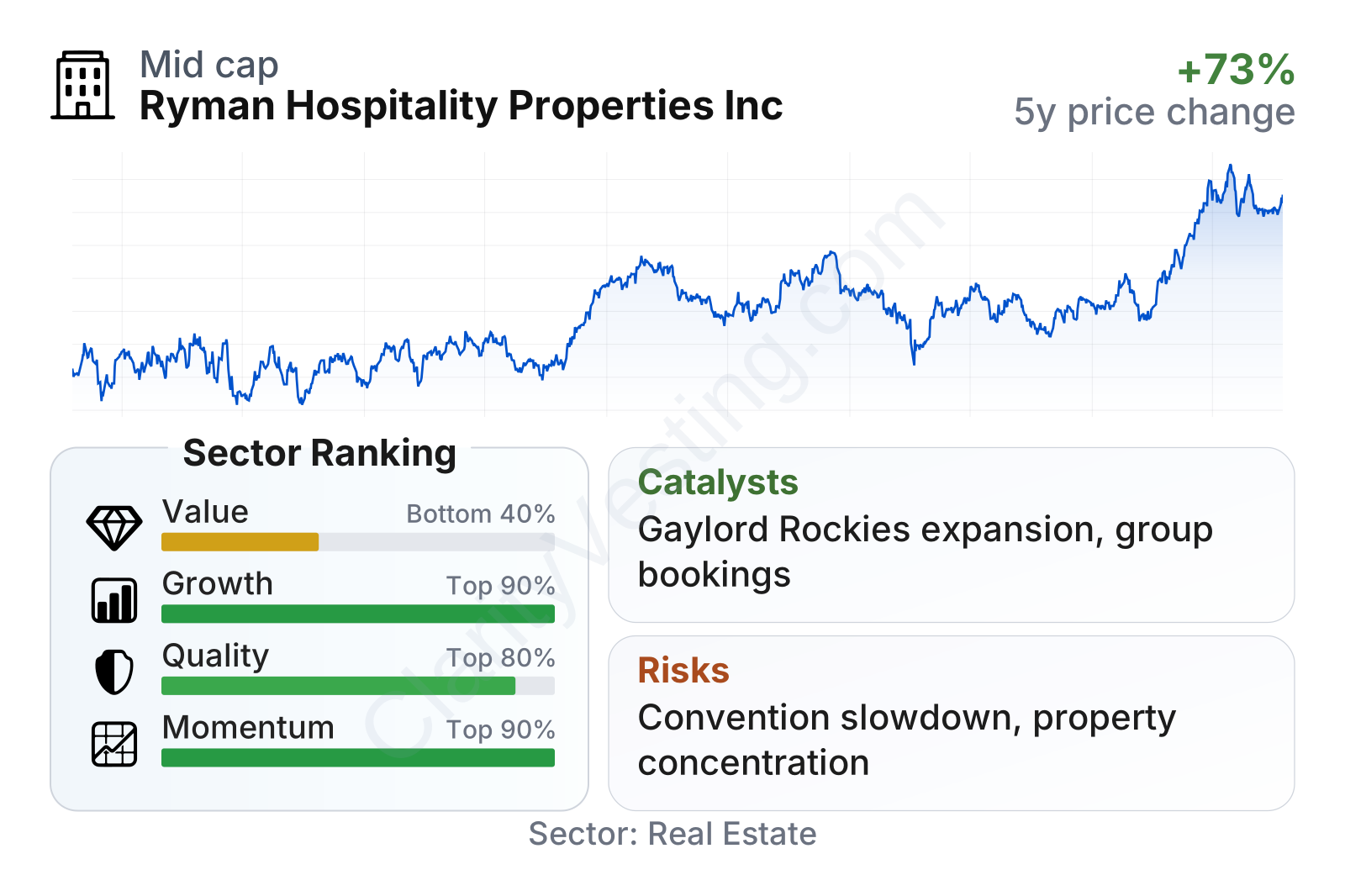
Ryman sits in the larger end of the hotel REIT space, with a market value around the mid-single-digit billions of dollars and share price volatility modestly above the broader market. The overall profile is mixed but clear: growth and momentum are strong, quality is above sector averages in several areas, and valuation looks demanding. Revenue growth of about 14% year over year, five-year revenue-per-share growth above 20%, and strong free cash flow expansion place it among the stronger growers in its real estate peer group. Returns on capital and assets are also ahead of sector medians, although debt remains meaningful and interest coverage is not especially wide. On the valuation side, earnings, cash flow yield, and especially price-to-book all point to a stock that trades above many sector norms.
Growth
Ryman operates in a part of hospitality that can still grow even in a mature lodging industry. Large-format group travel, conventions, corporate gatherings, and event-driven leisure remain important for companies, associations, and entertainment-oriented travelers. This is not a high-volume commodity business; it is a niche where scale, location, and property design matter. That gives Ryman a chance to keep growing through pricing, higher occupancy, more booked event days, and expansion of non-room spending.
The company’s strategy is coherent for long-term growth because it focuses on assets that are difficult and expensive to replicate. A competing developer would need a large site, major capital, strong brand partnerships, and the ability to attract convention demand years in advance. Ryman also benefits from integration with Marriott’s distribution system for the Gaylord hotels, which broadens access to group and transient customers while allowing Ryman to keep ownership of the real estate.
The longer-term operating trend has been favorable. Revenue per share climbed sharply from 2021 through 2023, paused slightly in 2024, and then moved higher again in 2025. That pattern suggests the company has not only recovered from the post-pandemic period but also built a larger earnings base than before.
Another sign of normalization is the dividend. The payout was nearly absent during the pandemic aftermath, then returned strongly and continued to rise into 2025. For a REIT, that matters because it reflects improved cash generation and management confidence in the recurring earning power of the assets, even if the trailing yield now sits somewhat below the sector median.
A major catalyst is the planned expansion of the Gaylord Rockies resort. Company disclosures have highlighted a significant room addition and related meeting-space enhancements intended to increase capacity at one of its strongest properties. For a company with only a handful of very large assets, a successful expansion can move the needle more than incremental growth would for a diversified hotel owner. Another growth lever is the maturation of entertainment assets such as Ole Red venues, which are smaller today but can strengthen brand reach and cross-property demand.
Recent company communications have also emphasized healthy group booking trends and strong future room-night visibility. That matters because Ryman’s model depends heavily on advance bookings, and a solid forward pipeline can support pricing and capital planning better than a hotel model driven mainly by short-notice leisure demand.
Risks
This article is for informational purposes only and does not constitute financial advice. Some content is AI-generated. See Disclaimer


