Stock Analysis · Robert Half International Inc (RHI)
Overview
Robert Half International Inc. is a staffing and business consulting company. It helps employers find workers for temporary, contract, and permanent roles, and it also provides consulting services through its Protiviti division. The company operates mainly in professional job categories such as finance and accounting, technology, administrative support, legal, marketing, and risk consulting.
Its business is tied closely to hiring demand. When companies are expanding, launching projects, or dealing with staff shortages, Robert Half can benefit from higher placement activity. When employers slow recruiting, delay projects, or cut discretionary spending, results usually weaken quickly. That makes the company more cyclical than many service businesses.
Based on the company’s recent annual reporting, revenue is mainly generated from the following activities:
- Contract talent solutions: approximately 61% of revenue. This includes temporary and project-based staffing across finance and accounting, technology, administrative and customer support, marketing and creative, and legal roles.
- Protiviti: approximately 23% of revenue. Protiviti provides consulting in internal audit, risk, compliance, technology, finance, data, and business transformation.
- Permanent placement talent solutions: approximately 16% of revenue. This business earns fees when clients hire candidates into full-time roles.
Geographically, the United States remains the core market, with additional operations in international regions that add diversification but do not change the company’s main exposure to U.S. labor-market conditions. Over the last several years, the business mix has remained centered on staffing, while Protiviti has provided a more advisory-oriented revenue stream that is generally less transactional than permanent placement.
The long-term financial flow also shows a clear pattern: revenue and profit peaked in 2022, then moved lower through 2023 to 2025 as hiring demand cooled. The important point is that the company still converts a meaningful share of gross profit into cash, but margins have compressed sharply from the cycle high.
Key Figures
| Metric | Value | Sector ⓘ |
|---|---|---|
| Date | Oct 17, 2026 | |
| Context | ||
| Sector | Industrials | |
| Industry | Staffing & Employment Services | |
| Market Cap ⓘ | $3.56B | |
| Beta ⓘ | 0.83 | |
Value (Cheapness) | ||
| P/E Ratio ⓘ | 30.30 | 22.10 |
| P/B Ratio ⓘ | 2.91 | 1.97 |
| FCF Yield ⓘ | 6.03% | 6.38% |
| Dividend Yield ⓘ | 6.86% | 1.94% |
| EBIT / EV ⓘ | 2.12% | 4.79% |
| PEG ⓘ | 5.46 | |
Growth (Business expansion) | ||
| Revenue Growth ⓘ | -2.40% | 9.30% |
| RPS Growth (5Y CAGR) ⓘ | -1.88% | 7.81% |
| EPS Growth (5Y CAGR) ⓘ | -51.49% | -13.06% |
| BVPS Growth (5Y CAGR) ⓘ | 0.71% | 6.14% |
| Margin Growth (5Y Trend) ⓘ | -7.88% | 0.88% |
| FCF Growth (5Y CAGR) ⓘ | -17.16% | 11.01% |
| DPS Growth (5Y CAGR) ⓘ | 11.67% | 9.48% |
Quality (Business durability) | ||
| ROIC (Latest) ⓘ | 3.84% | 10.84% |
| ROA (Latest) ⓘ | 4.02% | 5.41% |
| ROIC (5Y Median) ⓘ | 21.12% | 9.38% |
| ROA (5Y Median) ⓘ | 13.76% | 4.95% |
| Net Debt / EBIT (Latest) ⓘ | -1.05 | 2.08 |
| Net Debt / EBIT (5Y Median) ⓘ | -0.28 | 2.27 |
| Net Debt / EBITDA (Latest) ⓘ | -0.54 | 1.39 |
| Net Debt / Assets ⓘ | -2.94% | 19.28% |
| EBITDA / Interest ⓘ | N/A | 9.58 |
| Operating Margin (Latest) ⓘ | 1.51% | 10.50% |
| Operating Margin (5Y Median) ⓘ | 7.31% | 10.29% |
| Debt to Equity (Latest) ⓘ | 19.94% | 65.48% |
| Profit Margin (Latest) ⓘ | 2.17% | 6.67% |
| Free Cash Flow (Latest) ⓘ | $215.06M | |
Momentum (Price trend) | ||
| 3Y Return ⓘ | -45.95% | +61.68% |
| 12M Return (excl. last month) ⓘ | +18.65% | +12.58% |
| 6M Return ⓘ | +42.75% | 0.00% |
| Price vs. 200-Day MA ⓘ | +13.54% | +0.02% |
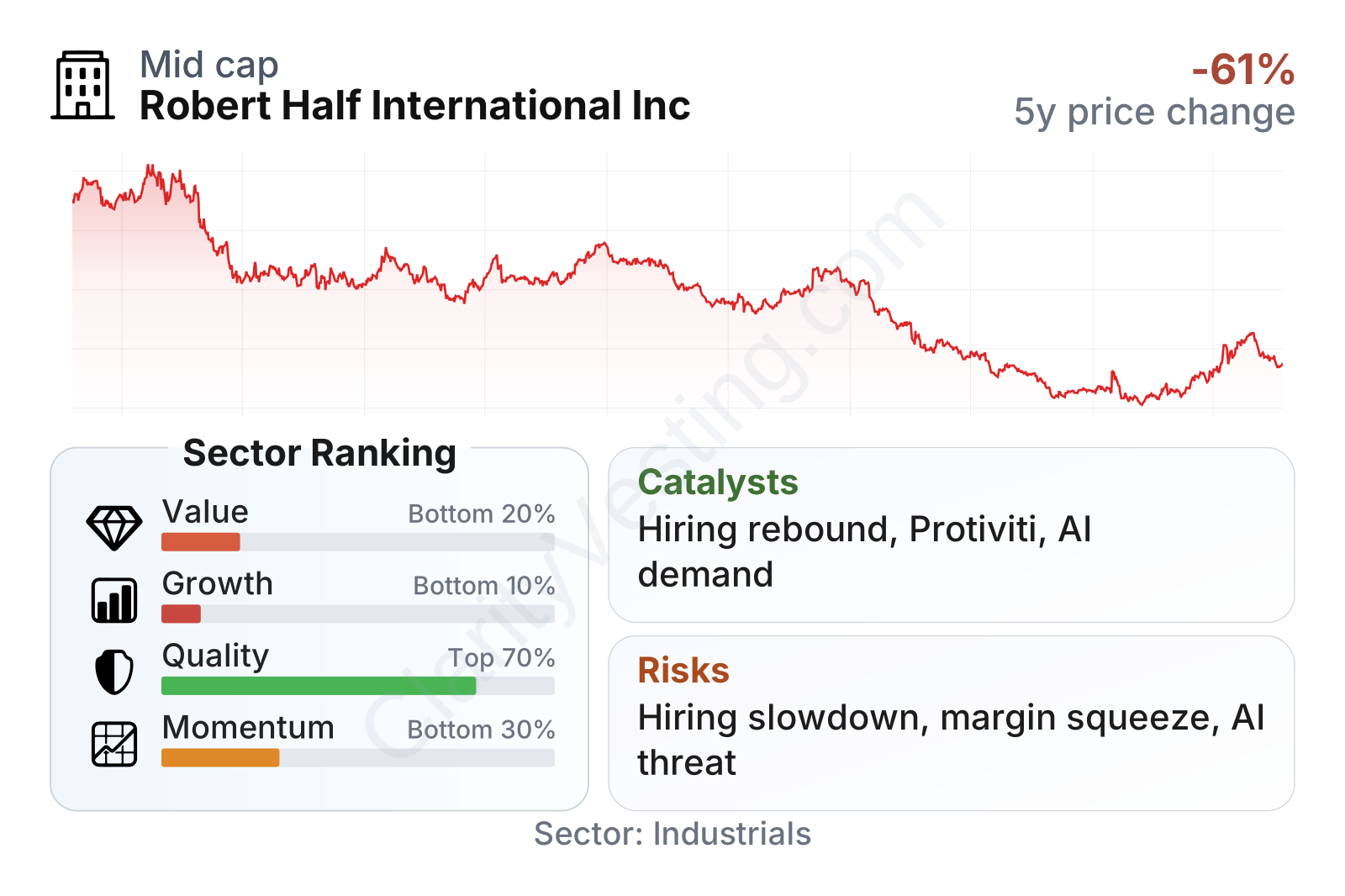
Robert Half is a mid-sized public company with a below-market beta, which means its share price has historically moved somewhat less aggressively than the broader market. The table points to a mixed profile. Balance-sheet quality is strong, with low leverage and even net cash on some measures, but growth ranks near the bottom of the sector after several years of declining revenue, earnings, and cash flow. On valuation, the stock does not look especially cheap relative to the company’s current earnings level, even though the dividend yield stands well above the sector median. Recent price momentum has improved, but that follows a very weak three-year share-price stretch.
Growth
Long term, Robert Half operates in a sector that should remain relevant. Companies increasingly need flexible staffing, specialized professionals, and outside help for risk, technology, compliance, and finance transformation. These are real structural tailwinds. However, the staffing industry is highly sensitive to the economic cycle, and that cyclical pressure has clearly outweighed the favorable long-term themes recently.
Revenue growth has been negative for an extended period, although the rate of decline appears to have moderated in the most recent quarters. That matters because staffing firms usually recover before broad labor-market data looks strong: client requisitions, interview activity, and project starts tend to improve first. A stabilization phase can therefore become an early sign of recovery, but at this stage it still looks more like a slowdown in the decline than a return to broad growth.
Protiviti is an important part of the future growth case. Consulting tied to internal audit, regulation, cybersecurity, technology modernization, and business process improvement is supported by durable corporate needs rather than only hiring volume. This gives Robert Half a second engine alongside staffing. The overall strategy makes sense: use staffing to serve recurring workforce needs and consulting to deepen client relationships in higher-value assignments.
Free cash flow remains positive, which is an important strength in a downturn, but it has trended lower from earlier levels. That suggests the company still has financial flexibility, yet it also shows how much operating conditions have softened. A stronger hiring cycle, improved demand for project work, and better permanent placement activity would likely be the main catalysts for a more convincing growth reset.
Recent company communications have emphasized artificial intelligence as both a client demand theme and a tool for recruiter productivity. If AI-related hiring, data governance, cybersecurity, and transformation spending continue to expand, both talent solutions and Protiviti could participate. That is a meaningful opportunity, although it is still more of a directional catalyst than a fully visible revenue inflection today.
Risks
This article is for informational purposes only and does not constitute financial advice. Some content is AI-generated. See Disclaimer


