Stock Analysis · Regis Resources Ltd (RGRNF)
Overview
Regis Resources Ltd is an Australian gold producer. The company explores for gold, develops mining projects, and operates producing mines. Its business is straightforward: it extracts gold ore, processes it into gold doré, and sells that metal into the gold market. For long-term readers, the key point is that Regis is primarily a single-commodity mining company, so its fortunes are closely tied to gold prices, mine performance, and reserve replacement.
Its operating base is centered in Australia, with major assets in Western Australia and New South Wales. Recent company reporting shows that the business is increasingly shaped by two main operating hubs: the Duketon operations in Western Australia and the Tropicana interest in Western Australia, while the McPhillamys project in New South Wales represents an important future development option rather than a current revenue source.
Revenue mainly comes from gold sales. Based on recent company disclosures and segment reporting, the mix appears heavily concentrated in a small number of producing assets.
- Duketon operations: approximately 60% to 70% of revenue. This includes the company’s core open-pit and underground mining and processing activities in Western Australia.
- Tropicana gold mine interest: approximately 30% to 40% of revenue. Regis owns a minority interest in Tropicana and records its share of production and cash generation from that asset.
- Other sources: a very small share of revenue, mainly incidental items rather than a distinct operating division.
The recent financial flow also shows a major improvement in the business model. Revenue and operating profit expanded sharply into fiscal 2026, while costs did not rise at the same pace. That points to a combination of stronger gold pricing, improved operating leverage, and better mine-level execution after a more uneven period in earlier years.
The latest annual flow highlights a business that has become far more profitable than it was in fiscal 2023 and fiscal 2024. Revenue has risen strongly, but the more important shift is that operating income and net income moved from weak or negative levels to very robust profits, showing how sensitive this company is to better mine performance and higher realized gold prices.
Key Figures
| Metric | Value | Sector ⓘ |
|---|---|---|
| Date | Oct 03, 2026 | |
| Context | ||
| Sector | Basic Materials | |
| Industry | Gold | |
| Market Cap ⓘ | $3.97B | |
| Beta ⓘ | 1.45 | |
Value (Cheapness) | ||
| P/E Ratio ⓘ | 7.93 | 17.61 |
| P/B Ratio ⓘ | 1.84 | 1.77 |
| FCF Yield ⓘ | 36.74% | 5.87% |
| Dividend Yield ⓘ | 4.08% | 2.06% |
| EBIT / EV ⓘ | N/A | 6.43% |
| PEG ⓘ | 0.47 | |
Growth (Business expansion) | ||
| Revenue Growth ⓘ | 44.90% | 11.30% |
| RPS Growth (5Y CAGR) ⓘ | 23.05% | 4.46% |
| EPS Growth (5Y CAGR) ⓘ | 6.96% | -13.11% |
| BVPS Growth (5Y CAGR) ⓘ | 8.21% | 5.51% |
| Margin Growth (5Y Trend) ⓘ | 39.52% | -1.57% |
| FCF Growth (5Y CAGR) ⓘ | 143.62% | 0.55% |
| DPS Growth (5Y CAGR) ⓘ | 4.35% | 6.02% |
Quality (Business durability) | ||
| ROIC (Latest) ⓘ | N/A | 9.31% |
| ROA (Latest) ⓘ | 36.04% | 4.94% |
| ROIC (5Y Median) ⓘ | 8.91% | 7.91% |
| ROA (5Y Median) ⓘ | 0.58% | 3.93% |
| Net Debt / EBIT (Latest) ⓘ | -0.75 | 1.40 |
| Net Debt / EBIT (5Y Median) ⓘ | -0.99 | 1.70 |
| Net Debt / EBITDA (Latest) ⓘ | -0.49 | 0.91 |
| Net Debt / Assets ⓘ | -33.23% | 13.69% |
| EBITDA / Interest ⓘ | 77.30 | 11.93 |
| Operating Margin (Latest) ⓘ | 34.51% | 13.07% |
| Operating Margin (5Y Median) ⓘ | 3.02% | 11.86% |
| Debt to Equity (Latest) ⓘ | 4.66% | 40.43% |
| Profit Margin (Latest) ⓘ | 30.44% | 6.57% |
| Free Cash Flow (Latest) ⓘ | $1.46B | |
Momentum (Price trend) | ||
| 3Y Return ⓘ | +529.25% | +65.06% |
| 12M Return (excl. last month) ⓘ | +106.70% | +36.05% |
| 6M Return ⓘ | +19.32% | +1.89% |
| Price vs. 200-Day MA ⓘ | +14.66% | +1.03% |
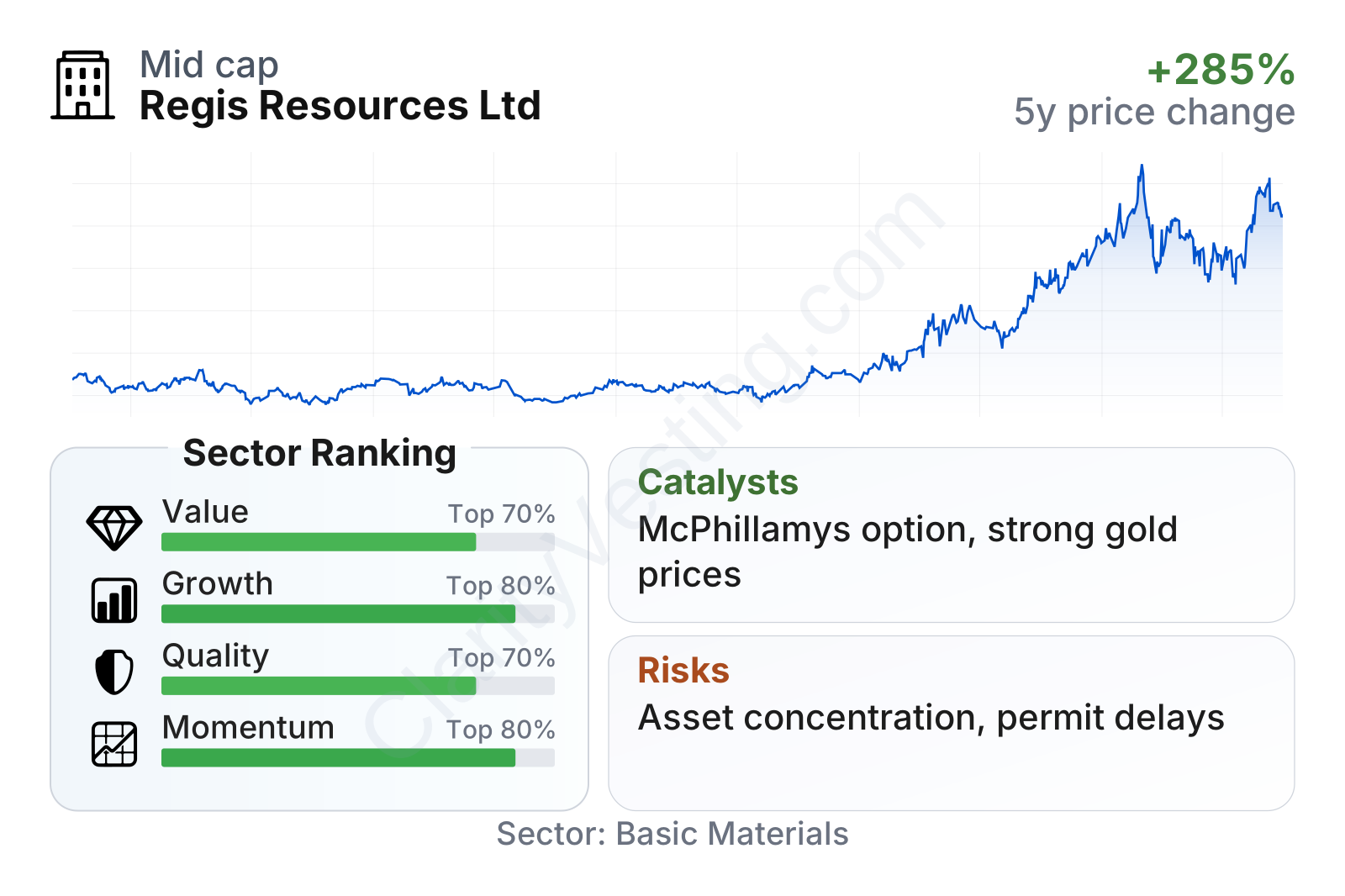
Regis currently stands out as a mid-sized gold producer with unusually strong cash generation for its size. The stock’s value profile looks favorable relative to much of the sector, with a low earnings multiple, a high free-cash-flow yield, and a dividend yield above the sector median. Growth, quality, and momentum rankings are also strong versus peers, suggesting the market is recognizing better fundamentals, but not valuing them as richly as many other mining names. The stock has also been volatile, which is typical for gold producers and reinforced by a beta above 1.
Growth
Gold remains a relevant long-term sector because it serves multiple roles at once: a store of value, a central-bank reserve asset, a hedge during financial stress, and a commodity with limited new supply growth. That does not make every gold miner attractive, but it does mean companies that can maintain reserves, control costs, and convert high gold prices into cash flow can benefit from a supportive backdrop.
Regis appears to be in one of its stronger operating phases. Revenue growth has been well ahead of the sector median, and longer-term trends in revenue per share, margins, and cash flow have also improved materially. This matters because mining growth is not only about producing more ounces; it is about producing profitable ounces after sustaining capital, royalties, and taxes.
The recent year-over-year revenue increase is strong by sector standards, indicating that Regis has been benefiting from both production support and a favorable gold price environment. More importantly, the company’s margin trend has improved over the last several years, which suggests the recent growth is not just superficial volume expansion.
Free cash flow has swung from negative territory to clearly positive territory, which is one of the most important developments in the company’s recent profile. For a mining company, this is a critical signal because it shows that operations are not only profitable on paper but are also generating cash after capital needs. That cash can support dividends, reduce debt, fund exploration, and help advance future projects.
Regis also has a visible strategic catalyst in project development. The McPhillamys gold project has long been one of the company’s most important growth options. If it progresses through permitting and development, it could materially extend the company’s production base and diversify it beyond the current operating centers. In addition, ongoing mine life extension through exploration around existing assets remains a practical growth path, especially in a business where replacing depleted reserves is essential.
A second catalyst is simpler: gold prices. Regis is now showing strong operating leverage, meaning changes in the gold price can have an outsized effect on profits and cash generation once fixed costs are covered. That is already visible in the sharp improvement in earnings and cash metrics.
Risks
This article is for informational purposes only and does not constitute financial advice. Some content is AI-generated. See Disclaimer