Stock Analysis · Royal Gold Inc (RGLD)
Overview
Royal Gold is a precious-metals royalty and streaming company. Instead of operating mines itself, it finances mining projects and, in return, receives either a royalty on future production revenue or the right to buy metal at a fixed low price and resell it at market prices. This business model is simpler than running mines directly: Royal Gold avoids most day-to-day mining costs, labor issues, and construction risk once a mine is in operation, while still benefiting when production rises or metal prices increase.
The company’s revenue is mainly tied to gold, with additional exposure to silver, copper, and smaller amounts of other metals. Based on recent annual reporting, revenue is broadly split as follows:
- Gold: about 75% to 80% of revenue. This includes royalties and streams linked to large producing mines.
- Silver: about 10% to 15% of revenue. This usually comes from streaming agreements where Royal Gold buys silver at preset prices.
- Copper: about 10% to 15% of revenue. Copper has become more important as several agreements are tied to large, long-life mines.
- Other minerals: a small residual share, depending on production mix and by-product sales.
Revenue is also concentrated in a relatively small number of major assets. Royal Gold’s portfolio includes interests in well-known mines such as Mount Milligan, Pueblo Viejo, Cortez, Andacollo, and Peñasquito, among others. That gives the company diversification across operators and countries, but a meaningful share of cash flow still comes from a handful of cornerstone assets.
What stands out in this model is margin quality. Because Royal Gold does not run the mines, its ongoing operating costs are low compared with traditional miners. That helps explain why profitability has stayed far above the broader gold industry. Over the last several years, revenue and earnings have generally trended upward, and the latest period shows a sharp acceleration.
The long-term picture shows a business that converts a large share of revenue into operating profit and net income. Revenue moved from roughly the mid-$600 million range a few years ago to above $1 billion more recently, while operating expenses stayed comparatively light. That operating leverage is one of the clearest attractions of the royalty model.
Key Figures
| Metric | Value | Sector ⓘ |
|---|---|---|
| Date | Oct 24, 2026 | |
| Context | ||
| Sector | Basic Materials | |
| Industry | Gold | |
| Market Cap ⓘ | $20.23B | |
| Beta ⓘ | 0.45 | |
Value (Cheapness) | ||
| P/E Ratio ⓘ | 26.44 | 16.92 |
| P/B Ratio ⓘ | 2.73 | 1.66 |
| FCF Yield ⓘ | 0.00% | 5.83% |
| Dividend Yield ⓘ | 0.81% | 2.07% |
| EBIT / EV ⓘ | 4.10% | 6.38% |
| PEG ⓘ | 1.06 | |
Growth (Business expansion) | ||
| Revenue Growth ⓘ | 115.50% | 11.25% |
| RPS Growth (5Y CAGR) ⓘ | 10.79% | 4.49% |
| EPS Growth (5Y CAGR) ⓘ | 12.28% | -15.24% |
| BVPS Growth (5Y CAGR) ⓘ | 26.87% | 5.49% |
| Margin Growth (5Y Trend) ⓘ | 7.18% | -1.54% |
| FCF Growth (5Y CAGR) ⓘ | N/A | 0.37% |
| DPS Growth (5Y CAGR) ⓘ | 9.17% | 5.91% |
Quality (Business durability) | ||
| ROIC (Latest) ⓘ | 10.50% | 9.59% |
| ROA (Latest) ⓘ | 10.61% | 4.92% |
| ROIC (5Y Median) ⓘ | N/A | 7.91% |
| ROA (5Y Median) ⓘ | 7.60% | 3.92% |
| Net Debt / EBIT (Latest) ⓘ | 0.24 | 1.36 |
| Net Debt / EBIT (5Y Median) ⓘ | 0.46 | 1.69 |
| Net Debt / EBITDA (Latest) ⓘ | 0.18 | 0.93 |
| Net Debt / Assets ⓘ | 2.26% | 13.69% |
| EBITDA / Interest ⓘ | 27.43 | 12.38 |
| Operating Margin (Latest) ⓘ | 58.53% | 13.24% |
| Operating Margin (5Y Median) ⓘ | 51.89% | 11.82% |
| Debt to Equity (Latest) ⓘ | 5.22% | 40.30% |
| Profit Margin (Latest) ⓘ | 48.05% | 6.38% |
| Free Cash Flow (Latest) ⓘ | $585.00K | |
Momentum (Price trend) | ||
| 3Y Return ⓘ | +126.68% | +73.47% |
| 12M Return (excl. last month) ⓘ | +31.62% | +27.59% |
| 6M Return ⓘ | -3.89% | -4.02% |
| Price vs. 200-Day MA ⓘ | +0.52% | -0.65% |
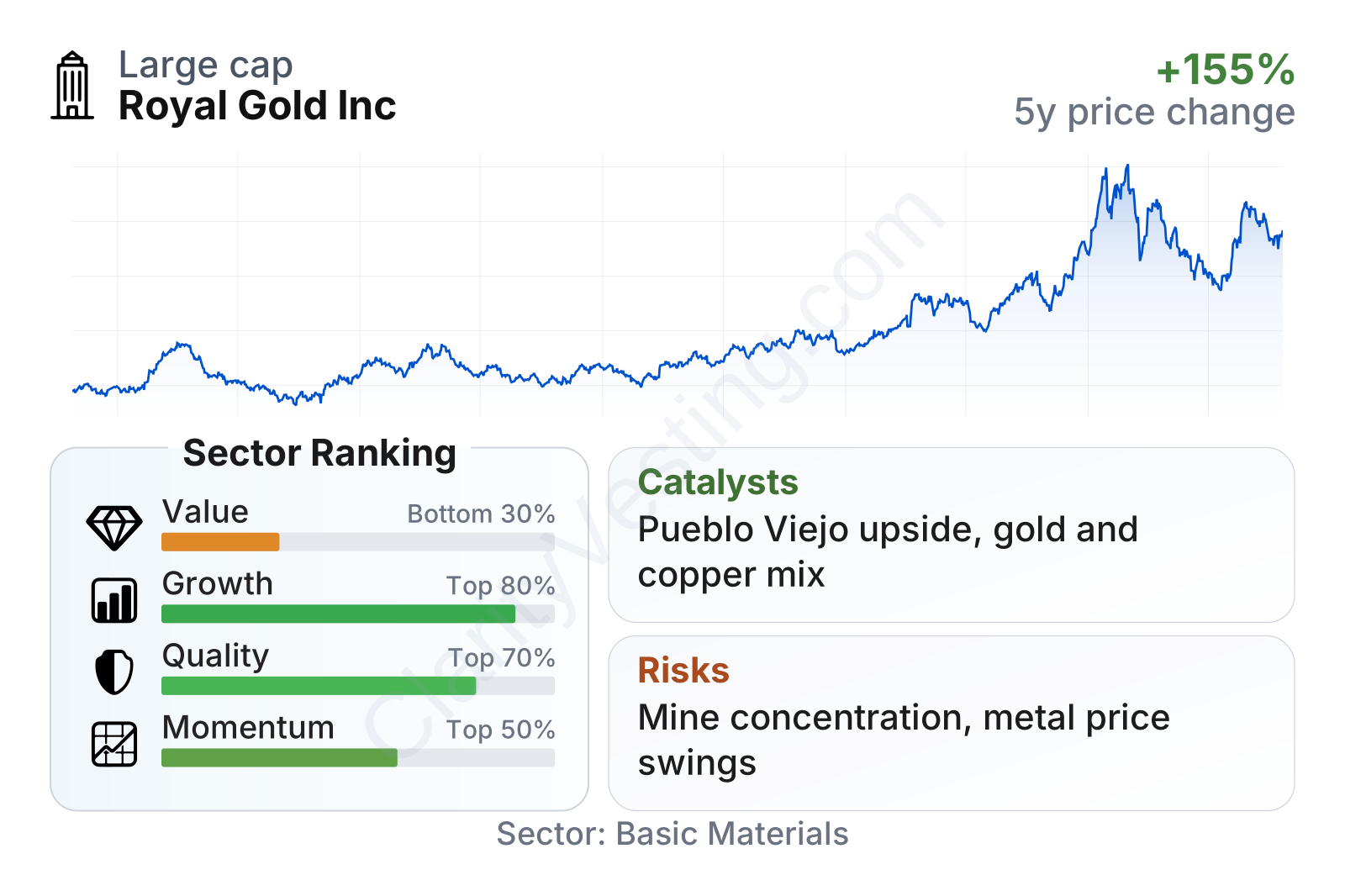
Royal Gold is a large company in the precious-metals space, with a market value in the tens of billions of dollars and a relatively low beta near 0.5, meaning its share price has historically moved less violently than many mining stocks. On growth and quality, the company ranks well versus much of its sector: revenue growth, earnings growth, returns on assets, and margins all sit comfortably above industry medians. Balance-sheet strength is another positive point, with very low leverage and strong interest coverage.
The weaker area is valuation. Earnings multiples and book-value multiples are above sector norms, while cash flow and dividend yield are lower than many peers. In simple terms, the market appears to be assigning a premium to Royal Gold’s cleaner business model, stronger margins, and lower financial risk.
Growth
Royal Gold operates in a sector with durable long-term relevance. Gold remains important as a store of value and portfolio hedge in periods of inflation, currency weakness, or geopolitical stress. At the same time, copper exposure adds a second growth angle because copper demand is supported by electrification, grid investment, electric vehicles, and broader infrastructure build-out. That combination gives Royal Gold exposure to both defensive and industrial metals.
The company’s strategy also makes sense for future growth. Management can expand by funding new streams and royalties rather than building mines. This can be an efficient use of capital when mining companies need financing but want to avoid issuing too much equity or taking on heavy debt. Royal Gold’s role is especially attractive in periods when financing conditions are tighter, because it can negotiate deals on long-life assets without assuming full operating responsibility.
Recent growth has been unusually strong. After a more mixed period in 2022 through early 2024, revenue growth turned sharply positive and accelerated into 2025 and 2026, far above the sector median. That suggests the company is benefiting from a combination of stronger production from key assets, improved metal prices, and the contribution of newer interests.
Free cash flow has been more uneven than net income, which is common for royalty companies when they make large upfront investments in new deals. That means cash generation can look lumpy from year to year. Even so, the broader business remains highly cash generative over time because the underlying operating cost base is small.
A key catalyst is the continued ramp-up or optimization of major mines tied to Royal Gold’s portfolio. Large assets such as Pueblo Viejo and other cornerstone operations can lift deliveries over multiple years if expansions, recoveries, or throughput improvements continue as planned. Another support factor is the gold price environment: because many stream purchase costs are fixed or low, rising metal prices can translate into disproportionately strong margin expansion.
Recent company updates have also emphasized ongoing portfolio management and the development pipeline behind existing royalties. That matters because Royal Gold does not need to keep winning brand-new deals every year to grow; some of its future upside is already embedded in assets that are still being expanded, optimized, or advanced toward production.
Risks
This article is for informational purposes only and does not constitute financial advice. Some content is AI-generated. See Disclaimer


