Stock Analysis · Regions Financial Corporation (RF)
Overview
Regions Financial Corporation is a large regional bank based in the United States, with a strong presence across the South, Midwest, and Texas. Through its main banking subsidiary, Regions Bank, the company serves consumers, small businesses, middle-market companies, and larger corporate clients. Its activities are fairly easy to understand: it gathers deposits, makes loans, processes payments, manages wealth, and provides a range of treasury and capital-markets services.
Like most banks, Regions makes most of its money from the spread between what it earns on loans and securities and what it pays on deposits and other funding. It also generates a meaningful amount of fee income from services that are less tied to interest rates.
The main revenue sources are approximately the following:
- Net interest income: about 70% to 75% of total revenue. This is the core banking engine and includes income from commercial loans, consumer loans, mortgages, credit cards, and securities, minus interest paid on deposits and borrowings.
- Service charges and card and payment fees: about 8% to 10%. This includes deposit account fees, debit and credit card-related revenue, interchange, merchant services, and other transaction banking activities.
- Wealth management and capital-markets related fees: about 7% to 9%. This covers investment management, trust, brokerage, treasury management, and advisory-related activities for affluent and business clients.
- Mortgage, investment banking, and other noninterest income: about 8% to 12%. This includes mortgage production and servicing, securities gains and losses, and various other banking fees.
That mix matters because it shows Regions is not purely dependent on lending. It is still mainly a spread-based bank, but fee businesses help diversify earnings when loan growth or interest margins are under pressure.
The multi-year income flow also shows a useful pattern: revenue expanded meaningfully from 2021 to 2025, while profits were squeezed in 2023 and 2024 by much higher interest expense and rising operating costs before improving again in 2025. In other words, the franchise kept growing, but the benefit to shareholders depended heavily on funding costs and efficiency.
Key Figures
| Metric | Value | Sector ⓘ |
|---|---|---|
| Date | Oct 20, 2026 | |
| Context | ||
| Sector | Financial Services | |
| Industry | Banks - Regional | |
| Market Cap ⓘ | $23.17B | |
| Beta ⓘ | 1.06 | |
Value (Cheapness) | ||
| P/E Ratio ⓘ | 11.10 | 12.26 |
| P/B Ratio ⓘ | 1.30 | 1.23 |
| FCF Yield ⓘ | 7.63% | 10.33% |
| Dividend Yield ⓘ | 3.99% | 3.02% |
| EBIT / EV ⓘ | 9.88% | 8.14% |
| PEG ⓘ | 1.45 | |
Growth (Business expansion) | ||
| Revenue Growth ⓘ | 5.20% | 9.25% |
| RPS Growth (5Y CAGR) ⓘ | 12.33% | 12.19% |
| EPS Growth (5Y CAGR) ⓘ | -4.05% | -8.95% |
| BVPS Growth (5Y CAGR) ⓘ | -39.87% | 4.99% |
| Margin Growth (5Y Trend) ⓘ | -20.14% | -3.86% |
| FCF Growth (5Y CAGR) ⓘ | -7.66% | 4.81% |
| DPS Growth (5Y CAGR) ⓘ | 11.27% | 8.79% |
Quality (Business durability) | ||
| ROIC (Latest) ⓘ | 9.52% | 9.49% |
| ROE (Latest) ⓘ | 12.35% | 13.87% |
| ROA (Latest) ⓘ | 1.42% | 1.54% |
| ROIC (5Y Median) ⓘ | 11.96% | 7.86% |
| ROE (5Y Median) ⓘ | 10.08% | 12.17% |
| ROA (5Y Median) ⓘ | 1.36% | 1.30% |
| Net Debt / EBIT (Latest) ⓘ | -0.81 | 0.99 |
| Net Debt / EBIT (5Y Median) ⓘ | -2.20 | 0.73 |
| Net Debt / EBITDA (Latest) ⓘ | 0.05 | 0.91 |
| Operating Margin (Latest) ⓘ | 29.77% | 22.30% |
| Operating Margin (5Y Median) ⓘ | 28.55% | 24.63% |
| Debt to Equity (Latest) ⓘ | 58.73% | 58.32% |
| Profit Margin (Latest) ⓘ | 31.29% | 26.57% |
| Free Cash Flow (Latest) ⓘ | $1.77B | |
Momentum (Price trend) | ||
| 3Y Return ⓘ | +114.79% | +88.67% |
| 12M Return (excl. last month) ⓘ | +9.18% | +19.19% |
| 6M Return ⓘ | -1.39% | +4.70% |
| Price vs. 200-Day MA ⓘ | -3.71% | +3.66% |
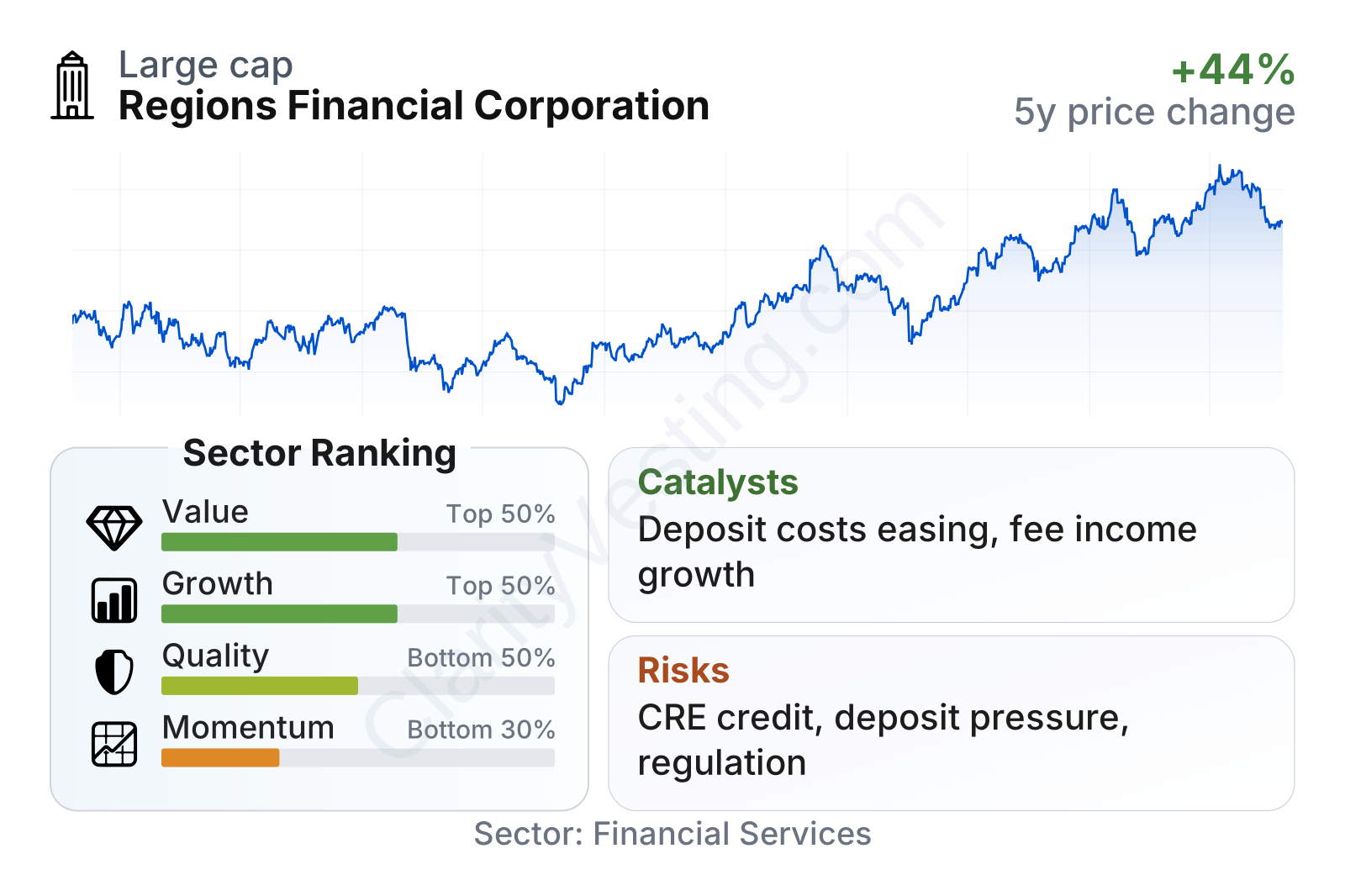
Regions sits in the large regional-bank category, with a market value in the low tens of billions of dollars and a stock that has been more volatile than the broad market, though not unusually extreme for a bank. The share price has recovered strongly from the pressure seen during the regional banking stress of 2023, and the longer three-year performance remains better than the sector median. More recently, however, price momentum has cooled, which suggests the market has become more selective after the rebound.
The overall factor profile is mixed. Valuation measures are around the better half of the sector, supported by a price-to-earnings ratio modestly below the sector median and a dividend yield near 4%, above the sector median. Quality is less impressive on current returns, even though margins remain solid and leverage metrics appear controlled. Growth indicators are also mixed: revenue trends are acceptable, but earnings and book value progression have been uneven over the past five years.
Growth
Banking is not a high-growth sector in the same way as software or semiconductors, but it remains structurally important and can grow steadily with population expansion, business formation, household borrowing, payments activity, and wealth accumulation. Regions operates in markets that have generally enjoyed favorable demographic and business trends, especially in parts of the Southeast and Texas. That geographic footprint gives it exposure to faster-growing areas than many older regional banks concentrated in slower-growth regions.
Management’s strategy has centered on deepening relationships rather than simply chasing loan volume. That includes growing treasury management, payments, wealth management, and capital-markets capabilities around commercial clients. This approach makes sense for long-term growth because these activities can improve fee income, strengthen customer retention, and make the bank less dependent on pure lending spreads.
Another potential support for growth is the interest-rate backdrop. When deposit competition stabilizes and loan pricing remains disciplined, regional banks can rebuild profitability even without dramatic balance-sheet expansion. Regions already showed revenue resilience through a difficult funding cycle, which suggests the franchise itself remains intact.
Earnings per share illustrate both the challenge and the recovery path. After drifting lower from 2021 through 2024, EPS improved in 2025, showing that profit pressure was not purely structural. That said, the recovery is not yet strong enough to describe Regions as a fast compounding earnings business. It looks more like a bank working back toward stronger normalized profitability.
Book value per share appears far better in the more recent period than the five-year growth figure might suggest. The longer-term metric is distorted by an older outlier, while the more recent progression from 2022 through 2025 shows a steady rebuild. For banks, book value matters because it reflects the capital base supporting future lending and earnings power. A rising book value trend is generally a constructive sign when it comes from retained earnings rather than aggressive balance-sheet expansion.
Recent company updates in 2026 have continued to emphasize expense discipline, balance-sheet positioning, and fee business development. For Regions, the most important catalyst is not a single breakthrough product; it is the combination of stable credit, better deposit economics, and gradual improvement in fee income. If those pieces align, earnings power can improve faster than revenue growth alone would suggest.
Risks
This article is for informational purposes only and does not constitute financial advice. Some content is AI-generated. See Disclaimer


