Stock Analysis · Resideo Technologies Inc (REZI)
Overview
Resideo Technologies is a building products and home technology company focused on residential comfort, security, and safety. Its brands are widely tied to thermostats, security systems, sensors, controls, and related software and services. The company mainly serves professional installers, distributors, and original equipment manufacturers rather than relying only on direct consumer sales. That matters for long-term analysis because Resideo sits in the installed base of homes and small commercial buildings, where replacement cycles, service relationships, and contractor channels can create recurring demand.
Resideo reports two main business segments. Based on recent annual filings, the revenue mix is heavily weighted toward products distribution, while the products-and-solutions segment contributes a smaller but strategically important share.
- ADI Global Distribution: about 80% to 85% of revenue. This segment distributes low-voltage and related products such as security, fire, audiovisual, networking, smart home, access control, and other building technology items. It is the larger business and gives Resideo broad customer reach through professional channels.
- Products & Solutions: about 15% to 20% of revenue. This includes comfort, water, air, security, and life-safety products sold under brands such as Honeywell Home, First Alert, and related connected-home offerings. This segment contains more of the company’s branded product portfolio and software-enabled home technology.
The business model mixes distribution scale with branded products. That combination can be useful: the distribution arm supports market access and customer relationships, while the product arm offers more differentiation through installed devices, replacement demand, and connected-home features. Over the past several years, revenue has generally expanded, but profit conversion has been much less stable. Sales rose from roughly $5.8 billion in 2021 to about $7.5 billion in 2025, while operating income and net income were much more volatile, showing that execution and cost control matter as much as top-line growth for this company.
The long-term pattern is clear: revenue and gross profit have grown, but overhead, interest expense, and weaker profitability in 2025 sharply reduced earnings. For a simple reading, Resideo is not struggling to generate sales; the bigger question is whether it can turn those sales into steadier cash generation and margins.
Key Figures
| Metric | Value | Sector ⓘ |
|---|---|---|
| Date | Oct 17, 2026 | |
| Context | ||
| Sector | Industrials | |
| Industry | Industrial Distribution | |
| Market Cap ⓘ | $2.52B | |
| Beta ⓘ | 1.50 | |
Value (Cheapness) | ||
| P/E Ratio ⓘ | 6.98 | 22.10 |
| P/B Ratio ⓘ | 0.83 | 1.97 |
| FCF Yield ⓘ | -55.47% | 6.38% |
| Dividend Yield ⓘ | N/A | 1.94% |
| EBIT / EV ⓘ | 10.44% | 4.79% |
| PEG ⓘ | N/A | |
Growth (Business expansion) | ||
| Revenue Growth ⓘ | 2.00% | 9.30% |
| RPS Growth (5Y CAGR) ⓘ | 6.23% | 7.81% |
| EPS Growth (5Y CAGR) ⓘ | -18.98% | -13.06% |
| BVPS Growth (5Y CAGR) ⓘ | 6.58% | 6.14% |
| Margin Growth (5Y Trend) ⓘ | -11.12% | 0.88% |
| FCF Growth (5Y CAGR) ⓘ | N/A | 11.01% |
| DPS Growth (5Y CAGR) ⓘ | N/A | 9.48% |
Quality (Business durability) | ||
| ROIC (Latest) ⓘ | 10.25% | 10.84% |
| ROA (Latest) ⓘ | 5.03% | 5.41% |
| ROIC (5Y Median) ⓘ | 6.26% | 9.38% |
| ROA (5Y Median) ⓘ | 3.22% | 4.95% |
| Net Debt / EBIT (Latest) ⓘ | 4.92 | 2.08 |
| Net Debt / EBIT (5Y Median) ⓘ | 2.27 | 2.27 |
| Net Debt / EBITDA (Latest) ⓘ | 3.78 | 1.39 |
| Net Debt / Assets ⓘ | 37.34% | 19.28% |
| EBITDA / Interest ⓘ | 4.82 | 9.58 |
| Operating Margin (Latest) ⓘ | 8.72% | 10.50% |
| Operating Margin (5Y Median) ⓘ | 6.06% | 10.29% |
| Debt to Equity (Latest) ⓘ | 127.35% | 65.48% |
| Profit Margin (Latest) ⓘ | 5.58% | 6.67% |
| Free Cash Flow (Latest) ⓘ | -$1.40B | |
Momentum (Price trend) | ||
| 3Y Return ⓘ | +58.22% | +61.68% |
| 12M Return (excl. last month) ⓘ | -26.62% | +12.58% |
| 6M Return ⓘ | -40.67% | 0.00% |
| Price vs. 200-Day MA ⓘ | -30.03% | +0.02% |
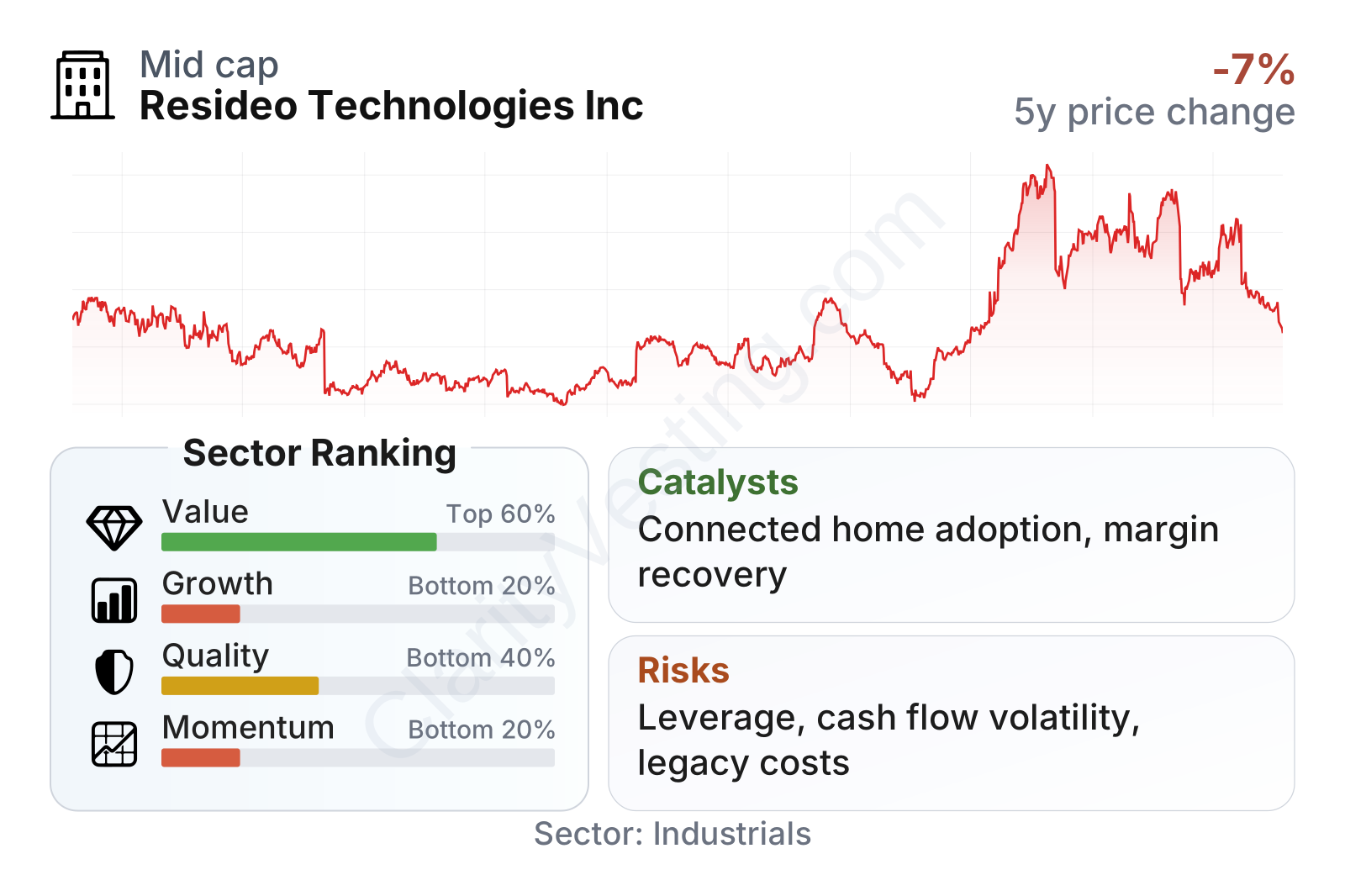
Resideo is a mid-sized company with a stock that has been more volatile than the broader market, as shown by its beta above 1.5. The table points to a mixed profile. On valuation, the shares screen as inexpensive relative to the sector, with a low earnings multiple and a price-to-book ratio below the sector median. On the other hand, growth, quality, and momentum rank weaker than much of the sector. In plain terms, the market is assigning a discounted valuation because recent operating performance has not been strong enough to support a richer multiple.
The share price has been far from stable over the last several years, including a major rebound after a weak stretch. That kind of path usually signals that investors are reassessing whether Resideo is moving past a difficult earnings period or whether the improvement is still fragile.
Growth
Resideo operates in categories with long-term relevance. Residential security, smart home controls, connected thermostats, sensing, water leak detection, and building automation all benefit from broader trends in energy efficiency, safety, retrofitting older homes, and more connected devices in buildings. These are real structural tailwinds, even if the company itself does not always convert them into fast headline growth.
The company’s strategy also makes industrial sense. ADI Global Distribution gives Resideo access to installers and integrators across a large product set, while the Products & Solutions segment gives it proprietary brands and installed devices that can drive replacement and upgrade demand. The combination creates cross-selling potential: contractors buying through distribution channels can also be exposed to Resideo’s own branded technologies.
Recent revenue growth has improved from the weaker 2023-2024 period, but the latest pace still looks modest compared with the sector median. That suggests Resideo is participating in end-market demand, yet not outperforming its broader industry group on expansion. For a long-term view, the more important question is whether recent growth is durable and profitable rather than simply whether revenue is moving up.
Cash generation is the main area that needs careful interpretation. Resideo had positive free cash flow in prior periods, but the trailing twelve-month figure turned sharply negative in 2026. A swing of that size can sometimes come from temporary items such as working-capital movements, settlements, restructuring, or one-time payments, but it still matters because it reduces financial flexibility until the business normalizes. If future filings show that cash flow improves as those temporary pressures fade, that would support the case that 2026 was an abnormal dip rather than a new baseline.
A meaningful catalyst in the broader sense is the replacement market. Many of Resideo’s products are tied to existing homes and installed systems, which can produce demand even when new construction slows. Another catalyst is the continued adoption of connected devices that help manage energy use, safety, and remote monitoring. Recent company communications have also emphasized portfolio actions and operational focus, which can become significant if they lead to a cleaner cost structure and more stable margins.
Risks
This article is for informational purposes only and does not constitute financial advice. Some content is AI-generated. See Disclaimer


