Stock Analysis · Rexford Industrial Realty Inc (REXR)
Overview
Rexford Industrial Realty is a real estate investment trust focused on industrial properties in Southern California. In simple terms, it owns warehouses, distribution buildings, light manufacturing sites, and related industrial real estate, then earns income by leasing those properties to tenants. The company concentrates on infill locations close to ports, highways, and dense population centers, especially in Los Angeles, Orange County, the Inland Empire, San Diego, and nearby submarkets. That geographic focus is central to its identity: rather than being a broad national landlord, Rexford is built around one of the most supply-constrained industrial regions in the United States.
Its revenue is overwhelmingly rental income from industrial real estate. Based on the company’s filings, the business is not meaningfully diversified by product line in the way a manufacturer or software company would be. The main economic drivers are occupancy, rent levels, lease renewals, acquisitions, redevelopment, and occasional property sales or other ancillary items.
The main sources of revenue can be summarized as follows:
- Rental and lease-related revenue: about 95% to 99% — base rent from industrial tenants, reimbursement income, and other property-level lease revenues tied to operating industrial buildings.
- Other real estate and management-related income: about 1% to 5% — includes smaller ancillary items that can vary by period.
- Property disposition gains: variable and not a stable operating revenue source — these can affect reported earnings in some periods, but they are not the core engine of the business.
Over the last several years, the company expanded revenue materially as it added properties and pushed rental income higher, while property-level costs rose much more slowly than total revenue. That is generally what long-term shareholders want to see from a landlord: a larger rent base with operating expenses staying relatively controlled, although more recent accounting earnings have been affected by non-cash items and higher financing costs.
The business model remains straightforward: buy well-located industrial assets, improve or reposition them, raise rents over time, and recycle capital when management sees better opportunities elsewhere.
Key Figures
| Metric | Value | Sector ⓘ |
|---|---|---|
| Date | Oct 17, 2026 | |
| Context | ||
| Sector | Real Estate | |
| Industry | REIT - Industrial | |
| Market Cap ⓘ | $8.57B | |
| Beta ⓘ | 1.20 | |
Value (Cheapness) | ||
| P/E Ratio ⓘ | N/A | 17.38 |
| P/B Ratio ⓘ | 1.15 | 0.85 |
| FCF Yield ⓘ | 2.65% | 7.38% |
| Dividend Yield ⓘ | 4.57% | 4.85% |
| EBIT / EV ⓘ | -2.54% | 3.78% |
| PEG ⓘ | 1.88 | |
Growth (Business expansion) | ||
| Revenue Growth ⓘ | -1.60% | 5.30% |
| RPS Growth (5Y CAGR) ⓘ | 7.51% | 6.02% |
| EPS Growth (5Y CAGR) ⓘ | 0.29% | -11.37% |
| BVPS Growth (5Y CAGR) ⓘ | 1.27% | 0.45% |
| Margin Growth (5Y Trend) ⓘ | 0.53% | -0.22% |
| FCF Growth (5Y CAGR) ⓘ | 12.78% | 5.40% |
| DPS Growth (5Y CAGR) ⓘ | 13.83% | 5.02% |
Quality (Business durability) | ||
| ROIC (Latest) ⓘ | -2.08% | 5.69% |
| ROE (Latest) ⓘ | -5.05% | 7.56% |
| ROA (Latest) ⓘ | -3.20% | 2.85% |
| ROIC (5Y Median) ⓘ | 2.20% | 4.22% |
| ROE (5Y Median) ⓘ | 2.93% | 6.03% |
| ROA (5Y Median) ⓘ | 2.19% | 2.44% |
| Net Debt / EBIT (Latest) ⓘ | N/A | 7.59 |
| Net Debt / EBIT (5Y Median) ⓘ | 8.98 | 8.40 |
| Net Debt / EBITDA (Latest) ⓘ | 1,593.77 | 5.27 |
| Net Debt / Assets ⓘ | 28.68% | 37.76% |
| EBITDA / Interest ⓘ | 0.02 | 4.10 |
| Operating Margin (Latest) ⓘ | -30.71% | 35.29% |
| Operating Margin (5Y Median) ⓘ | 34.55% | 37.31% |
| Debt to Equity (Latest) ⓘ | 44.68% | 88.87% |
| Profit Margin (Latest) ⓘ | -39.16% | 19.61% |
| Free Cash Flow (Latest) ⓘ | $227.15M | |
Momentum (Price trend) | ||
| 3Y Return ⓘ | -15.08% | +30.75% |
| 12M Return (excl. last month) ⓘ | -5.49% | +4.36% |
| 6M Return ⓘ | +5.98% | -2.52% |
| Price vs. 200-Day MA ⓘ | +3.41% | -2.34% |
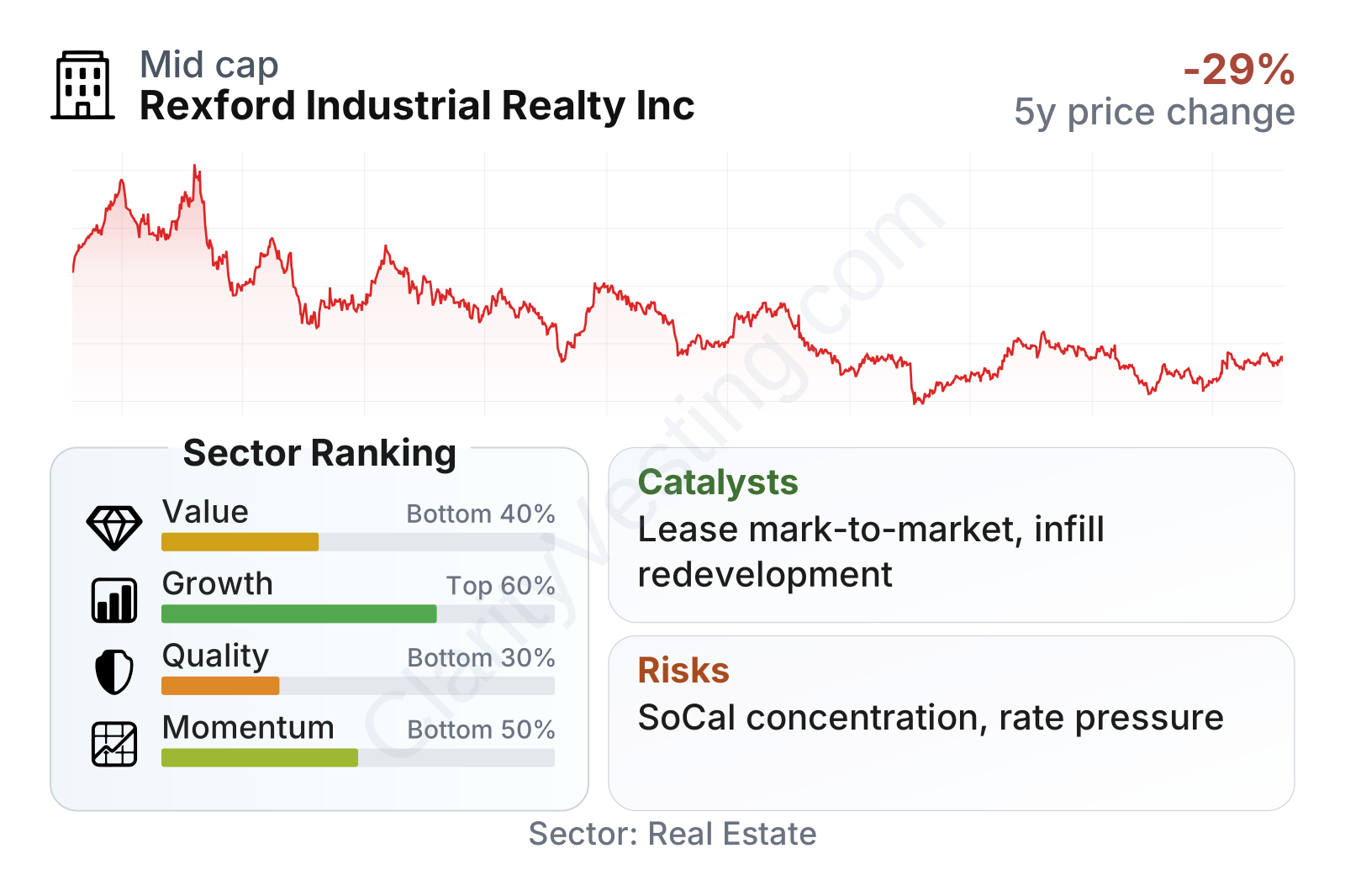
Rexford is a mid-to-large industrial REIT by sector standards, with share-price volatility somewhat above the market average. The current factor profile looks mixed. Growth metrics remain better than much of the real estate sector over a five-year view, especially in revenue per share, free cash flow, and dividend growth. By contrast, recent value, profitability, and momentum readings are weaker, with current profitability ratios distorted by negative trailing earnings metrics. That combination points to a company with a strong longer-term expansion record but a less comfortable near-term financial picture.
Growth
Industrial real estate remains one of the more attractive property categories over the long run because modern supply chains need warehouse space near consumers, ports, and transportation corridors. Southern California is especially important because it combines huge consumption demand with critical logistics infrastructure. That supports Rexford’s strategy: focus on locations where land is scarce, replacement costs are high, and many industrial sites have alternative uses that limit new supply.
Its strategy also makes sense operationally. Rexford has spent years assembling a dense portfolio in a concentrated region, which can create local market knowledge, leasing advantages, and redevelopment opportunities that are harder for a more scattered landlord to replicate. Management has repeatedly emphasized value creation not only from buying buildings, but also from releasing space at higher rents, renovating underused assets, and converting properties to more productive uses.
Revenue per share has moved steadily higher over the last five years, which matters because it shows growth was not only driven by issuing more shares. On a longer horizon, that is one of the cleaner signs that the company has been able to expand its portfolio while still increasing the amount of revenue attached to each share.
The dividend per share has also climbed consistently, with five-year growth clearly ahead of the sector median. For a REIT, that pattern usually signals that underlying cash generation has expanded over time, even if accounting earnings are noisy from quarter to quarter.
A notable catalyst is the gap between older in-place leases and current market rents in supply-constrained Southern California industrial markets. When leases expire, Rexford can often reset rents materially higher if market conditions remain supportive. Another potential growth driver is redevelopment. Industrial landlords in infill California markets may be able to unlock more value by upgrading properties, changing layouts, or repositioning older sites for modern logistics uses.
Recent company communications have also highlighted continued investment activity, development and redevelopment opportunities, and the resilience of demand for well-located logistics space. Even when transaction markets slow, a specialist owner with balance sheet access and local sourcing can still find attractive deals or off-market opportunities.
Risks
This article is for informational purposes only and does not constitute financial advice. Some content is AI-generated. See Disclaimer


