Stock Analysis · REX American Resources Corporation (REX)
Overview
REX American Resources Corporation is a small U.S. industrial company centered on ethanol production and the wider value chain around renewable fuels. Through interests in several ethanol plants, the company produces ethanol, distillers grains, non-food grade corn oil, and other co-products that come from processing corn. REX has also been expanding beyond traditional fuel ethanol into higher-value and lower-carbon opportunities, especially carbon capture and sequestration and other energy-related projects.
The business is still mainly tied to the economics of ethanol manufacturing: the price of ethanol and co-products on one side, and the cost of corn and natural gas on the other. That makes REX easier to understand than many diversified chemical companies, but it also means results can move sharply when commodity spreads change.
Based on recent annual reporting, the company’s revenue is concentrated in a few sources:
- Ethanol and related products: approximately 80% to 90% of revenue. This includes fuel ethanol sold into transportation markets.
- Distillers grains: approximately 7% to 12% of revenue. These are animal feed co-products created during ethanol production.
- Corn oil and other co-products: approximately 3% to 8% of revenue. This includes non-food grade corn oil and smaller by-product streams.
Revenue has fallen from the unusually strong levels seen earlier in the cycle, but profitability has held up better than sales. That suggests the company has recently benefited from improved production economics, disciplined operating costs, or both.
The flow of revenue to profit shows a cyclical business with volatile sales, yet recent results point to stronger earnings conversion than in prior years. Revenue is below the peak reached a few years ago, while net income has rebounded sharply, indicating better margins rather than simple top-line expansion.
Key Figures
| Metric | Value | Sector ⓘ |
|---|---|---|
| Date | Oct 03, 2026 | |
| Context | ||
| Sector | Basic Materials | |
| Industry | Chemicals | |
| Market Cap ⓘ | $1.41B | |
| Beta ⓘ | 0.63 | |
Value (Cheapness) | ||
| P/E Ratio ⓘ | 11.67 | 17.61 |
| P/B Ratio ⓘ | 2.50 | 1.77 |
| FCF Yield ⓘ | 4.85% | 5.87% |
| Dividend Yield ⓘ | N/A | 2.06% |
| EBIT / EV ⓘ | 12.48% | 6.43% |
| PEG ⓘ | 1.74 | |
Growth (Business expansion) | ||
| Revenue Growth ⓘ | 17.90% | 11.30% |
| RPS Growth (5Y CAGR) ⓘ | -2.40% | 4.46% |
| EPS Growth (5Y CAGR) ⓘ | 14.15% | -13.11% |
| BVPS Growth (5Y CAGR) ⓘ | 10.69% | 5.51% |
| Margin Growth (5Y Trend) ⓘ | 3.83% | -1.57% |
| FCF Growth (5Y CAGR) ⓘ | -13.09% | 0.55% |
| DPS Growth (5Y CAGR) ⓘ | -1.45% | 6.02% |
Quality (Business durability) | ||
| ROIC (Latest) ⓘ | 22.16% | 9.31% |
| ROA (Latest) ⓘ | 15.01% | 4.94% |
| ROIC (5Y Median) ⓘ | 13.93% | 7.91% |
| ROA (5Y Median) ⓘ | 9.79% | 3.93% |
| Net Debt / EBIT (Latest) ⓘ | -0.54 | 1.40 |
| Net Debt / EBIT (5Y Median) ⓘ | -1.89 | 1.70 |
| Net Debt / EBITDA (Latest) ⓘ | -0.48 | 0.91 |
| Net Debt / Assets ⓘ | -8.58% | 13.69% |
| EBITDA / Interest ⓘ | N/A | 11.93 |
| Operating Margin (Latest) ⓘ | 20.03% | 13.07% |
| Operating Margin (5Y Median) ⓘ | 11.82% | 11.86% |
| Debt to Equity (Latest) ⓘ | 2.65% | 40.43% |
| Profit Margin (Latest) ⓘ | 17.61% | 6.57% |
| Free Cash Flow (Latest) ⓘ | $68.55M | |
Momentum (Price trend) | ||
| 3Y Return ⓘ | +113.41% | +65.06% |
| 12M Return (excl. last month) ⓘ | +31.31% | +36.05% |
| 6M Return ⓘ | -4.65% | +1.89% |
| Price vs. 200-Day MA ⓘ | +4.42% | +1.03% |
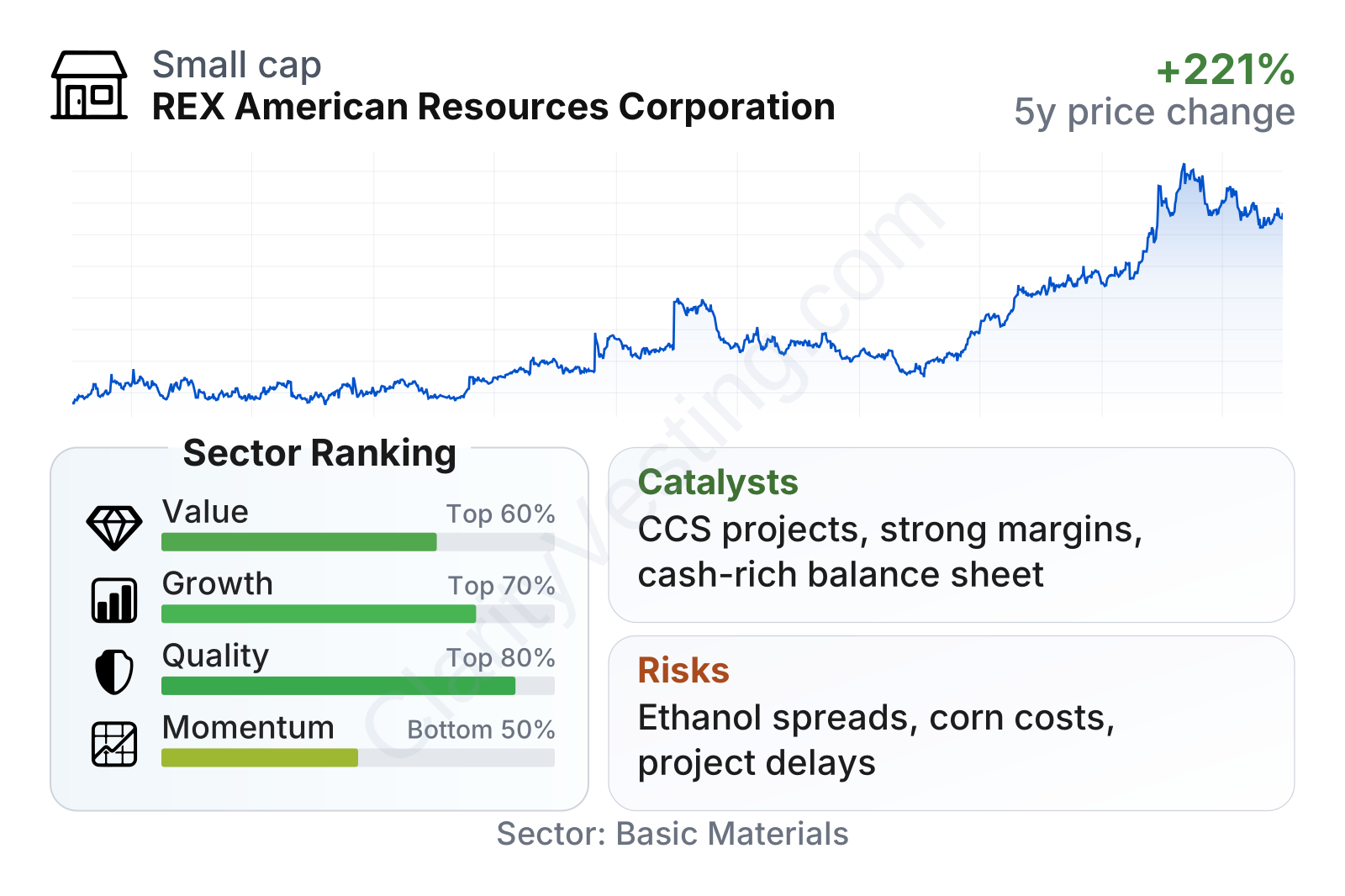
REX stands out more for business quality and balance sheet strength than for pure momentum. Profitability metrics sit well above the sector median, debt is extremely low, and returns on capital are notably strong for a commodity-exposed manufacturer. On valuation, the earnings multiple is below the sector median, while the company trades at a somewhat richer multiple of book value, which is common for businesses with excess cash and higher returns on assets. Recent share-price performance has been positive over several years, although the shorter-term trend has been more uneven.
In practical terms, this is a relatively small company with low share-price volatility, a strong cash position, and no meaningful leverage pressure. That gives it flexibility that many commodity processors do not have when industry conditions weaken.
Growth
The sector backdrop is mixed but relevant for long-term growth. Conventional ethanol is a mature business in the United States, so the strongest opportunities are not simply in producing more fuel gallons. The more important trend is the push toward lower-carbon fuels and emissions reduction infrastructure. That is where REX’s strategy appears most logical: use its ethanol base to participate in higher-value projects such as carbon capture and sequestration and potentially benefit from cleaner-fuel demand and related incentives.
Management has spent the last few years positioning the company for this next phase rather than relying only on commodity ethanol margins. For a company of this size, that matters. Traditional ethanol production alone can produce highly variable results, while low-carbon fuel projects may create more durable strategic value if execution is successful.
Revenue growth has been volatile, which is normal in ethanol because selling prices and input costs move quickly. More recently, the trend has turned positive again, with year-over-year growth running above the sector median. That does not remove cyclicality, but it suggests the business has regained some commercial momentum after a weaker stretch.
Cash generation has also been uneven, including a negative period followed by recovery. That pattern reinforces an important point for long-term analysis: REX is not a smooth compounding business quarter to quarter. However, its return to positive free cash flow, combined with a very strong balance sheet, gives the company room to fund projects and endure downturns without depending heavily on external financing.
A key catalyst is the company’s involvement in carbon capture and sequestration development around its ethanol assets. If those projects move from planning into operation, REX could become more relevant in the low-carbon fuels market than its current size suggests. Another favorable factor is that U.S. biofuel policy still supports domestic renewable fuel production, and lower-carbon compliance markets can add value to ethanol producers that reduce lifecycle emissions.
Recent company communications have also highlighted continued operational focus and capital allocation discipline. For a niche company, that combination of patience, cash, and project optionality can be meaningful when new infrastructure opportunities open up.
Risks
This article is for informational purposes only and does not constitute financial advice. Some content is AI-generated. See Disclaimer