Stock Analysis · Replimune Group Inc (REPL)
Overview
Replimune Group Inc is a clinical-stage biotechnology company focused on cancer treatment. Its approach is based on oncolytic immunotherapy, which means using engineered viruses designed to infect tumors, destroy cancer cells directly, and help the immune system recognize and attack the cancer more effectively. The company’s lead programs are aimed mainly at skin cancers and other solid tumors.
At this stage, Replimune is still in the development phase rather than the commercial phase. That matters for long-term analysis because the business is being judged less on current sales and more on whether its drug candidates can successfully move through clinical trials, gain regulatory approval, and eventually become marketable products.
The company’s revenue base is currently very limited. In its latest fiscal year filings, Replimune reported no product revenue, which means it does not yet have an approved medicine generating recurring commercial sales. As a result, its economic model today is driven primarily by financing rather than operating income.
The main sources of revenue or funding support can be summarized as follows:
- Product revenue: 0% — no approved product sales at the latest annual reporting date.
- Collaboration or licensing revenue: not a meaningful recurring source currently — no major recurring revenue stream appears to support the business at this point.
- External financing: effectively the core source of cash support — operations have been funded mainly through cash on hand, debt, and equity financing rather than business revenue.
That profile makes Replimune very different from established pharmaceutical companies. The upside can be significant if its lead treatment platform works and reaches the market, but the path is highly dependent on clinical and regulatory milestones rather than present-day sales execution.
Over the last several years, spending has been dominated by research and development, and that is consistent with a biotech trying to push multiple drug candidates through trials. Operating losses have expanded as development activity increased, with R&D remaining the largest expense line by a wide margin.
The operating structure is straightforward: essentially no revenue, steadily rising research spending, and growing net losses as the pipeline advances. For a company at this stage, the central question is not current profitability but whether today’s cash burn is building a future oncology franchise with meaningful commercial value.
Key Figures
| Metric | Value | Sector ⓘ |
|---|---|---|
| Date | Oct 17, 2026 | |
| Context | ||
| Sector | Healthcare | |
| Industry | Biotechnology | |
| Market Cap ⓘ | $1.07B | |
| Beta ⓘ | 0.94 | |
Value (Cheapness) | ||
| P/E Ratio ⓘ | N/A | 24.79 |
| P/B Ratio ⓘ | 10.77 | 3.08 |
| FCF Yield ⓘ | -26.14% | 3.15% |
| Dividend Yield ⓘ | N/A | 1.94% |
| EBIT / EV ⓘ | -25.63% | 0.57% |
| PEG ⓘ | N/A | |
Growth (Business expansion) | ||
| Revenue Growth ⓘ | N/A | 7.45% |
| RPS Growth (5Y CAGR) ⓘ | N/A | 8.61% |
| EPS Growth (5Y CAGR) ⓘ | -33.47% | -17.81% |
| BVPS Growth (5Y CAGR) ⓘ | -30.95% | 3.72% |
| Margin Growth (5Y Trend) ⓘ | N/A | -0.62% |
| FCF Growth (5Y CAGR) ⓘ | N/A | 1.04% |
| DPS Growth (5Y CAGR) ⓘ | N/A | 6.77% |
Quality (Business durability) | ||
| ROIC (Latest) ⓘ | -90.28% | 3.24% |
| ROA (Latest) ⓘ | -92.54% | 3.01% |
| ROIC (5Y Median) ⓘ | -36.21% | 4.60% |
| ROA (5Y Median) ⓘ | -38.05% | 1.89% |
| Net Debt / EBIT (Latest) ⓘ | N/A | 1.34 |
| Net Debt / EBIT (5Y Median) ⓘ | N/A | 1.84 |
| Net Debt / EBITDA (Latest) ⓘ | N/A | 1.00 |
| Net Debt / Assets ⓘ | -29.07% | 5.45% |
| EBITDA / Interest ⓘ | N/A | 9.64 |
| Operating Margin (Latest) ⓘ | N/A | 9.27% |
| Operating Margin (5Y Median) ⓘ | N/A | 7.38% |
| Debt to Equity (Latest) ⓘ | 105.99% | 28.58% |
| Profit Margin (Latest) ⓘ | N/A | 3.59% |
| Free Cash Flow (Latest) ⓘ | -$280.55M | |
Momentum (Price trend) | ||
| 3Y Return ⓘ | -19.80% | +42.80% |
| 12M Return (excl. last month) ⓘ | +129.81% | +18.50% |
| 6M Return ⓘ | +415.35% | +7.57% |
| Price vs. 200-Day MA ⓘ | +29.98% | +5.12% |
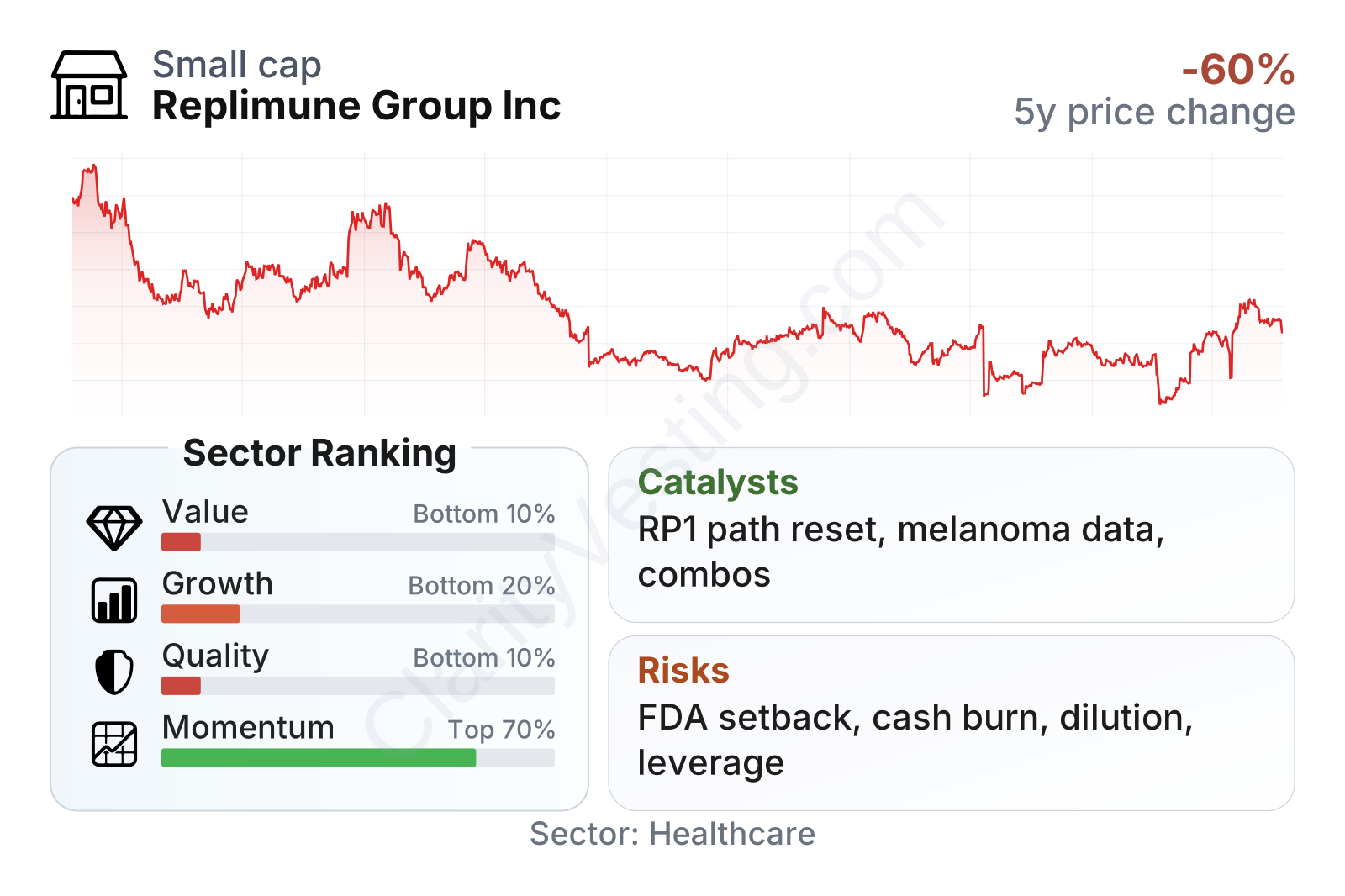
Replimune is a small-cap biotech with stock behavior that reflects binary clinical outcomes rather than steady business momentum. The share price has been extremely volatile over the past few years, including a deep collapse followed by a sharp rebound in 2026. That kind of move usually signals that the market is rapidly reassessing either the probability of success of the pipeline or the company’s financing outlook.
On the factor table, the weakest areas are value, quality, and growth relative to the broader healthcare sector. That is typical for a pre-revenue biotech, but Replimune sits particularly low because it has no meaningful revenue, deeply negative returns on capital, and large cash outflows. Momentum is stronger than most of its sector after the recent rebound, but that says more about changing sentiment than about an already proven business model.
The balance sheet and income statement also need to be read in context. Traditional measures such as earnings, profit margin, or price-to-earnings are not very useful here because there is no commercial engine yet. More relevant signals are cash consumption, leverage trends, and whether the company has enough financial flexibility to reach major clinical readouts.
Growth
Replimune operates in a part of healthcare that continues to attract major long-term interest: cancer immunotherapy. Oncology remains one of the largest and most active areas in drug development, and treatments that can improve response rates or work well in combination with checkpoint inhibitors still represent an important commercial opportunity. In that sense, the company is clearly in a growing sector.
Its strategy also has a logical foundation. Rather than trying to compete as a broad pharmaceutical company, Replimune is focused on a specialized platform using engineered herpes simplex virus-based therapies. The thesis is that these agents can both attack tumors locally and stimulate a broader immune response. If that mechanism translates into durable clinical benefit, the platform could potentially support more than one indication and more than one product candidate.
The main growth catalyst is not current revenue expansion but clinical conversion into commercial potential. Replimune’s lead asset, RP1, has been studied in combination with Bristol Myers Squibb’s Opdivo in advanced melanoma and other tumor types. Positive late-stage development progress, regulatory acceptance, or eventual approval would be the step that could transform the company from a research organization into a commercial oncology company.
Another favorable point is that the company is working in indications where there is an existing treatment framework. That can make physician adoption easier if clinical data are strong enough, especially when a new therapy is positioned as an add-on or enhancer to widely used immuno-oncology drugs rather than a complete replacement for current standards.
At the same time, the cash profile shows how demanding this strategy is. Free cash flow has become increasingly negative over the last several years, moving from already sizable deficits to much larger annual cash outflows by 2026. That trend is common during late-stage biotech development, but it means growth is currently being purchased through cash burn rather than funded by customers.
Recent corporate developments are especially important here. In 2026, the company reported a complete response letter from the U.S. Food and Drug Administration for the biologics license application related to RP1 in advanced melanoma. Management has said the issue was linked to the confirmatory trial not being considered adequate and well-controlled, rather than a manufacturing or safety deficiency. This is a major event because it delayed the clearest near-term route to commercialization in the United States. Even so, the market later reacted strongly to updates around the company’s plans and broader pipeline direction, which helps explain the sharp stock rebound after an earlier collapse.
So the long-term growth case still exists, but it is now more dependent on the company’s ability to redesign the path forward, generate additional convincing data, and preserve enough capital to reach the next key milestones.
Risks
This article is for informational purposes only and does not constitute financial advice. Some content is AI-generated. See Disclaimer


