Stock Analysis · Regeneron Pharmaceuticals Inc (REGN)
Overview
Regeneron Pharmaceuticals is a large biotechnology company focused on discovering, developing, and commercializing medicines. Its business is centered on biologic drugs, especially antibody-based treatments, used in areas such as eye disease, cancer, inflammation, respiratory disease, and rare disorders. Regeneron also earns revenue by partnering with larger pharmaceutical companies that help fund development, manufacturing, and commercialization in certain markets.
The company’s revenue base is fairly concentrated, but broader than a single-product biotech. Based on its latest annual reporting and recent quarterly trends, the main sources of revenue are approximately:
- EYLEA and EYLEA HD sales in the U.S.: roughly 40% to 45% of total revenue. These are treatments for retinal diseases such as wet age-related macular degeneration and diabetic eye disease.
- Dupixent profit share and collaboration revenue: roughly 20% to 25%. Regeneron co-develops Dupixent with Sanofi and records its share of profits and certain collaboration payments. Dupixent is used across several inflammatory diseases including atopic dermatitis, asthma, COPD, and other immune-related conditions.
- Libtayo revenue and collaboration-related amounts: roughly 10% to 15%. This includes cancer immunotherapy revenue, with Regeneron sharing economics with Sanofi in some markets.
- Product sales from other marketed medicines: roughly 10% to 15%. This includes medicines such as Praluent and a group of rarer or more specialized therapies.
- Collaboration, licensing, and other revenue: roughly 10% to 15%. This comes from research alliances, technology licensing, and milestone-related payments.
One important feature of Regeneron’s model is that it combines a profitable commercial business with a heavy research engine. Over the last several years, revenue has remained in the low-to-mid teens of billions of dollars, while research spending has climbed meaningfully. That mix can pressure near-term earnings, but it also shows that management is trying to turn today’s cash-generating medicines into a larger future product base.
The long-term pattern is clear: gross profit remains very strong, while research and development has expanded sharply. That suggests the company is using a large share of current earnings to build its next generation of medicines rather than simply maximizing short-term profit.
Key Figures
| Metric | Value | Sector ⓘ |
|---|---|---|
| Date | Oct 24, 2026 | |
| Context | ||
| Sector | Healthcare | |
| Industry | Biotechnology | |
| Market Cap ⓘ | $82.95B | |
| Beta ⓘ | 0.15 | |
Value (Cheapness) | ||
| P/E Ratio ⓘ | 19.92 | 25.42 |
| P/B Ratio ⓘ | 2.76 | 3.08 |
| FCF Yield ⓘ | 4.25% | 3.12% |
| Dividend Yield ⓘ | 0.45% | 1.85% |
| EBIT / EV ⓘ | 6.76% | 0.56% |
| PEG ⓘ | 1.32 | |
Growth (Business expansion) | ||
| Revenue Growth ⓘ | 16.70% | 7.50% |
| RPS Growth (5Y CAGR) ⓘ | -2.01% | 8.60% |
| EPS Growth (5Y CAGR) ⓘ | -17.36% | -17.73% |
| BVPS Growth (5Y CAGR) ⓘ | 14.53% | 3.72% |
| Margin Growth (5Y Trend) ⓘ | -21.61% | -0.57% |
| FCF Growth (5Y CAGR) ⓘ | -11.09% | 0.96% |
| DPS Growth (5Y CAGR) ⓘ | -2.55% | 6.69% |
Quality (Business durability) | ||
| ROIC (Latest) ⓘ | 13.13% | 3.17% |
| ROA (Latest) ⓘ | 10.57% | 2.98% |
| ROIC (5Y Median) ⓘ | 25.46% | 4.56% |
| ROA (5Y Median) ⓘ | 12.69% | 1.87% |
| Net Debt / EBIT (Latest) ⓘ | -0.09 | 1.34 |
| Net Debt / EBIT (5Y Median) ⓘ | -0.02 | 1.86 |
| Net Debt / EBITDA (Latest) ⓘ | -0.08 | 1.00 |
| Net Debt / Assets ⓘ | -1.12% | 5.06% |
| EBITDA / Interest ⓘ | 103.79 | 9.55 |
| Operating Margin (Latest) ⓘ | 33.61% | 9.25% |
| Operating Margin (5Y Median) ⓘ | 36.77% | 7.33% |
| Debt to Equity (Latest) ⓘ | 6.26% | 26.68% |
| Profit Margin (Latest) ⓘ | 27.87% | 3.34% |
| Free Cash Flow (Latest) ⓘ | $3.52B | |
Momentum (Price trend) | ||
| 3Y Return ⓘ | +3.93% | +51.61% |
| 12M Return (excl. last month) ⓘ | +35.65% | +19.90% |
| 6M Return ⓘ | +10.00% | +10.10% |
| Price vs. 200-Day MA ⓘ | +11.48% | +6.44% |
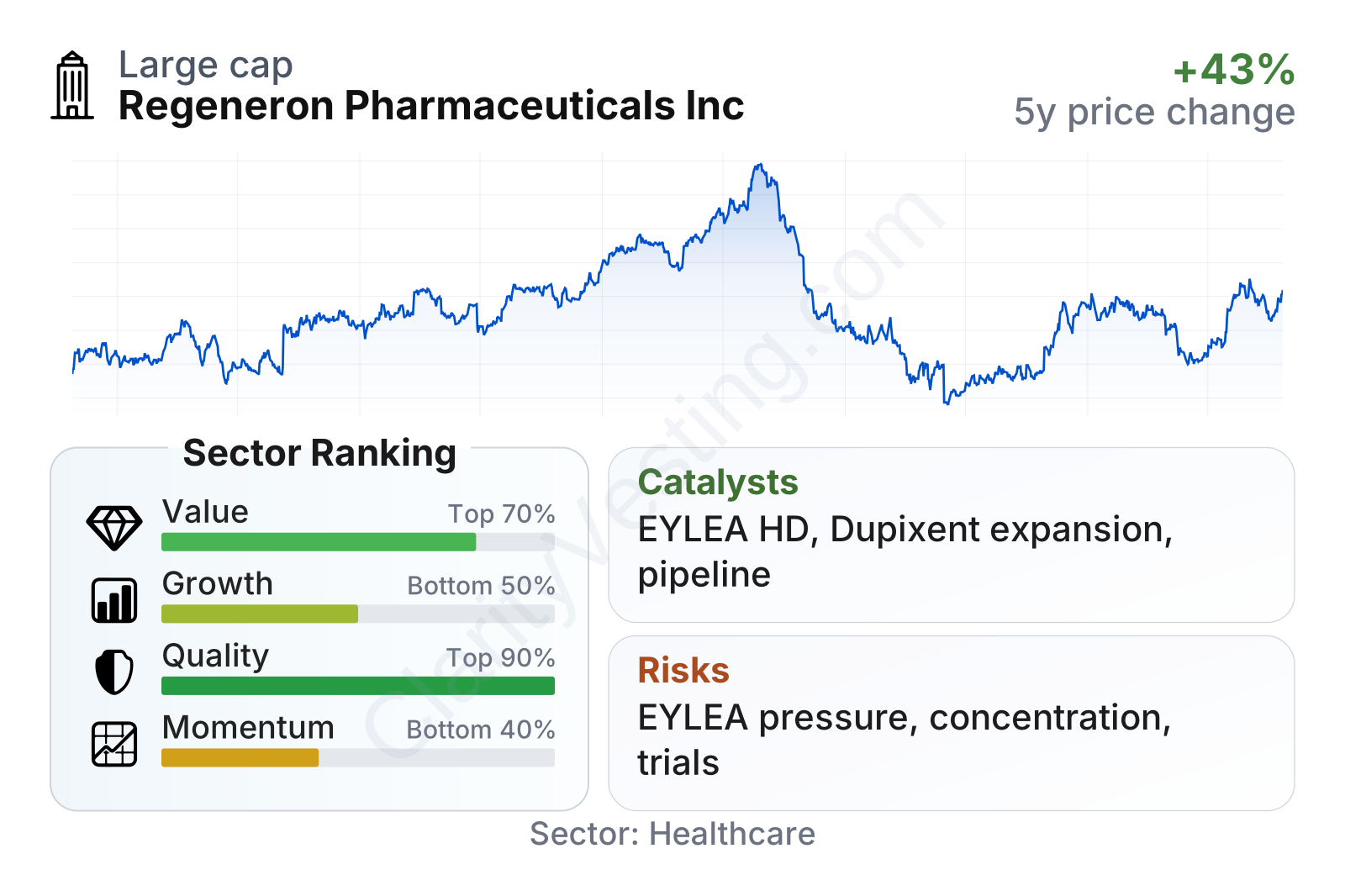
Regeneron stands out for business quality rather than headline excitement. Profitability remains far above the biotechnology sector median, returns on capital are strong, and the balance sheet is unusually conservative for a drug developer. Debt is low, cash generation is solid, and the company’s low beta points to a share price that has historically moved less than the broader market. On the other hand, growth metrics are more mixed: recent revenue growth has improved, but five-year trends still reflect pressure from product concentration, pricing shifts, and heavier research spending.
The stock’s trading history also shows that the market has repeatedly re-rated the company. After a strong run through 2024, the shares corrected sharply in 2025 and then partially recovered in 2026. That pattern suggests sentiment around product transitions, especially in eye care, has been a major driver of valuation.
Growth
Regeneron operates in one of the most attractive parts of healthcare: biologic medicines for serious chronic diseases. This is a sector supported by aging populations, rising diagnosis rates, broader use of specialty drugs, and continued scientific progress in immunology and oncology. Demand is not tied closely to the economic cycle, which gives large biotech companies a more durable backdrop than many industries.
The company’s growth strategy makes industrial sense. It is not trying to rely only on one blockbuster. Instead, it is expanding established products, adding new indications, and funding a broad clinical pipeline. Dupixent is a major example of this approach. Rather than being limited to one disease, it has expanded across multiple inflammatory conditions and has become one of the most valuable assets connected to Regeneron. In oncology, Libtayo and the company’s broader antibody platform add another potential leg of growth, even if that business is still smaller than eye care and immunology.
Recent revenue growth has re-accelerated into the mid-to-high teens on a year-over-year basis, which is notably stronger than the sector median. That matters because it suggests the business is moving past a slower phase and seeing better momentum from its commercial portfolio. Even so, the longer-term picture is less smooth, which is why the market continues to watch whether newer products and line extensions can offset maturity in older franchises.
Free cash flow remains substantial, in the multi-billion-dollar range even after large research investments. That gives Regeneron unusual flexibility: it can keep funding clinical programs, support manufacturing, pursue partnerships, and still preserve a very strong financial position. Few biotech companies combine this level of profitability with this level of reinvestment capacity.
A key catalyst is the company’s effort to defend and upgrade its retinal franchise through EYLEA HD, a higher-dose version designed to improve durability and help maintain leadership in a very competitive market. Another important driver is continued Dupixent expansion into additional patient groups and new uses. Regeneron has also highlighted broad pipeline opportunities in oncology, immunology, hematology, and obesity-related research, which could become more material over time if clinical results are favorable.
Recent company updates have also pointed to continued regulatory and clinical progress across multiple programs. For long-term analysis, the main significance is not any single announcement, but the fact that Regeneron has several meaningful shots on goal at once rather than depending on one binary event.
Risks
This article is for informational purposes only and does not constitute financial advice. Some content is AI-generated. See Disclaimer


