Stock Analysis · Regency Centers Corporation (REG)
Overview
Regency Centers Corporation is a retail real estate investment trust, or REIT. In simple terms, it owns shopping centers and earns money mainly by leasing space to stores, restaurants, and service businesses. The company focuses heavily on grocery-anchored centers, meaning many of its properties are built around supermarkets that help bring regular traffic. That matters because grocery visits are recurring and tend to be more resilient than many discretionary retail categories.
Its portfolio is concentrated in suburban trade areas with higher household income and dense populations. Regency also has a smaller business in mixed-use and development projects, where it invests in new or redeveloped properties to increase rent potential and property value over time. Like most equity REITs, it must distribute a large share of taxable income, so the business is typically judged on occupancy, rent spreads, redevelopment returns, balance sheet strength, and dividend capacity rather than on manufacturing-style metrics.
The company’s revenue is driven primarily by property operations. Based on recent annual reporting structure, the main sources are approximately:
- Base rent and fixed lease revenue: about 70% to 75%. This is the recurring rent paid by tenants for occupying store space.
- Recoveries and other property income: about 15% to 20%. This usually includes reimbursements for common area maintenance, real estate taxes, insurance, and other property-related charges.
- Percentage rent, lease termination fees, parking and ancillary income: about 2% to 5%. These items are smaller and can vary from year to year.
- Management, transaction, and development-related income: usually a low-single-source contributor relative to total revenue. This reflects the company’s investment and development activity rather than its core rent engine.
Over the last several years, the business has shown a generally favorable pattern of rising revenue and operating income. Interest expense has also moved higher, which is normal in a capital-intensive real estate model, but profitability has remained solid overall.
Key Figures
| Metric | Value | Sector ⓘ |
|---|---|---|
| Date | Oct 17, 2026 | |
| Context | ||
| Sector | Real Estate | |
| Industry | REIT - Retail | |
| Market Cap ⓘ | $13.66B | |
| Beta ⓘ | 0.82 | |
Value (Cheapness) | ||
| P/E Ratio ⓘ | 24.59 | 17.38 |
| P/B Ratio ⓘ | 1.95 | 0.85 |
| FCF Yield ⓘ | 3.79% | 7.38% |
| Dividend Yield ⓘ | 4.14% | 4.85% |
| EBIT / EV ⓘ | 4.07% | 3.78% |
| PEG ⓘ | 2.70 | |
Growth (Business expansion) | ||
| Revenue Growth ⓘ | 8.90% | 5.30% |
| RPS Growth (5Y CAGR) ⓘ | 4.86% | 6.02% |
| EPS Growth (5Y CAGR) ⓘ | -2.77% | -11.37% |
| BVPS Growth (5Y CAGR) ⓘ | 1.02% | 0.45% |
| Margin Growth (5Y Trend) ⓘ | 6.09% | -0.22% |
| FCF Growth (5Y CAGR) ⓘ | -0.17% | 5.40% |
| DPS Growth (5Y CAGR) ⓘ | 5.11% | 5.02% |
Quality (Business durability) | ||
| ROIC (Latest) ⓘ | N/A | 5.69% |
| ROE (Latest) ⓘ | 9.82% | 7.56% |
| ROA (Latest) ⓘ | 5.03% | 2.85% |
| ROIC (5Y Median) ⓘ | 5.09% | 4.22% |
| ROE (5Y Median) ⓘ | 6.05% | 6.03% |
| ROA (5Y Median) ⓘ | 3.33% | 2.44% |
| Net Debt / EBIT (Latest) ⓘ | 6.90 | 7.59 |
| Net Debt / EBIT (5Y Median) ⓘ | 8.57 | 8.40 |
| Net Debt / EBITDA (Latest) ⓘ | 4.49 | 5.27 |
| Net Debt / Assets ⓘ | 40.37% | 37.76% |
| EBITDA / Interest ⓘ | 5.45 | 4.10 |
| Operating Margin (Latest) ⓘ | 44.58% | 35.29% |
| Operating Margin (5Y Median) ⓘ | 40.78% | 37.31% |
| Debt to Equity (Latest) ⓘ | 79.84% | 88.87% |
| Profit Margin (Latest) ⓘ | 33.00% | 19.61% |
| Free Cash Flow (Latest) ⓘ | $516.97M | |
Momentum (Price trend) | ||
| 3Y Return ⓘ | +38.24% | +30.75% |
| 12M Return (excl. last month) ⓘ | +8.64% | +4.36% |
| 6M Return ⓘ | -6.34% | -2.52% |
| Price vs. 200-Day MA ⓘ | -2.88% | -2.34% |
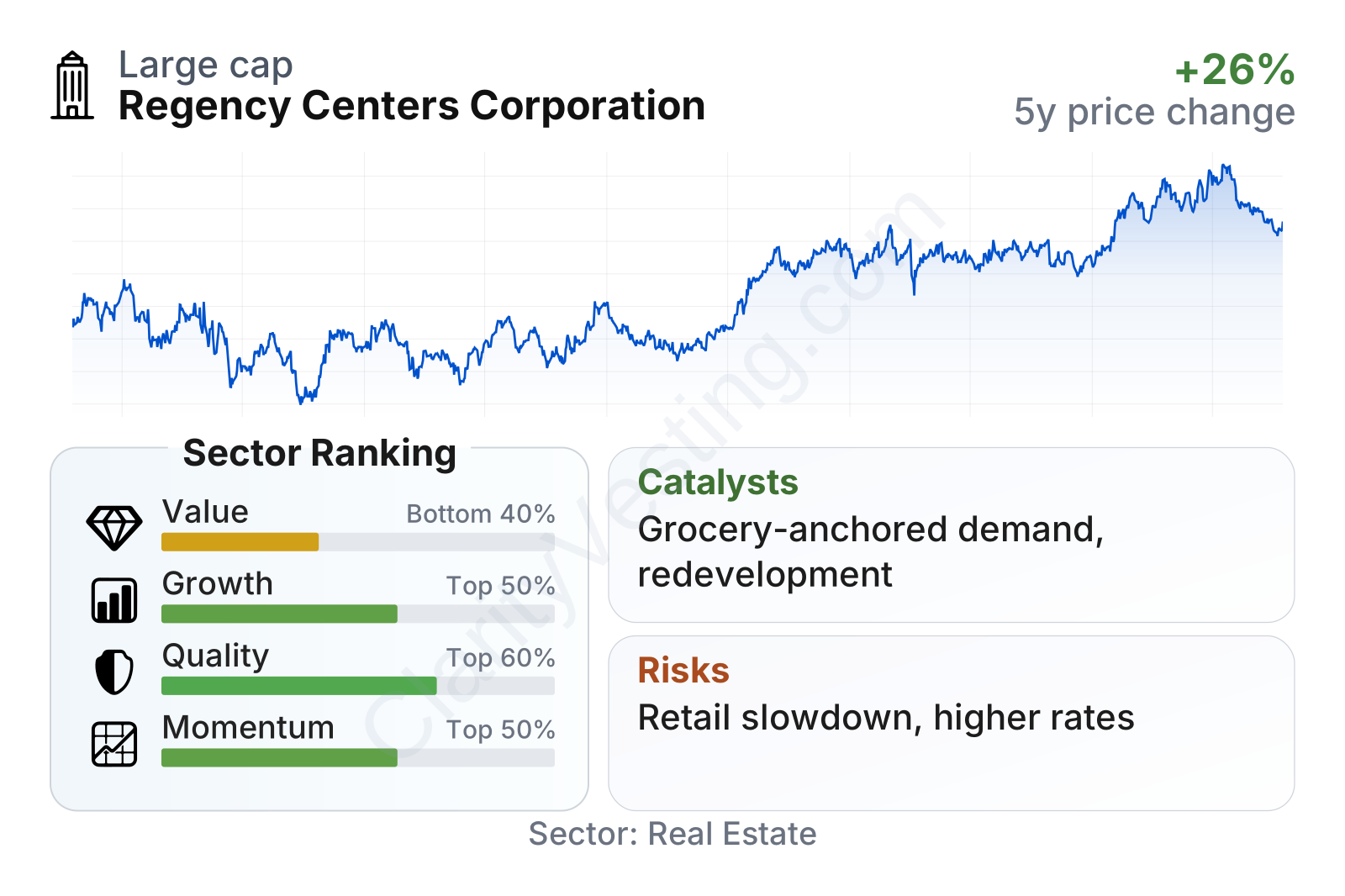
Regency Centers is a large retail REIT with a stock that has been less volatile than the broader market, as reflected by a beta below 1. The factor picture is fairly clear: quality is the strongest area, while value and recent momentum look less compelling. Profitability stands above many peers, with returns on assets and equity ahead of sector medians and operating margin also comfortably stronger than the typical retail REIT. Growth is more mixed. Recent year-over-year revenue growth has been better than the sector median, but longer-term free cash flow growth has been soft. On valuation, the shares trade at higher P/E and P/B multiples than many peers, which suggests the market is paying up for stability, asset quality, and execution.
Growth
Regency Centers operates in a part of commercial real estate that has held up better than many people expected. Open-air shopping centers anchored by grocery stores, pharmacies, restaurants, fitness operators, and neighborhood services have remained relevant because many of those visits are difficult to replace fully online. That does not make the sector risk-free, but it does provide a more durable demand base than malls or highly discretionary retail formats.
The company’s strategy is consistent with that theme. It focuses on necessity-based centers in affluent and supply-constrained markets, which can support occupancy and rent growth over time. This positioning also helps Regency attract national retailers that want predictable traffic and strong household spending nearby. In a market where weaker retail properties can struggle, higher-quality neighborhood centers may continue to capture leasing demand.
Revenue per share has climbed steadily over the last five years, which is an encouraging sign because it shows growth even after accounting for the share count. The pace has not been explosive, but it has been consistent, and consistency is especially important in REITs where compounding often comes from rent increases, redevelopment, and disciplined capital allocation rather than sudden jumps in sales.
Another favorable element is redevelopment and selective development. Regency has long used this playbook to upgrade centers, add mixed-use components in some locations, and improve the tenant mix. These projects can create a second layer of growth beyond simple annual rent increases. If construction costs and leasing conditions remain manageable, this pipeline can support net operating income growth over time.
Dividend growth has also been steady, with dividends per share trending upward at roughly a mid-single-digit annual pace over the last five years. For a REIT, that usually signals management confidence in recurring cash generation. The current yield is not among the highest in the sector, but the pattern suggests Regency has prioritized sustainability and gradual increases rather than stretching for a larger payout.
A key catalyst in the current environment is the possibility that high-quality retail landlords continue gaining pricing power as new shopping center supply remains limited in many markets. If tenant demand stays healthy and Regency keeps occupancy and rent spreads strong, internal growth could remain solid. Another support is its strong property profile, which can make it easier to retain and attract tenants even if the broader economy slows.
Risks
This article is for informational purposes only and does not constitute financial advice. Some content is AI-generated. See Disclaimer


