Stock Analysis · Reece Limited (REECF)
Overview
Reece Limited is a plumbing, waterworks, and HVAC-R distributor. In simple terms, it supplies the pipes, fittings, fixtures, valves, tools, and related products used in residential housing, commercial buildings, civil infrastructure, and maintenance work. The group operates mainly in Australia, New Zealand, and the United States, with a branch-based distribution model supported by trade-focused customer relationships and a growing digital offering.
The business earns most of its revenue from selling products to professional contractors, builders, and infrastructure customers rather than from manufacturing. Based on recent company reporting, revenue is concentrated in two main geographic segments.
- United States: about 58% of group revenue. This mainly includes plumbing, HVAC, and waterworks distribution through the MORSCO platform and related brands, serving residential, commercial, and municipal end markets.
- Australia and New Zealand: about 42% of group revenue. This includes plumbing supplies, bathroom and kitchen products, civil and irrigation products, pools, and heating/cooling distribution across the Reece branch network.
That mix matters because it gives Reece exposure to both mature repair-and-maintenance demand and cyclical new construction activity. It also means the company is not dependent on one single product category. Over the last several years, sales have generally trended upward, but profitability has come under pressure more recently as operating costs have risen faster than revenue.
Revenue has continued to expand to the high single-digit billions over the last five fiscal years, and gross profit has also increased. The weaker point is that selling and administrative costs have absorbed a larger share of sales, which has pushed operating income and net income below their recent peaks even as revenue reached a new high.
Key Figures
| Metric | Value | Sector ⓘ |
|---|---|---|
| Date | Oct 24, 2026 | |
| Context | ||
| Sector | Industrials | |
| Industry | Industrial Distribution | |
| Market Cap ⓘ | $6.03B | |
| Beta ⓘ | 1.04 | |
Value (Cheapness) | ||
| P/E Ratio ⓘ | 35.00 | 22.29 |
| P/B Ratio ⓘ | 1.61 | 1.98 |
| FCF Yield ⓘ | N/A | 6.26% |
| Dividend Yield ⓘ | 1.92% | 1.92% |
| EBIT / EV ⓘ | 6.11% | 4.83% |
| PEG ⓘ | N/A | |
Growth (Business expansion) | ||
| Revenue Growth ⓘ | 3.40% | 9.30% |
| RPS Growth (5Y CAGR) ⓘ | 6.51% | 7.76% |
| EPS Growth (5Y CAGR) ⓘ | -6.02% | -13.17% |
| BVPS Growth (5Y CAGR) ⓘ | 4.34% | 6.13% |
| Margin Growth (5Y Trend) ⓘ | -1.89% | 0.74% |
| FCF Growth (5Y CAGR) ⓘ | 115.87% | 10.79% |
| DPS Growth (5Y CAGR) ⓘ | -2.12% | 9.41% |
Quality (Business durability) | ||
| ROIC (Latest) ⓘ | N/A | 10.75% |
| ROA (Latest) ⓘ | N/A | 5.41% |
| ROIC (5Y Median) ⓘ | 8.10% | 9.37% |
| ROA (5Y Median) ⓘ | 5.73% | 4.95% |
| Net Debt / EBIT (Latest) ⓘ | N/A | 2.04 |
| Net Debt / EBIT (5Y Median) ⓘ | 1.16 | 2.27 |
| Net Debt / EBITDA (Latest) ⓘ | N/A | 1.39 |
| Net Debt / Assets ⓘ | 9.69% | 19.27% |
| EBITDA / Interest ⓘ | N/A | 9.58 |
| Operating Margin (Latest) ⓘ | N/A | 10.49% |
| Operating Margin (5Y Median) ⓘ | 6.37% | 10.30% |
| Debt to Equity (Latest) ⓘ | N/A | 64.82% |
| Profit Margin (Latest) ⓘ | 3.29% | 6.67% |
| Free Cash Flow (Latest) ⓘ | N/A | |
Momentum (Price trend) | ||
| 3Y Return ⓘ | -13.94% | +67.77% |
| 12M Return (excl. last month) ⓘ | +25.67% | +12.05% |
| 6M Return ⓘ | +39.36% | 0.00% |
| Price vs. 200-Day MA ⓘ | +15.20% | +0.67% |
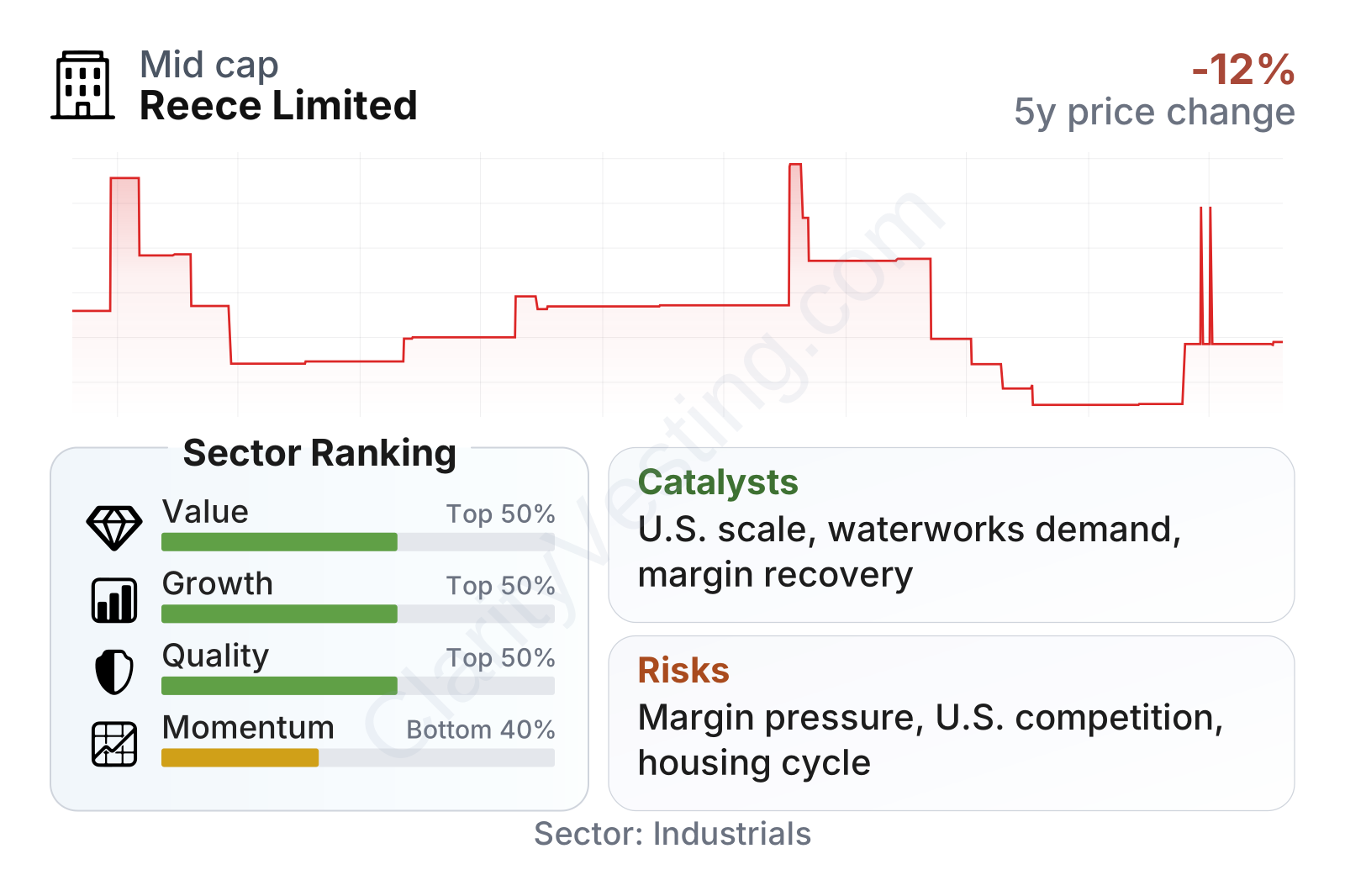
Reece sits in the mid-cap range, with share-price volatility close to the broader market. The stock has staged a sharp rebound over the last 6 to 12 months after a weak multiyear stretch, which helps explain why recent momentum looks stronger than the longer-term record.
On valuation, the picture is mixed. The earnings multiple is above the sector median, while the price-to-book ratio is below it. The business also shows a stronger EBIT-to-enterprise-value yield than the sector median, which suggests the shares are not uniformly expensive across every measure.
Growth metrics are also uneven. Recent yearly revenue growth has been positive but slower than the sector median, and five-year revenue-per-share growth is solid rather than exceptional. Earnings per share over five years compare better than many peers in a difficult sector backdrop, but margin trends have weakened. One notable positive is cash generation: free cash flow growth over five years has been very strong, even if recent profit margins remain modest.
Balance-sheet quality looks relatively sound. Net debt appears moderate compared with sector norms, and net debt as a share of assets is lower than the median. That gives the company some financial flexibility, although profitability measures such as operating margin and net margin are below many peers.
Growth
Reece operates in a sector with durable long-term demand drivers. Plumbing, water infrastructure, and HVAC systems are essential rather than optional. Even when housing construction slows, repair, replacement, and maintenance work usually continue. Over time, population growth, aging water systems, energy-efficiency upgrades, and stricter building standards can all support demand for the products Reece distributes.
The company’s strategy also has a reasonable long-term logic. Distribution scale matters in this industry because customers value product availability, local branch coverage, delivery speed, and technical support. Reece has been building its U.S. presence since the MORSCO acquisition while defending a strong position in Australia and New Zealand. If management can improve branch productivity and cost control, the existing footprint offers room for operating leverage.
A meaningful catalyst is the company’s exposure to non-discretionary infrastructure and maintenance spending. Waterworks demand in particular can benefit from public investment in municipal systems, while HVAC and plumbing replacement can remain active even in softer construction environments. Another support is that revenue reached a fresh high in fiscal 2026, showing that end-market demand has not collapsed despite pressure on margins.
Recent company reporting points to continued investment in branch network capability, customer service, and digital tools. None of that guarantees faster earnings growth on its own, but it fits the economics of distribution: better availability, logistics, and account management can strengthen customer retention and raise share in local markets over time.
Risks
This article is for informational purposes only and does not constitute financial advice. Some content is AI-generated. See Disclaimer


