Stock Analysis · Redwire Corp (RDW)
Overview
Redwire Corp is a space infrastructure and aerospace company focused on technologies used in orbit and beyond. Its activities include satellite components, onboard avionics, space sensors, deployable structures such as solar arrays, digital engineering software, mission payloads, and in-space manufacturing. In simple terms, Redwire sells the building blocks and specialized systems that governments and commercial customers use to design, launch, operate, and expand space missions.
The company’s customer base is still heavily tied to government-funded space activity, especially civil and national security programs, but it also serves private space companies. Recent corporate developments have pushed Redwire toward a broader platform model, combining hardware, software, and mission solutions rather than just selling individual parts.
Based on the company’s most recent annual disclosures and segment reporting, revenue is primarily generated from two operating segments.
- Space Infrastructure: approximately 70% to 80% of revenue. This segment includes deployable structures, power systems, avionics, mission hardware, and other core space systems used on satellites, stations, and exploration missions.
- Mission Solutions: approximately 20% to 30% of revenue. This area includes sensors, payloads, modeling and digital engineering, mission design support, and technologies tied to in-space servicing, robotics, and specialized mission applications.
Within that mix, a large share of sales comes from U.S. government programs, including NASA and defense-related customers, with commercial business representing a smaller but strategically important layer. The business model is therefore not based on mass consumer demand; it depends more on winning contracts, delivering technically demanding systems, and staying embedded in long-duration space programs.
One visible trend over the last several years is that revenue has climbed meaningfully, but costs and operating expenses have remained heavy. Gross profit improved in 2023 before weakening again later, showing that Redwire’s challenge is no longer only to grow sales, but to translate that growth into steadier margins.
The financial flow shows a company that has expanded revenue substantially since 2021, but profitability has not followed the same path. Selling, general, and administrative costs became much heavier in 2025, and interest expense also increased, which helps explain why rising revenue alone has not yet produced durable earnings.
Key Figures
| Metric | Value | Sector ⓘ |
|---|---|---|
| Date | Oct 17, 2026 | |
| Context | ||
| Sector | Industrials | |
| Industry | Aerospace & Defense | |
| Market Cap ⓘ | $2.29B | |
| Beta ⓘ | 3.13 | |
Value (Cheapness) | ||
| P/E Ratio ⓘ | N/A | 22.10 |
| P/B Ratio ⓘ | 1.17 | 1.97 |
| FCF Yield ⓘ | -4.49% | 6.38% |
| Dividend Yield ⓘ | N/A | 1.94% |
| EBIT / EV ⓘ | -9.29% | 4.79% |
| PEG ⓘ | N/A | |
Growth (Business expansion) | ||
| Revenue Growth ⓘ | 89.60% | 9.30% |
| RPS Growth (5Y CAGR) ⓘ | 6.33% | 7.81% |
| EPS Growth (5Y CAGR) ⓘ | -45.48% | -13.06% |
| BVPS Growth (5Y CAGR) ⓘ | 50.90% | 6.14% |
| Margin Growth (5Y Trend) ⓘ | N/A | 0.88% |
| FCF Growth (5Y CAGR) ⓘ | N/A | 11.01% |
| DPS Growth (5Y CAGR) ⓘ | N/A | 9.48% |
Quality (Business durability) | ||
| ROIC (Latest) ⓘ | -13.27% | 10.84% |
| ROA (Latest) ⓘ | -14.40% | 5.41% |
| ROIC (5Y Median) ⓘ | -28.24% | 9.38% |
| ROA (5Y Median) ⓘ | -29.41% | 4.95% |
| Net Debt / EBIT (Latest) ⓘ | N/A | 2.08 |
| Net Debt / EBIT (5Y Median) ⓘ | N/A | 2.27 |
| Net Debt / EBITDA (Latest) ⓘ | N/A | 1.39 |
| Net Debt / Assets ⓘ | -24.22% | 19.28% |
| EBITDA / Interest ⓘ | N/A | 9.58 |
| Operating Margin (Latest) ⓘ | -51.19% | 10.50% |
| Operating Margin (5Y Median) ⓘ | -29.02% | 10.29% |
| Debt to Equity (Latest) ⓘ | 5.34% | 65.48% |
| Profit Margin (Latest) ⓘ | -57.26% | 6.67% |
| Free Cash Flow (Latest) ⓘ | -$102.82M | |
Momentum (Price trend) | ||
| 3Y Return ⓘ | +224.06% | +61.68% |
| 12M Return (excl. last month) ⓘ | +20.71% | +12.58% |
| 6M Return ⓘ | -12.13% | 0.00% |
| Price vs. 200-Day MA ⓘ | -22.65% | +0.02% |
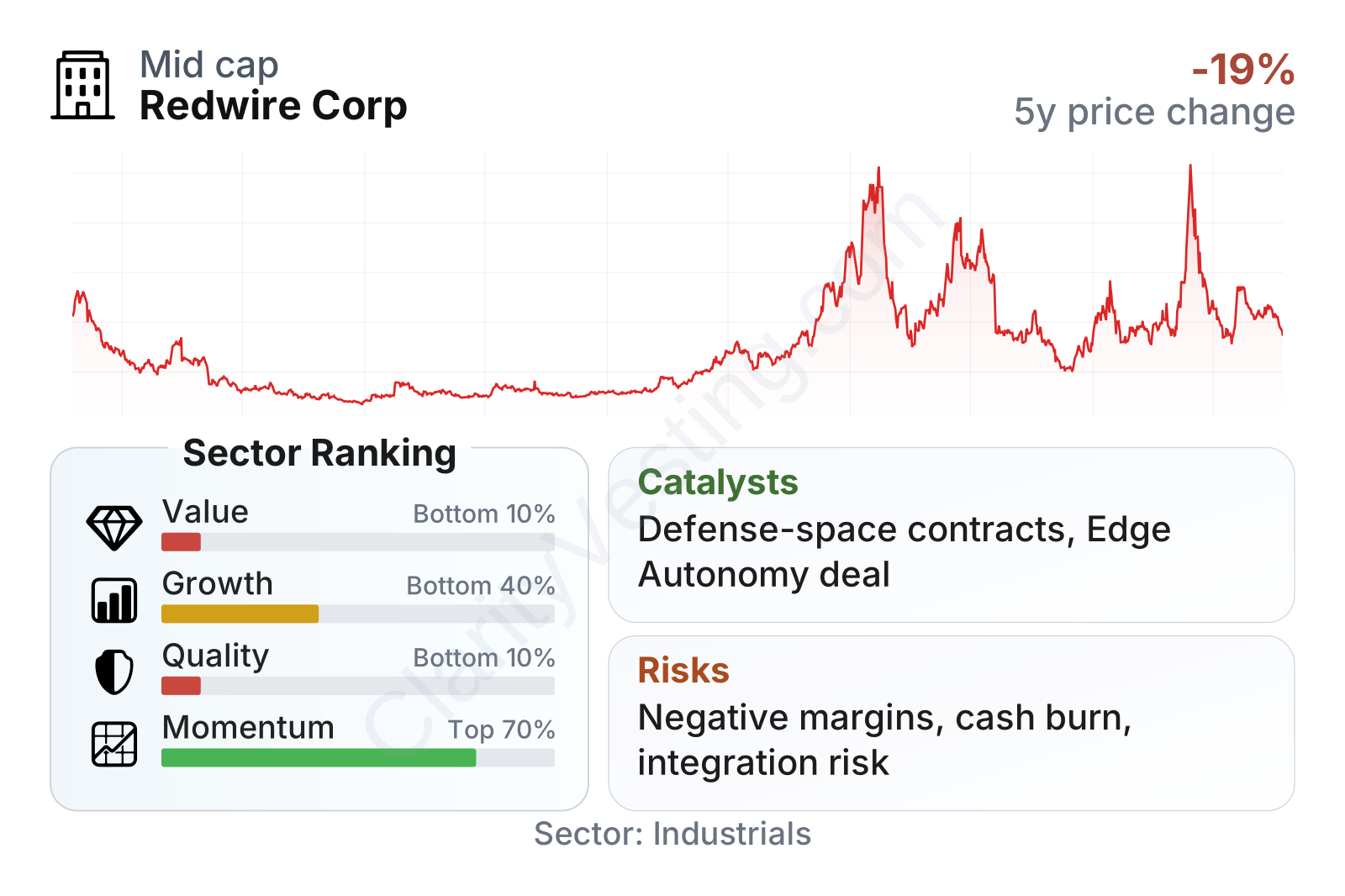
Redwire is a mid-sized aerospace and defense company with unusually high share-price volatility, reflected in a beta above 3. Market performance has been strong over the last three years compared with much of the sector, but the fundamental profile remains mixed. Growth has recently accelerated well above the industry median, while quality and valuation metrics still rank near the bottom of the sector because profitability and free cash flow remain negative. In other words, the market has rewarded the expansion potential, but the core financial engine is still under construction.
Growth
Redwire operates in a sector with favorable long-term demand drivers. Space spending is being supported by several trends at once: more satellite deployments, rising national security demand, lunar and deep-space programs, and increasing interest in commercial orbital infrastructure. These are multi-year themes rather than short-lived cycles, which is important for a company whose projects often run across long development timelines.
The company’s strategy also makes industrial sense. Instead of trying to become a launch provider or a consumer-facing space brand, Redwire has positioned itself in the less visible but essential layers of the value chain: components, subsystems, mission hardware, and specialized services. That can create repeat business because customers often prefer flight-proven suppliers once a system is qualified for space use.
Revenue growth has been strong but uneven. After a softer patch in 2025, growth reaccelerated sharply into 2026, far above the sector median. That suggests Redwire is benefiting from contract timing, program ramp-ups, and a broader business base. The challenge is that this kind of growth can be lumpy, since large aerospace and space awards do not convert into revenue in a smooth line every quarter.
Recent company announcements point to several meaningful opportunities. Redwire has continued to deepen its role in national security space, civil space programs, and orbital infrastructure. The pending combination with Edge Autonomy is particularly notable because it would expand Redwire beyond space hardware into autonomous airborne systems, creating a broader defense technology platform with more scale, more customer access, and potentially better resilience across budget cycles. The company has also highlighted momentum in areas such as proliferated satellite architectures, advanced sensors, and in-space manufacturing, all of which fit major industry spending priorities.
Cash generation remains the weak point in the growth case. Free cash flow has moved deeper into negative territory over time, especially in the most recent period shown. That does not automatically invalidate the expansion plan, since aerospace businesses often consume cash while scaling programs, but it does mean growth is not yet self-funding. For long-term analysis, the key issue is whether current contract wins eventually convert into stronger margins and cash collection rather than just bigger revenue.
Risks
This article is for informational purposes only and does not constitute financial advice. Some content is AI-generated. See Disclaimer


