Stock Analysis · RadNet Inc (RDNT)
Overview
RadNet is a healthcare services company focused on outpatient diagnostic imaging. In simple terms, it operates imaging centers where patients receive scans such as MRI, CT, PET, mammography, ultrasound, and X-ray. The company also has a fast-growing technology arm tied to radiology software and artificial intelligence tools, including products that help detect disease, improve workflow, and support screening programs. Its footprint across major U.S. markets gives it scale in a part of healthcare that benefits from recurring medical demand rather than one-time product sales.
The business is mainly built around two revenue streams. Based on recent company reporting, the imaging-center network remains the core source of sales, while digital health and software are still smaller but strategically important.
- Imaging services and related operations: approximately 90% to 95% of revenue. This includes routine and advanced outpatient scans, breast health services, and payments tied to imaging procedures performed in owned or operated centers.
- Digital health and artificial intelligence solutions: approximately 5% to 10% of revenue. This includes radiology software, AI-based clinical tools, and technology platforms serving providers, health systems, and screening programs.
That mix matters because the legacy imaging business brings scale and steady patient volume, while the software segment offers a path to higher-value growth if adoption expands. Revenue has moved higher over the last several years, but the earnings picture has been much less smooth because costs, interest expense, and investment spending have taken a meaningful share of that growth.
The financial flow shows a clear pattern: sales have expanded strongly over time, but a large cost base and rising financing costs have limited how much of that growth reaches the bottom line. Operating income has stayed positive, yet net income has been very thin and recently negative, which highlights the importance of execution and margin improvement.
Key Figures
| Metric | Value | Sector ⓘ |
|---|---|---|
| Date | Oct 03, 2026 | |
| Context | ||
| Sector | Healthcare | |
| Industry | Diagnostics & Research | |
| Market Cap ⓘ | $5.43B | |
| Beta ⓘ | 1.40 | |
Value (Cheapness) | ||
| P/E Ratio ⓘ | N/A | 24.06 |
| P/B Ratio ⓘ | 6.68 | 3.08 |
| FCF Yield ⓘ | -1.08% | 3.07% |
| Dividend Yield ⓘ | N/A | 2.05% |
| EBIT / EV ⓘ | 1.46% | 0.63% |
| PEG ⓘ | 0.96 | |
Growth (Business expansion) | ||
| Revenue Growth ⓘ | 25.00% | 7.50% |
| RPS Growth (5Y CAGR) ⓘ | 2.46% | 8.70% |
| EPS Growth (5Y CAGR) ⓘ | -55.03% | -18.20% |
| BVPS Growth (5Y CAGR) ⓘ | 51.32% | 3.95% |
| Margin Growth (5Y Trend) ⓘ | -3.20% | -0.58% |
| FCF Growth (5Y CAGR) ⓘ | N/A | 0.88% |
| DPS Growth (5Y CAGR) ⓘ | 61.88% | 6.80% |
Quality (Business durability) | ||
| ROIC (Latest) ⓘ | 2.98% | 3.29% |
| ROA (Latest) ⓘ | -0.54% | 3.02% |
| ROIC (5Y Median) ⓘ | 6.39% | 4.75% |
| ROA (5Y Median) ⓘ | 0.12% | 1.93% |
| Net Debt / EBIT (Latest) ⓘ | 13.70 | 1.33 |
| Net Debt / EBIT (5Y Median) ⓘ | 11.12 | 1.83 |
| Net Debt / EBITDA (Latest) ⓘ | 4.32 | 0.99 |
| Net Debt / Assets ⓘ | 34.46% | 5.33% |
| EBITDA / Interest ⓘ | 4.73 | 9.63 |
| Operating Margin (Latest) ⓘ | 4.68% | 9.25% |
| Operating Margin (5Y Median) ⓘ | 6.56% | 7.80% |
| Debt to Equity (Latest) ⓘ | 199.14% | 28.99% |
| Profit Margin (Latest) ⓘ | -0.93% | 3.60% |
| Free Cash Flow (Latest) ⓘ | -$58.45M | |
Momentum (Price trend) | ||
| 3Y Return ⓘ | +140.84% | +37.48% |
| 12M Return (excl. last month) ⓘ | +5.24% | +20.85% |
| 6M Return ⓘ | +22.40% | +9.73% |
| Price vs. 200-Day MA ⓘ | +3.37% | +4.69% |
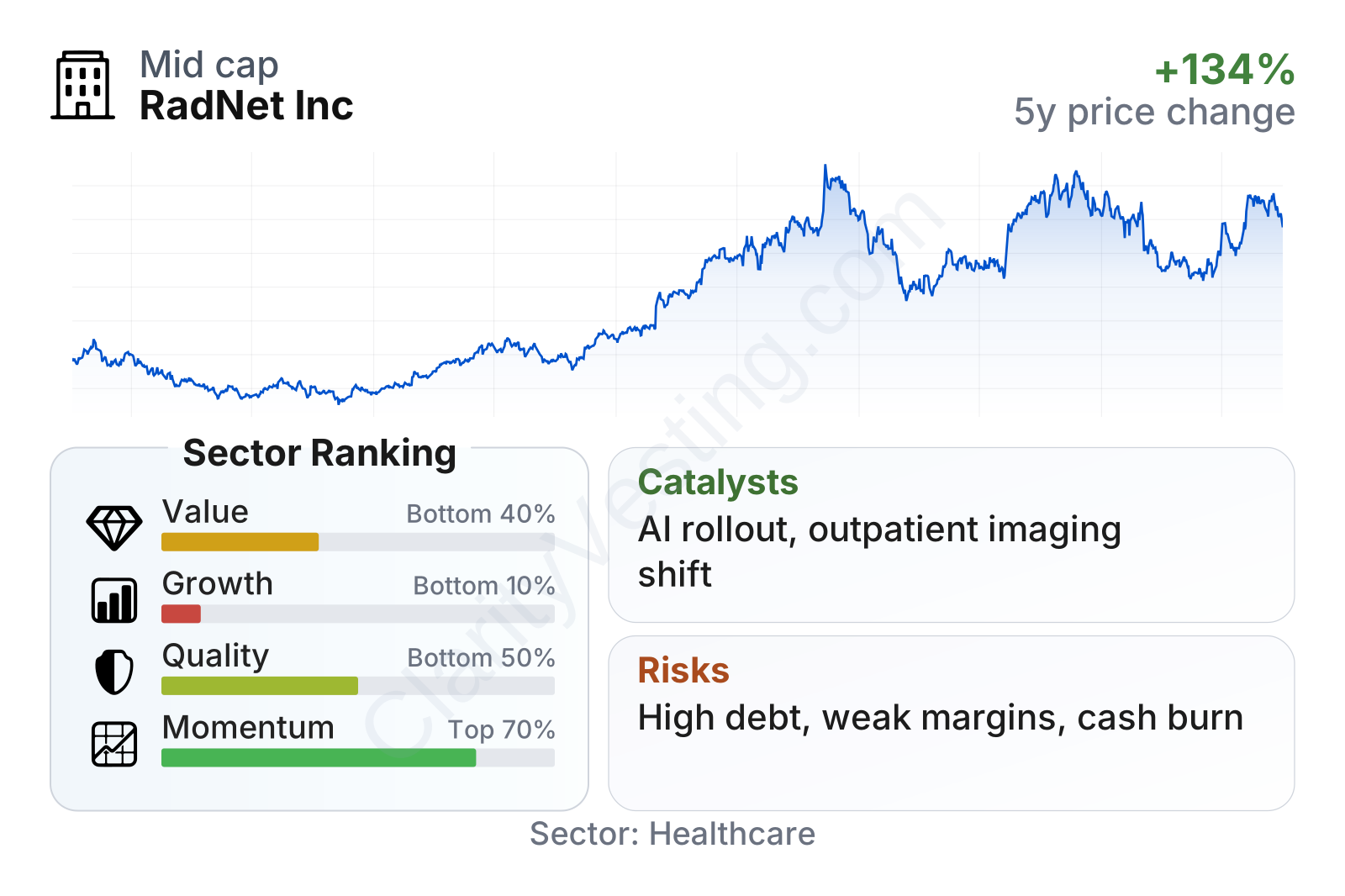
RadNet is now a mid-sized healthcare company with above-average share-price volatility, reflected in a beta above 1.0. The market performance over three years has been strong, but the underlying fundamentals are more mixed. Revenue growth has recently been much faster than the sector median, while profitability, free cash flow, and balance-sheet leverage rank weaker. Valuation metrics also send mixed signals: the PEG ratio looks moderate, but price-to-book is elevated and free-cash-flow yield is currently negative.
Growth
RadNet operates in a healthcare niche with durable long-term demand. Medical imaging benefits from an aging population, wider use of early detection, ongoing cancer screening, and the shift from hospital settings toward lower-cost outpatient care. Those trends support procedure volume over time, especially in dense urban markets where the company already has a meaningful presence.
The company’s strategy also has a clear industrial logic. Its imaging-center network can produce recurring patient traffic, payer relationships, and local physician referral patterns. On top of that installed base, RadNet is building software and AI products that can be sold more broadly. That combination is important: the physical network creates real-world clinical data and workflow access, while the technology arm creates a possible second engine of growth that is not limited to opening more centers.
Recent growth has accelerated. Year-over-year revenue gains were already healthy for several quarters and then moved into a much faster range in 2026, clearly above the healthcare sector median. That suggests the company is benefiting from a combination of acquisitions, center expansion, technology contribution, or stronger utilization, rather than simply growing in line with the broader industry.
The weaker point is cash conversion. Free cash flow has been volatile, moving from negative territory to positive and then back down sharply. That pattern often appears in businesses that are still spending heavily on expansion, equipment, or integration. For a company in imaging, that is not surprising because scanners, center build-outs, and software development require capital. Still, long-term growth becomes more convincing when revenue gains start turning into steadier cash generation.
A meaningful catalyst is the broader commercialization of AI tools in radiology and breast health. RadNet has been investing in this area through its digital health operations, and the opportunity is larger than its current revenue contribution. If these products gain wider use with hospitals, physicians, and screening programs, they could gradually improve the business mix toward offerings with better margins than traditional imaging services alone.
Another notable opportunity is healthcare’s continued push toward cost efficiency. Insurers and health systems often prefer outpatient settings over hospital-based imaging when quality is comparable and costs are lower. RadNet is well positioned to benefit from that trend because outpatient imaging is the center of its business model.
Risks
This article is for informational purposes only and does not constitute financial advice. Some content is AI-generated. See Disclaimer