Stock Analysis · Radian Group Inc (RDN)
Overview
Radian Group Inc is a specialty financial services company best known for mortgage insurance in the United States. Its core business helps lenders reduce the risk of loss when homebuyers make relatively small down payments. In practical terms, Radian stands between mortgage lenders and potential credit losses, which makes it closely tied to the health of the housing market, mortgage origination volumes, and the credit quality of insured borrowers.
The company reports through two main segments: Mortgage Insurance and Homegenius. Mortgage Insurance is by far the dominant business and includes the insurance premiums and related income generated from insuring residential mortgage loans. Homegenius is a smaller technology and real estate services platform that supports parts of the mortgage and real estate workflow, including title, valuation, asset management, and closing-related services.
Based on recent company reporting, revenue is heavily concentrated in the insurance operation.
- Mortgage Insurance: approximately 90% to 95% of total revenue. This includes primary mortgage insurance premiums, investment income linked to the insurance business, and other mortgage-insurance-related activities.
- Homegenius and other services: approximately 5% to 10% of total revenue. This includes real estate, title, valuation, and technology-enabled services that are meant to broaden Radian’s role across the housing finance ecosystem.
The broader earnings profile shows a business with strong margins for a financial company. Revenue has stayed around the same general range over the last several years, while operating expenses have come down meaningfully, especially in 2025. Net income has remained solid even as revenue has fluctuated, which suggests disciplined cost control and a business model that can stay profitable through different housing conditions.
Key Figures
| Metric | Value | Sector ⓘ |
|---|---|---|
| Date | Oct 24, 2026 | |
| Context | ||
| Sector | Financial Services | |
| Industry | Insurance - Specialty | |
| Market Cap ⓘ | $4.50B | |
| Beta ⓘ | 0.71 | |
Value (Cheapness) | ||
| P/E Ratio ⓘ | 8.56 | 12.46 |
| P/B Ratio ⓘ | 0.98 | 1.25 |
| FCF Yield ⓘ | 37.26% | 9.82% |
| Dividend Yield ⓘ | 2.94% | 2.94% |
| EBIT / EV ⓘ | 13.78% | 8.11% |
| PEG ⓘ | 0.76 | |
Growth (Business expansion) | ||
| Revenue Growth ⓘ | 93.50% | 9.10% |
| RPS Growth (5Y CAGR) ⓘ | 6.65% | 12.31% |
| EPS Growth (5Y CAGR) ⓘ | -17.57% | -6.97% |
| BVPS Growth (5Y CAGR) ⓘ | 2.63% | 5.02% |
| Margin Growth (5Y Trend) ⓘ | 2.54% | -4.00% |
| FCF Growth (5Y CAGR) ⓘ | -32.11% | 4.71% |
| DPS Growth (5Y CAGR) ⓘ | 18.07% | 8.92% |
Quality (Business durability) | ||
| ROIC (Latest) ⓘ | 10.18% | 9.18% |
| ROE (Latest) ⓘ | 11.34% | 13.93% |
| ROA (Latest) ⓘ | 5.69% | 1.57% |
| ROIC (5Y Median) ⓘ | 10.66% | 7.80% |
| ROE (5Y Median) ⓘ | 13.40% | 12.15% |
| ROA (5Y Median) ⓘ | 7.61% | 1.28% |
| Net Debt / EBIT (Latest) ⓘ | 1.42 | 1.02 |
| Net Debt / EBIT (5Y Median) ⓘ | 1.66 | 0.72 |
| Net Debt / EBITDA (Latest) ⓘ | 1.39 | 0.88 |
| Operating Margin (Latest) ⓘ | 47.44% | 22.30% |
| Operating Margin (5Y Median) ⓘ | 66.44% | 24.50% |
| Debt to Equity (Latest) ⓘ | 25.62% | 59.34% |
| Profit Margin (Latest) ⓘ | 32.51% | 26.42% |
| Free Cash Flow (Latest) ⓘ | $1.67B | |
Momentum (Price trend) | ||
| 3Y Return ⓘ | +52.78% | +95.73% |
| 12M Return (excl. last month) ⓘ | -2.03% | +17.30% |
| 6M Return ⓘ | -1.04% | +6.07% |
| Price vs. 200-Day MA ⓘ | -0.31% | +5.36% |
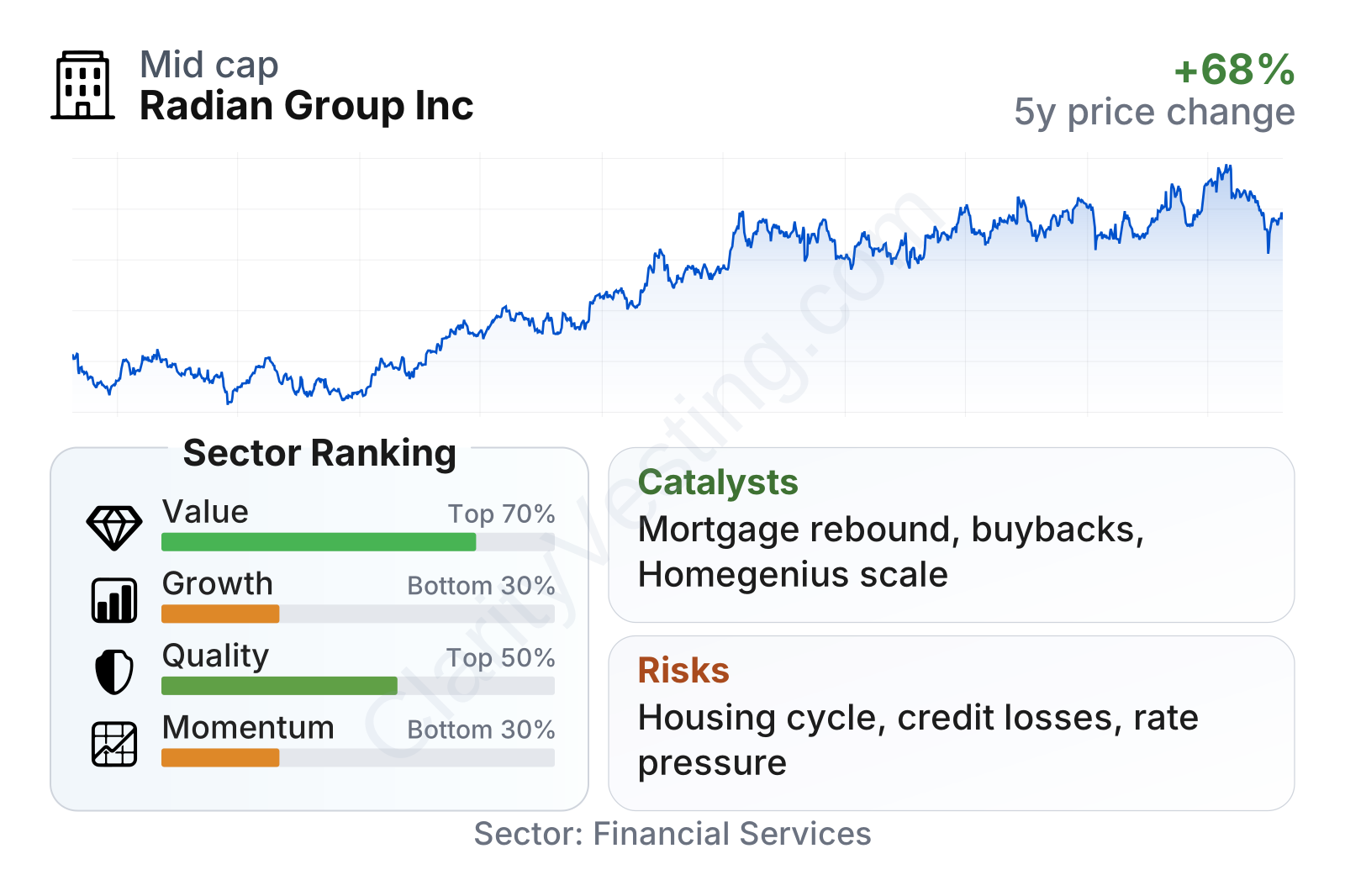
Radian is a mid-sized financial company with a market value of roughly $4 billion and a stock that has shown lower volatility than the broader market, as reflected by a beta below 1. The valuation profile stands out: earnings and book-value multiples are below the sector median, while free cash flow yield and operating profitability are notably stronger than many peers. At the same time, the company’s growth ranking is weaker, and recent share-price momentum has trailed the sector, which helps explain why the market is not assigning it a richer multiple.
The stock price trend has still been positive over the last several years, rising from the high teens in late 2021 to the upper $30s in mid-2026. That shows the market has recognized Radian’s resilience, even if enthusiasm has been more restrained than for faster-growing financial names.
Growth
Radian operates in a sector with long-term relevance rather than rapid structural expansion. Mortgage insurance is tied to homeownership, credit availability, and housing turnover. Those are durable needs, but they are cyclical. When interest rates are high and housing affordability is stretched, mortgage origination volumes can slow. When rates ease or housing activity improves, insurers like Radian can benefit from stronger new business production.
The company’s strategy for growth is sensible because it combines a mature cash-generating insurance franchise with selective expansion into adjacent housing and mortgage services. That approach can deepen customer relationships and reduce reliance on one revenue stream over time, although the newer service businesses are still much smaller than the core insurance operation.
A meaningful catalyst is the possibility of improving mortgage activity if financing conditions become more favorable. Radian’s core franchise is positioned to benefit if purchase originations recover, especially among borrowers using lower down payments, where private mortgage insurance is most relevant. Another supportive factor is the company’s continued capital return framework, which can steadily lift per-share results when paired with stable profitability.
Earnings per share have been solid but not steadily rising. Results jumped in 2022, then moderated, and have remained in a healthy range since. That pattern fits the nature of the business: profitability can be strong, but it is not a straight-line growth model. Over a five-year view, the company’s EPS growth record is weaker than the sector median, so future upside depends more on underwriting discipline, housing-market recovery, and capital allocation than on rapid revenue expansion alone.
Book value per share has improved meaningfully since 2022 and reached the mid-$30s by 2025. For an insurer, that matters because book value is a simple way to track the accumulation of shareholder capital over time. The trend points to a company that has continued to rebuild and compound underlying value, even without standout top-line growth. Recent company communications have also highlighted ongoing execution around capital management and the development of the Homegenius platform, which remains a smaller but potentially useful long-term opportunity if it reaches better scale.
Risks
This article is for informational purposes only and does not constitute financial advice. Some content is AI-generated. See Disclaimer


