Stock Analysis · Arcus Biosciences Inc (RCUS)
Overview
Arcus Biosciences is a clinical-stage biotechnology company focused on cancer treatment. Its business is built around discovering and developing immuno-oncology medicines, often in combination with other therapies, with the goal of helping the immune system recognize and attack tumors more effectively. The company does not yet rely on broad commercial product sales as a mature pharmaceutical company would. Instead, its economic model is still centered on partnership-related payments, research collaborations, and the long-term potential of its drug pipeline.
Arcus has several drug candidates in development across areas such as TIGIT, adenosine pathway biology, and antibody-based cancer combinations. A major part of the company’s strategy has been to share development costs and expand clinical reach through large partners, most notably Gilead. That structure matters because it gives Arcus outside funding and validation, but it also means reported revenue can be uneven from year to year depending on milestones, collaboration accounting, and program timing.
The main revenue sources are currently concentrated in collaboration and license-related activities rather than recurring product demand.
- Collaboration revenue and license revenue: approximately 100% of recent revenue. This includes upfront payments recognized over time, development support, milestone-related amounts when earned, and cost-sharing or co-development arrangements tied to partners.
- Product revenue: 0% at this stage. Arcus remains primarily a development-stage biotechnology company without a large, established marketed product base.
That concentration is important for long-term analysis: Arcus is being evaluated mainly on pipeline value, clinical execution, and partnership economics rather than on stable current sales.
The business has shown very high gross profit relative to revenue because collaboration revenue carries low direct production cost, but operating losses have widened as research spending expanded. Research and development has become the dominant use of cash, which is typical for a company pushing multiple oncology programs forward at the same time.
Key Figures
| Metric | Value | Sector ⓘ |
|---|---|---|
| Date | Oct 24, 2026 | |
| Context | ||
| Sector | Healthcare | |
| Industry | Biotechnology | |
| Market Cap ⓘ | $2.43B | |
| Beta ⓘ | 0.94 | |
Value (Cheapness) | ||
| P/E Ratio ⓘ | N/A | 25.42 |
| P/B Ratio ⓘ | 5.26 | 3.08 |
| FCF Yield ⓘ | -19.53% | 3.12% |
| Dividend Yield ⓘ | N/A | 1.85% |
| EBIT / EV ⓘ | -15.47% | 0.56% |
| PEG ⓘ | N/A | |
Growth (Business expansion) | ||
| Revenue Growth ⓘ | -74.40% | 7.50% |
| RPS Growth (5Y CAGR) ⓘ | -18.36% | 8.60% |
| EPS Growth (5Y CAGR) ⓘ | -18.35% | -17.73% |
| BVPS Growth (5Y CAGR) ⓘ | -15.23% | 3.72% |
| Margin Growth (5Y Trend) ⓘ | N/A | -0.57% |
| FCF Growth (5Y CAGR) ⓘ | N/A | 0.96% |
| DPS Growth (5Y CAGR) ⓘ | N/A | 6.69% |
Quality (Business durability) | ||
| ROIC (Latest) ⓘ | -54.57% | 3.17% |
| ROA (Latest) ⓘ | -47.63% | 2.98% |
| ROIC (5Y Median) ⓘ | -41.68% | 4.56% |
| ROA (5Y Median) ⓘ | -25.16% | 1.87% |
| Net Debt / EBIT (Latest) ⓘ | N/A | 1.34 |
| Net Debt / EBIT (5Y Median) ⓘ | N/A | 1.86 |
| Net Debt / EBITDA (Latest) ⓘ | N/A | 1.00 |
| Net Debt / Assets ⓘ | -3.90% | 5.06% |
| EBITDA / Interest ⓘ | N/A | 9.55 |
| Operating Margin (Latest) ⓘ | -366.67% | 9.25% |
| Operating Margin (5Y Median) ⓘ | -139.68% | 7.33% |
| Debt to Equity (Latest) ⓘ | 24.57% | 26.68% |
| Profit Margin (Latest) ⓘ | N/A | 3.34% |
| Free Cash Flow (Latest) ⓘ | -$475.00M | |
Momentum (Price trend) | ||
| 3Y Return ⓘ | +19.65% | +51.61% |
| 12M Return (excl. last month) ⓘ | +114.62% | +19.90% |
| 6M Return ⓘ | -27.27% | +10.10% |
| Price vs. 200-Day MA ⓘ | -21.90% | +6.44% |
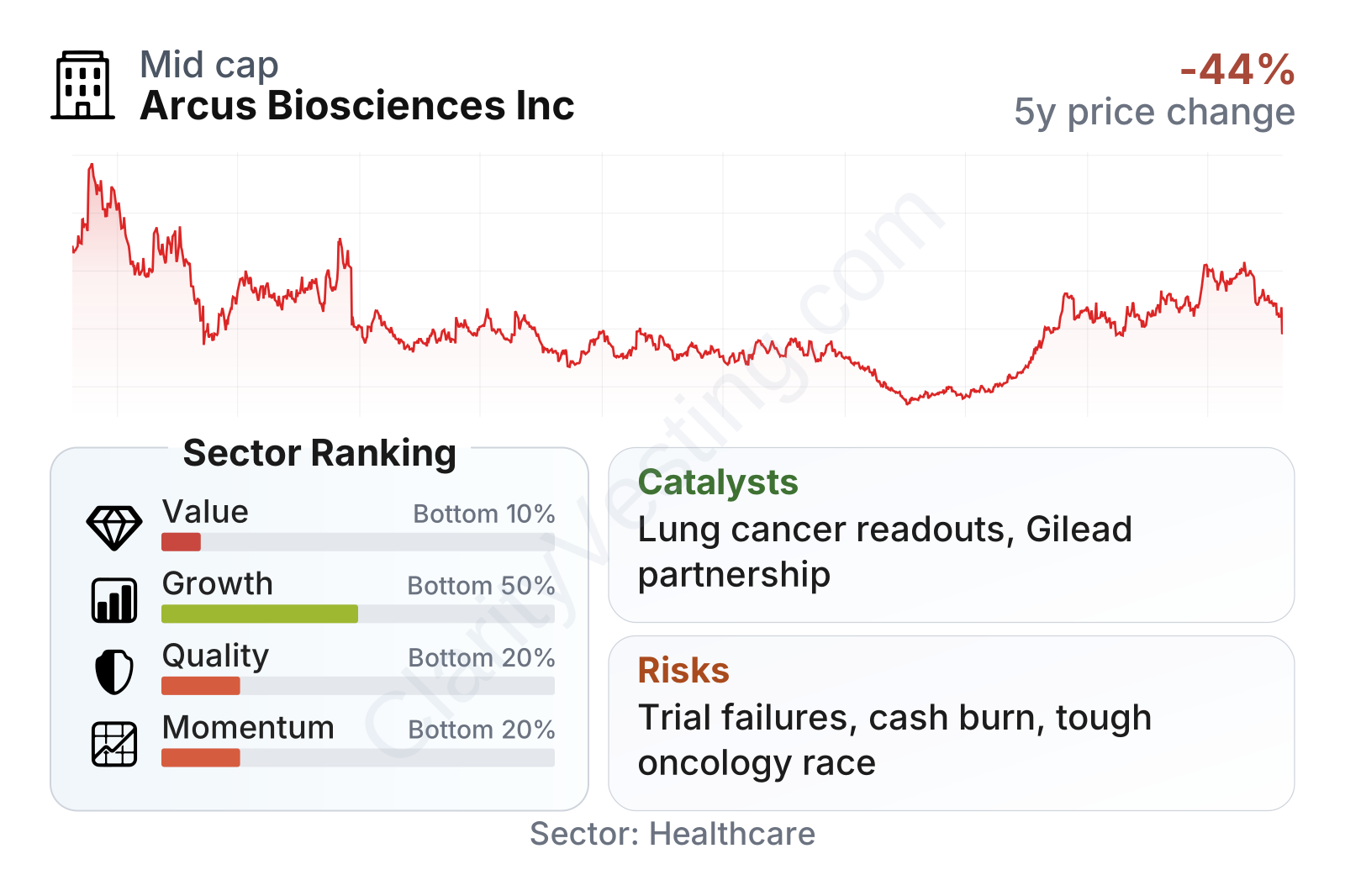
Arcus sits in the biotechnology segment where current earnings often understate future potential, but the present financial profile is clearly weak on traditional measures. Relative to the healthcare sector, the company ranks poorly on value, quality, and growth metrics, mainly because profitability is deeply negative and free cash flow remains heavily negative. The brighter area is market momentum: the stock has recovered strongly over the last year and over three years has held up somewhat better than the sector median, suggesting that the market has recently become more optimistic about upcoming pipeline outcomes.
Arcus is still a mid-sized biotech by market value, with a beta below 1.0, which means its broad market sensitivity has been somewhat lower than many growth stocks. That said, company-specific biotech volatility remains substantial because clinical updates and partnership events can drive sharp share-price moves.
Growth
The company operates in one of the most important long-term areas of healthcare: oncology. Cancer remains a large and growing treatment market, and immunotherapy continues to attract major research spending across the industry. Within that field, Arcus is trying to build combinations that could matter in large solid tumor settings. If even one major late-stage program succeeds commercially, the difference between today’s financial profile and a future one could be significant.
Arcus’s strategy broadly makes sense for a clinical-stage biotech. It has focused on large unmet-need cancer indications, built several assets instead of relying on a single molecule, and partnered with a large pharmaceutical company to reduce funding pressure and strengthen development capabilities. That approach can increase optionality: success in one program can support others, while collaboration can provide both cash and external scientific validation.
Revenue growth, however, is not smooth. Recent year-over-year comparisons have been extremely volatile, including sharp declines, because the revenue base depends on collaboration accounting and milestone timing rather than steady product demand. That makes short-term revenue trends less useful than pipeline progress when assessing Arcus.
Cash generation is still firmly negative, and the trend has become more demanding as the company invested more aggressively in development. Free cash flow has moved deeper into negative territory over time, which means future growth depends not only on scientific progress but also on maintaining enough capital to fund trials until meaningful milestones or commercialization arrive.
Recent company updates in 2026 have kept attention on Arcus’s clinical pipeline and partner-supported programs. For a company at this stage, the strongest catalysts are not small operational improvements but major development events: late-stage trial readouts, regulatory progress, and any signs that key assets could move closer to approval or larger commercial partnerships. In Arcus’s case, progress in its lung cancer and broader immuno-oncology programs stands out as the main source of upside potential.
Risks
This article is for informational purposes only and does not constitute financial advice. Some content is AI-generated. See Disclaimer


