Stock Analysis · Robertet SA (RBTEF)
Overview
Robertet SA is a French specialty ingredients company focused on products that give foods, perfumes, and personal care items their smell, taste, and active botanical properties. Its core expertise is natural raw materials: flowers, plants, fruits, spices, and other botanical sources that are transformed into fragrances, flavor solutions, and active ingredients. The group operates globally, but it is still closely associated with Grasse, France, a historic center of perfumery.
Its business is generally organized around three main revenue streams:
- Fragrances, about 40% to 45% of revenue: perfume compositions for fine fragrance, personal care, household products, and air care.
- Flavors, about 35% to 40% of revenue: taste solutions for beverages, dairy, confectionery, savory products, and other food applications.
- Raw materials and naturals, about 15% to 20% of revenue: essential oils, absolutes, botanical extracts, and natural ingredients sold both internally and to external customers. This segment is strategically important because it supports vertical integration and supply security.
That mix matters because Robertet is not only a formulator selling finished scent and taste creations; it also has upstream access to natural ingredients. This makes the company more distinctive than many chemical businesses and gives it exposure to the ongoing shift toward natural, traceable, and plant-based inputs.
Over the last several years, revenue has moved from a little above €600 million to above €800 million, while gross profit and operating income have also expanded. The broad pattern suggests a business that has grown without taking on excessive leverage, even if yearly margins can move around with raw material costs and integration spending.
The long-term picture is favorable: sales and profit have trended upward from 2021 through 2024, with gross profit rising faster than revenue over that period. That points to a business with improving value capture, although 2025 line items appear unusual in places and are best treated cautiously until confirmed against the company’s published annual statements.
Key Figures
| Metric | Value | Sector ⓘ |
|---|---|---|
| Date | Oct 17, 2026 | |
| Context | ||
| Sector | Basic Materials | |
| Industry | Chemicals | |
| Market Cap ⓘ | $1.81B | |
| Beta ⓘ | 0.37 | |
Value (Cheapness) | ||
| P/E Ratio ⓘ | 16.60 | 16.90 |
| P/B Ratio ⓘ | 2.57 | 1.65 |
| FCF Yield ⓘ | 7.27% | 5.76% |
| Dividend Yield ⓘ | 1.39% | 2.13% |
| EBIT / EV ⓘ | N/A | 6.30% |
| PEG ⓘ | N/A | |
Growth (Business expansion) | ||
| Revenue Growth ⓘ | -0.50% | 11.10% |
| RPS Growth (5Y CAGR) ⓘ | 10.38% | 4.49% |
| EPS Growth (5Y CAGR) ⓘ | -10.72% | -13.47% |
| BVPS Growth (5Y CAGR) ⓘ | 4.16% | 5.51% |
| Margin Growth (5Y Trend) ⓘ | 0.92% | -1.54% |
| FCF Growth (5Y CAGR) ⓘ | 1.06% | 0.37% |
| DPS Growth (5Y CAGR) ⓘ | 14.62% | 6.08% |
Quality (Business durability) | ||
| ROIC (Latest) ⓘ | N/A | 9.26% |
| ROA (Latest) ⓘ | 18.77% | 4.91% |
| ROIC (5Y Median) ⓘ | 11.91% | 7.70% |
| ROA (5Y Median) ⓘ | 9.33% | 3.86% |
| Net Debt / EBIT (Latest) ⓘ | 0.96 | 1.40 |
| Net Debt / EBIT (5Y Median) ⓘ | 0.88 | 1.70 |
| Net Debt / EBITDA (Latest) ⓘ | 0.66 | 0.95 |
| Net Debt / Assets ⓘ | 11.15% | 13.69% |
| EBITDA / Interest ⓘ | 7.41 | 12.34 |
| Operating Margin (Latest) ⓘ | 7.44% | 13.20% |
| Operating Margin (5Y Median) ⓘ | 15.44% | 11.80% |
| Debt to Equity (Latest) ⓘ | 39.67% | 40.56% |
| Profit Margin (Latest) ⓘ | 11.77% | 6.43% |
| Free Cash Flow (Latest) ⓘ | $131.51M | |
Momentum (Price trend) | ||
| 3Y Return ⓘ | +2.51% | +68.89% |
| 12M Return (excl. last month) ⓘ | -1.61% | +30.21% |
| 6M Return ⓘ | -14.15% | -4.16% |
| Price vs. 200-Day MA ⓘ | -9.59% | -1.27% |
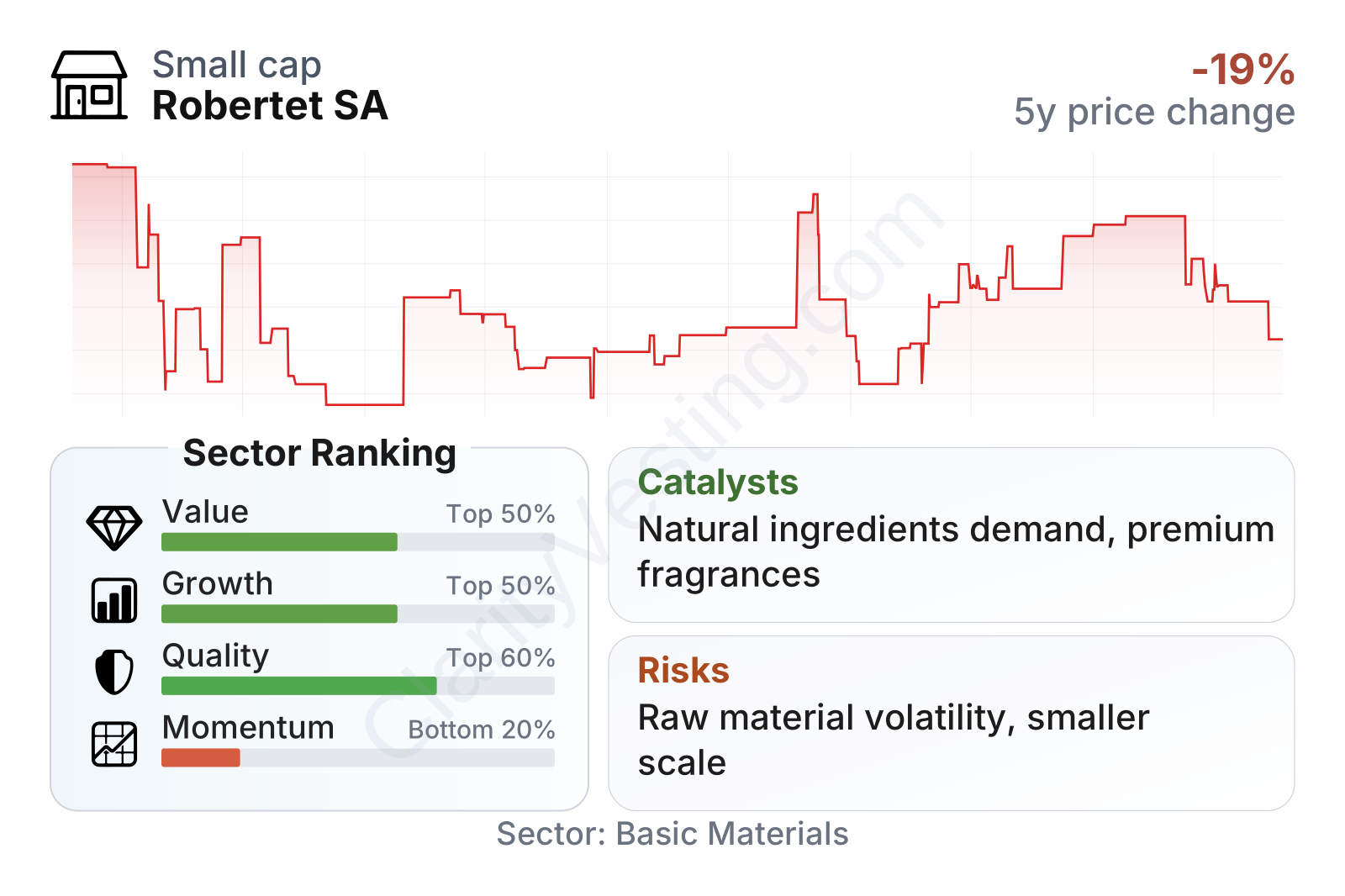
Robertet sits in the mid-cap range and has shown unusually low share-price volatility, with a beta well below 1. On valuation, the earnings multiple is close to the sector median, while the price-to-book ratio is somewhat higher, which often reflects the value of brands, formulation know-how, and customer relationships that are not fully captured on the balance sheet.
Cash generation looks solid. Free cash flow yield is above the sector median, and absolute free cash flow is meaningful for a company of this size. Profitability is more mixed: net margin is stronger than the sector median, asset returns are notably high, and five-year return measures are good, but the current operating margin sits below the sector median. That combination can happen when a company has strong niche positioning yet is going through a period of cost pressure or temporary mix effects.
Balance sheet quality appears sound. Net debt remains modest relative to EBIT and EBITDA, and debt-to-equity is around the sector norm. Interest coverage is adequate rather than exceptional, so borrowing does not look excessive, but it is still something to watch if rates stay elevated.
Growth indicators show a split picture. The latest year was roughly flat on revenue, which is weaker than the broader chemicals sector, but the five-year revenue-per-share growth rate is clearly stronger than the sector median. Margin trend over five years is also positive, and dividend growth has been strong. Market momentum, however, is weak: the stock has lagged the sector over 6 months, 12 months, and 3 years, and it trades below its 200-day average. That tends to signal muted market expectations rather than operational distress on its own.
Growth
Robertet operates in markets with durable structural demand. Fragrances and flavors usually grow over time because they are tied to everyday consumption: food, beverages, beauty, hygiene, and household products. Within those categories, natural ingredients are one of the strongest themes. Consumer brands increasingly emphasize origin, traceability, plant-based inputs, and cleaner formulas. That plays directly into Robertet’s positioning because the company has long focused on natural raw materials and extraction expertise.
Its strategy also makes sense for future growth. Large consumer goods companies often want suppliers that can provide not just formulation skills, but also dependable access to scarce natural ingredients. Robertet’s upstream presence in botanicals and extracts can make it more useful to customers than a pure blender or distributor. This can support pricing, customer retention, and product development opportunities across fragrance, flavor, and active ingredients.
The company also has exposure to the growing market for health-oriented and functional natural ingredients through botanical extracts and active ingredients used in nutrition, cosmetics, and well-being products. That part of the portfolio may be smaller than fragrances and flavors today, but it can strengthen the overall growth profile because it broadens end markets beyond traditional perfumery and food flavoring.
Another positive element is the company’s long-term record. Even though recent annual revenue growth has been close to flat, the five-year pattern remains stronger, with revenue per share up by about 10% annually and operating margin trend improving over time. In other words, the latest slowdown does not erase the broader expansion seen over the last several years.
A practical catalyst is the continued premiumization of natural perfumes, clean-label food products, and botanical-based cosmetics. When brand owners seek differentiated ingredients with a credible sourcing chain, Robertet is well placed to benefit. Its relatively modest leverage also gives it room to keep investing in sourcing networks, extraction capabilities, and selective acquisitions if opportunities appear.
Risks
This article is for informational purposes only and does not constitute financial advice. Some content is AI-generated. See Disclaimer


