Stock Analysis · Rubis SCA (RBSFY)
Overview
Rubis SCA is a French energy distribution and storage company with activities spread across Europe, the Caribbean, and Africa. Its core business is not large-scale oil production or refining. Instead, it mainly earns money by importing, storing, transporting, and distributing fuels and related energy products to businesses, industrial clients, aviation customers, public services, and households. The group also has a growing position in bitumen and some exposure to renewable electricity through its stake in HDF Energy.
The business model is relatively easy to understand: Rubis operates logistics infrastructure and local distribution networks in markets where supply reliability matters. That tends to create recurring demand, especially for everyday products such as service-station fuels, LPG, jet fuel, marine fuels, and bitumen.
Based on the latest annual disclosures, Rubis’ revenue is mainly generated by its Energy distribution activities, with support from storage and trading-related operations. The mix can shift with energy prices, acquisition effects, and regional demand, but the broad structure is as follows:
- Energy distribution: approximately 85% to 90% of revenue. This includes retail and commercial distribution of fuels, LPG, aviation fuel, marine products, lubricants, and bitumen across multiple regions.
- Support and services linked to infrastructure, storage, and other activities: approximately 10% to 15% of revenue. This includes logistics and terminal-related activities, although storage contributes a higher share of operating profit than of sales because it is generally less exposed to raw commodity pass-through effects.
One useful point for long-term readers is that reported sales can be heavily influenced by oil product prices. That means revenue may move sharply even when physical volumes and the underlying economics are more stable. Over the last several years, the group’s sales stayed around the mid-single-digit billions of euros, while net income remained profitable and fairly resilient despite changing fuel-price conditions. The broad trend also shows that most of the group’s revenue is absorbed by product costs, which is normal for fuel distribution, while operating profit and net profit depend on logistics efficiency, local market positions, and disciplined capital allocation.
The profit flow highlights an important feature of Rubis: headline revenue is large, but margins are structurally modest because fuel distribution is a high-volume, lower-margin business. What matters more than sales growth alone is whether Rubis protects operating profit, cash generation, and returns through pricing discipline and efficient logistics.
Key Figures
| Metric | Value | Sector ⓘ |
|---|---|---|
| Date | Oct 03, 2026 | |
| Context | ||
| Sector | Energy | |
| Industry | Oil & Gas Refining & Marketing | |
| Market Cap ⓘ | $4.34B | |
| Beta ⓘ | 0.91 | |
Value (Cheapness) | ||
| P/E Ratio ⓘ | 11.34 | 14.47 |
| P/B Ratio ⓘ | 1.54 | 1.70 |
| FCF Yield ⓘ | 12.55% | 8.66% |
| Dividend Yield ⓘ | 5.65% | 3.77% |
| EBIT / EV ⓘ | N/A | 7.46% |
| PEG ⓘ | N/A | |
Growth (Business expansion) | ||
| Revenue Growth ⓘ | 24.20% | 27.35% |
| RPS Growth (5Y CAGR) ⓘ | 8.94% | 6.75% |
| EPS Growth (5Y CAGR) ⓘ | 4.00% | -15.45% |
| BVPS Growth (5Y CAGR) ⓘ | 0.41% | 5.85% |
| Margin Growth (5Y Trend) ⓘ | -0.99% | 0.75% |
| FCF Growth (5Y CAGR) ⓘ | 32.24% | 3.62% |
| DPS Growth (5Y CAGR) ⓘ | 25.86% | 16.85% |
Quality (Business durability) | ||
| ROIC (Latest) ⓘ | N/A | 11.33% |
| ROA (Latest) ⓘ | 10.19% | 6.03% |
| ROIC (5Y Median) ⓘ | 8.39% | 10.16% |
| ROA (5Y Median) ⓘ | 5.23% | 5.34% |
| Net Debt / EBIT (Latest) ⓘ | 1.78 | 1.62 |
| Net Debt / EBIT (5Y Median) ⓘ | 2.86 | 1.91 |
| Net Debt / EBITDA (Latest) ⓘ | 1.15 | 1.06 |
| Net Debt / Assets ⓘ | 26.53% | 17.29% |
| EBITDA / Interest ⓘ | 8.93 | 9.64 |
| Operating Margin (Latest) ⓘ | 7.82% | 16.32% |
| Operating Margin (5Y Median) ⓘ | 8.16% | 19.53% |
| Debt to Equity (Latest) ⓘ | 91.00% | 54.41% |
| Profit Margin (Latest) ⓘ | 4.60% | 8.79% |
| Free Cash Flow (Latest) ⓘ | $544.05M | |
Momentum (Price trend) | ||
| 3Y Return ⓘ | +136.65% | +62.93% |
| 12M Return (excl. last month) ⓘ | +24.68% | +44.83% |
| 6M Return ⓘ | +13.81% | -1.62% |
| Price vs. 200-Day MA ⓘ | +13.35% | +5.18% |
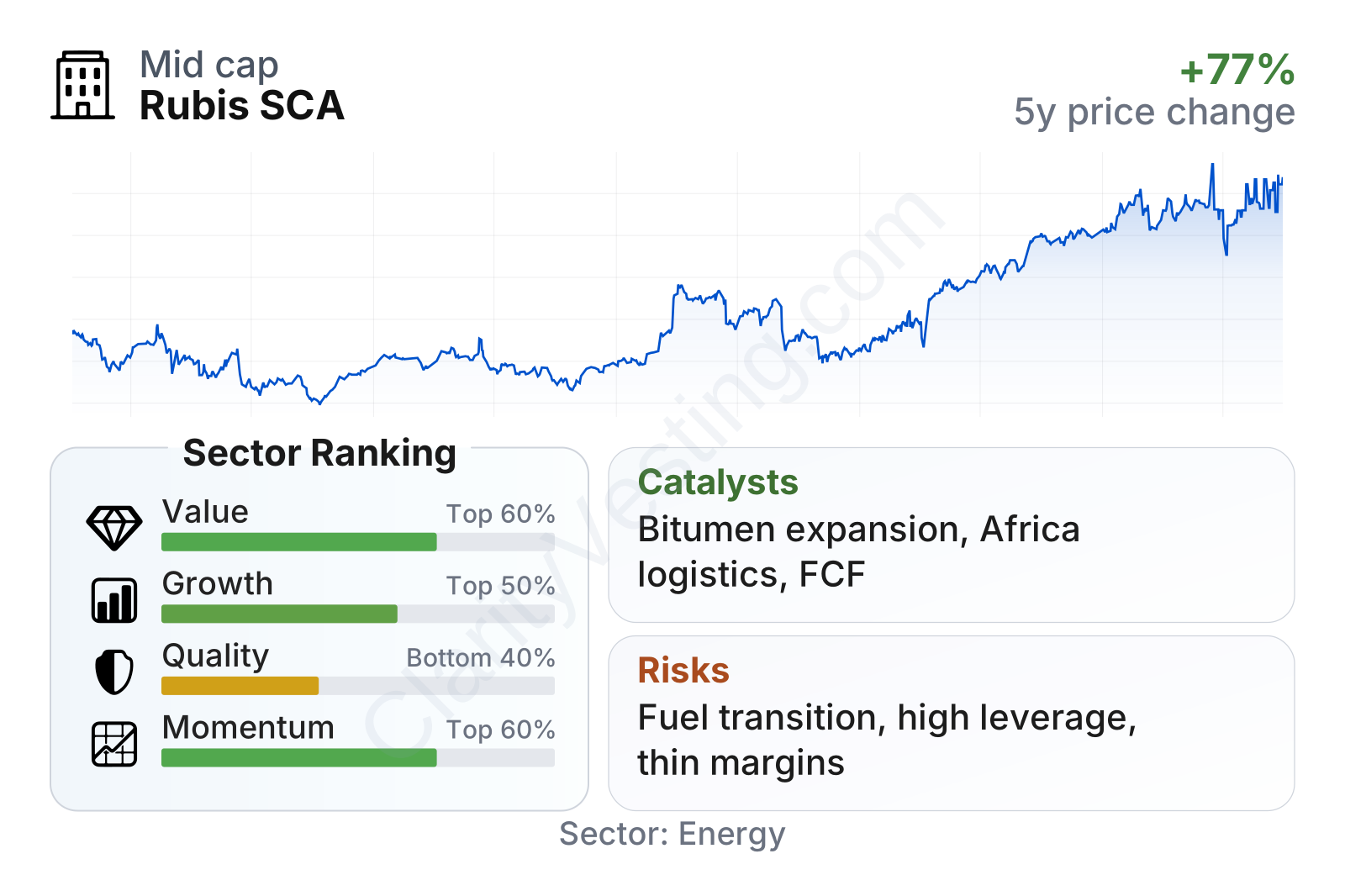
Rubis currently looks moderate on valuation compared with many energy peers, with an earnings multiple below the sector median and a price-to-book ratio close to the group average in its industry. Cash generation stands out more clearly: free cash flow yield is above the sector median, and the dividend yield is also higher than many peers. Growth metrics are mixed but not weak overall. Longer-term revenue per share, free cash flow, and dividend growth have been solid, while margins and book value growth have been less impressive. Quality metrics are more uneven, with leverage and operating margins sitting on the weaker side relative to the sector, even though return on assets remains respectable.
The share-price trend has been favorable over the last three years, and the stock has continued moving upward into 2026. That momentum suggests the market has been giving more credit to Rubis’ cash generation, business resilience, and portfolio adjustments than it did a few years ago.
Growth
Rubis operates in a sector that is mature in developed markets but still has selective growth pockets. Fuel distribution by itself is not a high-growth industry in the classic sense. However, demand remains durable in many island economies, African markets, aviation supply chains, and essential transport segments where alternatives are developing slowly. That creates a more stable backdrop than many people assume when they only look at the long-term transition away from fossil fuels.
The company’s strategy has generally centered on businesses with local barriers to entry: storage assets, import infrastructure, branded retail networks, aviation fuel distribution, LPG, and specialized products such as bitumen. This approach makes strategic sense because it focuses on activities where reliability, logistics, and local market presence can matter more than sheer global scale.
Rubis has also been reshaping its portfolio in recent years, including expansion in bitumen and efforts to strengthen higher-value distribution positions. Bitumen can be an interesting area because it is closely linked to road construction and infrastructure spending, which often follows long investment cycles rather than short consumer cycles. In parallel, the HDF Energy stake gives the group a limited but visible connection to the energy transition, especially in hydrogen-based power solutions, although this is still far from being the main profit engine.
A meaningful catalyst for future growth is execution in African and Caribbean markets, where energy demand, infrastructure needs, and supply-chain constraints can support well-positioned distributors. Another is continued optimization of the asset base: if Rubis can keep refining its geographic mix and improve margins in distribution, earnings growth can outpace pure volume growth. The company’s strong free cash flow profile also gives it room to fund acquisitions, maintain infrastructure, and support shareholder distributions without relying entirely on external financing.
Recent developments have reinforced this idea more than they have transformed the company. The important point is not a single breakthrough event, but the continuation of a strategy built around essential fuel logistics, selective expansion, and gradual diversification rather than a disruptive reinvention.
Risks
This article is for informational purposes only and does not constitute financial advice. Some content is AI-generated. See Disclaimer


