Stock Analysis · Reckitt Benckiser Group PLC (RBGPF)
Overview
Reckitt Benckiser Group PLC is a global consumer goods company focused on everyday health, hygiene, and nutrition products. Its brands are sold through supermarkets, pharmacies, e-commerce platforms, and other retail channels across both developed and emerging markets. The business is built around products that consumers tend to buy repeatedly, which usually makes demand more stable than in many cyclical industries.
Reckitt organizes its portfolio around well-known consumer brands, with revenue mainly coming from health and hygiene categories. Based on recent annual reporting, the business mix is approximately the following:
- Hygiene: about 42% of revenue. This includes disinfectants, surface cleaners, laundry additives, dishwashing, and other home and fabric care products, led by brands such as Lysol, Dettol, Finish, Vanish, and Harpic.
- Health: about 39% of revenue. This includes over-the-counter and self-care products such as Durex, Mucinex, Gaviscon, Nurofen, Strepsils, and related wellness items.
- Nutrition / Essential Home and Mead Johnson-related infant nutrition: about 19% of revenue. This mainly covers infant and child nutrition products sold under Mead Johnson brands such as Enfamil.
Geographically, Reckitt is broadly diversified, with meaningful exposure to North America, Europe, and fast-growing developing markets. That spread lowers reliance on any single country, but it also exposes the group to foreign exchange swings and very different local competitive conditions.
One notable feature of the company is its emphasis on brand power rather than low-cost manufacturing alone. Consumers often choose products like Lysol, Dettol, Durex, or Enfamil by name, which can support pricing and shelf space. That said, the portfolio is not equally strong across all categories, and management has been reshaping the business to focus on its higher-priority brands and improve execution.
The long-term operating picture shows a business with durable gross profit generation and strong cash conversion, although reported earnings have been uneven from year to year. Revenue has been fairly steady in the last several years, while operating profit and net income have moved around more noticeably, which suggests that pricing, product mix, one-off items, and cost pressures matter a lot for annual results.
Key Figures
| Metric | Value | Sector ⓘ |
|---|---|---|
| Date | Oct 03, 2026 | |
| Context | ||
| Sector | Consumer Defensive | |
| Industry | Household & Personal Products | |
| Market Cap ⓘ | $41.22B | |
| Beta ⓘ | 0.25 | |
Value (Cheapness) | ||
| P/E Ratio ⓘ | 11.42 | 18.16 |
| P/B Ratio ⓘ | 7.48 | 1.27 |
| FCF Yield ⓘ | 8.63% | 12.39% |
| Dividend Yield ⓘ | 3.18% | 2.83% |
| EBIT / EV ⓘ | N/A | 6.45% |
| PEG ⓘ | 2.11 | |
Growth (Business expansion) | ||
| Revenue Growth ⓘ | -8.20% | 3.80% |
| RPS Growth (5Y CAGR) ⓘ | 4.04% | 6.20% |
| EPS Growth (5Y CAGR) ⓘ | -19.13% | -14.64% |
| BVPS Growth (5Y CAGR) ⓘ | 3.27% | 3.26% |
| Margin Growth (5Y Trend) ⓘ | 3.42% | -0.25% |
| FCF Growth (5Y CAGR) ⓘ | 9.01% | 4.65% |
| DPS Growth (5Y CAGR) ⓘ | 5.29% | 6.86% |
Quality (Business durability) | ||
| ROIC (Latest) ⓘ | N/A | 12.58% |
| ROA (Latest) ⓘ | 16.60% | 6.35% |
| ROIC (5Y Median) ⓘ | 11.83% | 10.36% |
| ROA (5Y Median) ⓘ | 5.88% | 5.44% |
| Net Debt / EBIT (Latest) ⓘ | 1.49 | 1.91 |
| Net Debt / EBIT (5Y Median) ⓘ | 2.74 | 2.32 |
| Net Debt / EBITDA (Latest) ⓘ | 1.26 | 1.36 |
| Net Debt / Assets ⓘ | 38.01% | 21.25% |
| EBITDA / Interest ⓘ | 12.25 | 9.61 |
| Operating Margin (Latest) ⓘ | 22.46% | 8.96% |
| Operating Margin (5Y Median) ⓘ | 20.63% | 9.53% |
| Debt to Equity (Latest) ⓘ | 179.24% | 71.66% |
| Profit Margin (Latest) ⓘ | 21.09% | 5.40% |
| Free Cash Flow (Latest) ⓘ | $3.56B | |
Momentum (Price trend) | ||
| 3Y Return ⓘ | +9.14% | +15.25% |
| 12M Return (excl. last month) ⓘ | +1.76% | +2.63% |
| 6M Return ⓘ | +2.47% | +2.43% |
| Price vs. 200-Day MA ⓘ | -3.59% | +0.43% |
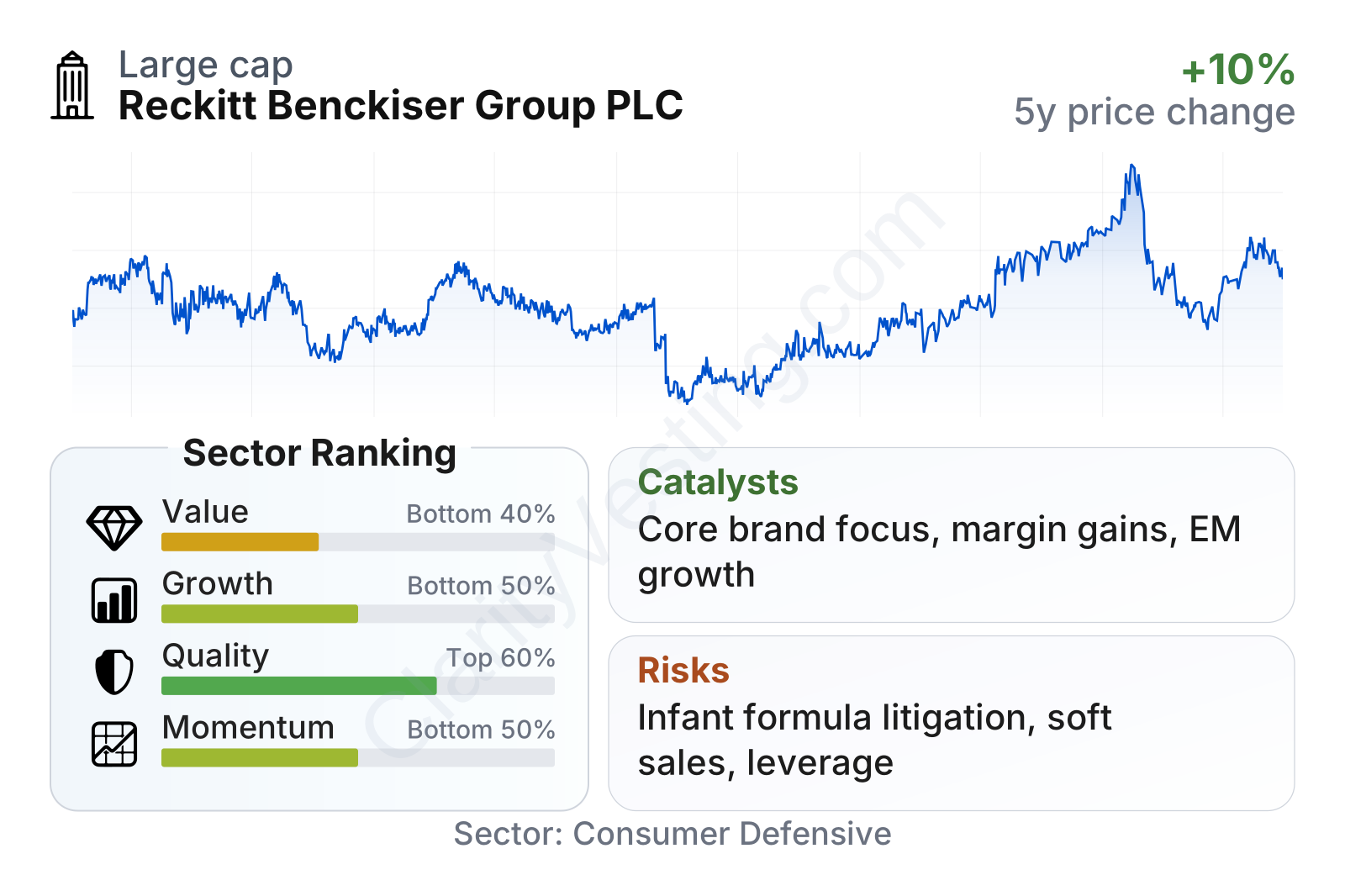
Reckitt stands out as a large consumer defensive company with unusually low share-price volatility, reflected in a beta well below 1. On profitability and operating efficiency, it looks stronger than much of its sector: margins are high, returns on assets are solid, and interest coverage remains comfortable. Cash generation is also meaningful, with free cash flow in the multi-billion-dollar range.
At the same time, the table points to a mixed profile rather than a simple bargain. The earnings multiple is below the sector median, which can make the stock look cheaper on one measure, but the price-to-book ratio is elevated and growth indicators are generally weaker than the broader peer group. Momentum is also not especially strong, which fits a stock that has recovered from past weakness but is still not being valued like a fast-growing consumer name.
Growth
Reckitt operates in a sector that is mature but still structurally attractive. Household cleaning, consumer health, and infant nutrition are not high-growth markets in the way software or semiconductors can be, yet they benefit from recurring demand, aging populations, health awareness, urbanization, and rising consumption in emerging markets. In other words, the industry backdrop supports resilience more than explosive expansion.
The company’s strategy is centered on prioritizing stronger brands, defending pricing, improving execution, and simplifying the portfolio. That approach makes sense for a business like Reckitt because long-term value in consumer staples often comes less from breakthrough expansion and more from steady category leadership, margin discipline, and reliable cash generation. Management has also been working on productivity and brand investment, which matters because these categories depend heavily on distribution strength, product trust, and advertising support.
Recent sales momentum has been modest, and the latest year-over-year revenue change is negative. That does not automatically mean the underlying business is deteriorating, because consumer goods groups often go through periods where volumes, pricing, divestments, and currency effects pull in different directions. Still, it does show that Reckitt currently looks more like a stabilization and execution case than a clear top-line growth story.
A more encouraging point is profitability. Over a five-year period, operating margin trends have improved, and free cash flow growth has been better than the sector median. That suggests the company has retained pricing power and cost control even when reported revenue growth has not been impressive. For a mature consumer company, expanding margins and converting earnings into cash can be as important as adding revenue quickly.
As for catalysts, several factors could matter over the next few years. Continued strength in self-care and hygiene demand, especially in emerging markets, could support organic growth. Better execution in core brands and further simplification of the portfolio could also lift returns. In nutrition, any operational improvement in Mead Johnson-related activities would be closely watched because that segment has had a more mixed history than the hygiene franchises. The company’s low-volatility profile and stable end markets may also draw more attention when broader markets become uncertain.
Risks
This article is for informational purposes only and does not constitute financial advice. Some content is AI-generated. See Disclaimer


