Stock Analysis · Republic Bancorp Inc (RBCAA)
Overview
Republic Bancorp, Inc. is a regional bank headquartered in Kentucky. Through Republic Bank & Trust Company, it provides traditional banking services such as commercial loans, consumer loans, mortgages, deposit accounts, and wealth-related services. What makes the company somewhat different from many local banks is that it also operates specialized fee businesses, most notably its tax refund solutions platform, which has historically generated a meaningful amount of noninterest income.
For a long-term reader, the business can be understood as a mix of two engines. The first is the classic bank model: gathering deposits and lending money at a higher rate. The second is a fee-based model tied to tax-season financial products and other banking services. That combination gives Republic Bancorp more diversification than a plain-vanilla community bank, although it also creates some dependence on niche activities.
Based on recent annual reporting, the company’s revenue mix is broadly divided between net interest income and noninterest income. Exact shares move from year to year with rates, loan growth, and tax-product volumes, but the business is centered on the following sources:
- Net interest income: approximately 55% to 65% of total revenue in recent years. This is the spread between interest earned on loans and securities and interest paid on deposits and borrowings.
- Refund transfer and related tax products: approximately 20% to 30%. This includes products that help taxpayers receive refunds and pay preparation fees through refund-related banking services.
- Mortgage banking, service charges, interchange, and other fees: approximately 10% to 20%. This bucket includes card fees, deposit account charges, mortgage-related income, and other service revenues.
- Wealth management and smaller specialty activities: low-single-digit share when separated out. These are useful for customer retention but are not the main earnings driver.
The company is still relatively small in public-market terms, with a market value around the lower end of the regional bank universe, which can create both opportunity and volatility. Its recent financial progression has been notable: total revenue has risen materially since 2021, while profitability has remained solid despite a much higher interest-rate environment.
Over the last several years, revenue has expanded from a little above $300 million to more than $500 million, while net income also moved higher. One important detail is that interest expense increased sharply during the period, which is normal for banks in a higher-rate environment. Even so, the company preserved healthy operating and profit margins, suggesting decent pricing power and cost control.
Key Figures
| Metric | Value | Sector ⓘ |
|---|---|---|
| Date | Oct 20, 2026 | |
| Context | ||
| Sector | Financial Services | |
| Industry | Banks - Regional | |
| Market Cap ⓘ | $1.78B | |
| Beta ⓘ | 0.57 | |
Value (Cheapness) | ||
| P/E Ratio ⓘ | 13.86 | 12.26 |
| P/B Ratio ⓘ | 1.55 | 1.23 |
| FCF Yield ⓘ | 7.43% | 10.33% |
| Dividend Yield ⓘ | 2.05% | 3.02% |
| EBIT / EV ⓘ | 10.09% | 8.14% |
| PEG ⓘ | 1.27 | |
Growth (Business expansion) | ||
| Revenue Growth ⓘ | 4.40% | 9.25% |
| RPS Growth (5Y CAGR) ⓘ | 14.94% | 12.19% |
| EPS Growth (5Y CAGR) ⓘ | 3.96% | -8.95% |
| BVPS Growth (5Y CAGR) ⓘ | 8.21% | 4.99% |
| Margin Growth (5Y Trend) ⓘ | -4.16% | -3.86% |
| FCF Growth (5Y CAGR) ⓘ | 14.53% | 4.81% |
| DPS Growth (5Y CAGR) ⓘ | 9.21% | 8.79% |
Quality (Business durability) | ||
| ROIC (Latest) ⓘ | 9.05% | 9.49% |
| ROE (Latest) ⓘ | 11.42% | 13.87% |
| ROA (Latest) ⓘ | 1.82% | 1.54% |
| ROIC (5Y Median) ⓘ | 13.02% | 7.86% |
| ROE (5Y Median) ⓘ | 10.64% | 12.17% |
| ROA (5Y Median) ⓘ | 1.51% | 1.30% |
| Net Debt / EBIT (Latest) ⓘ | -0.58 | 0.99 |
| Net Debt / EBIT (5Y Median) ⓘ | 0.81 | 0.73 |
| Net Debt / EBITDA (Latest) ⓘ | -0.53 | 0.91 |
| Operating Margin (Latest) ⓘ | 33.65% | 22.30% |
| Operating Margin (5Y Median) ⓘ | 31.79% | 24.63% |
| Debt to Equity (Latest) ⓘ | 22.10% | 58.32% |
| Profit Margin (Latest) ⓘ | 33.47% | 26.57% |
| Free Cash Flow (Latest) ⓘ | $132.35M | |
Momentum (Price trend) | ||
| 3Y Return ⓘ | +125.09% | +88.67% |
| 12M Return (excl. last month) ⓘ | +28.58% | +19.19% |
| 6M Return ⓘ | +21.49% | +4.70% |
| Price vs. 200-Day MA ⓘ | +11.16% | +3.66% |
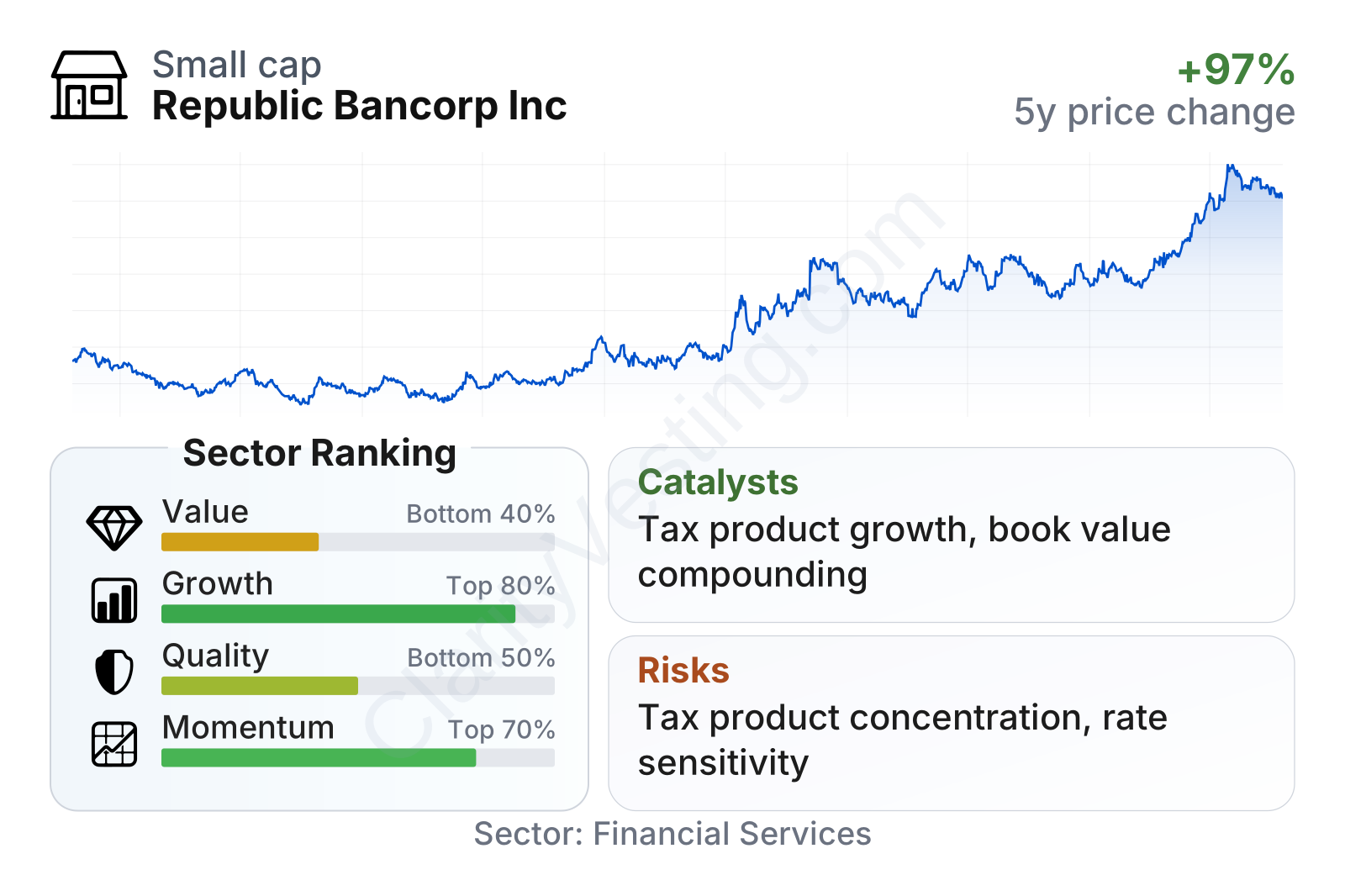
Republic Bancorp stands out for strong long-term growth compared with many regional banks, but its current valuation is no longer obviously cheap. Growth metrics rank well within the sector, momentum has also been strong, and profitability margins are better than many peers. On the other hand, the stock trades somewhat above sector medians on price-to-earnings and price-to-book, while dividend yield is lower than the typical regional bank. The balance sheet looks conservative, with debt-to-equity around 22%, well below the sector median.
The stock price trend has been powerful since 2023, with a particularly strong move into 2026. That kind of rerating usually means the market is recognizing improving earnings quality, stronger niche positioning, or both. It also means expectations are less forgiving than they were when the shares traded below book value a few years ago.
Growth
Regional banking is not usually seen as a high-growth industry, but some niches inside it can grow faster than the sector. Republic Bancorp’s tax-related banking operation is one of those niches. It gives the company a way to generate fee income that is less tied to plain loan growth than a traditional bank. That matters because many regional banks are heavily dependent on local lending conditions alone.
The company’s strategy appears coherent for future growth. It combines steady community and commercial banking with specialized products that can scale without requiring branch expansion at the same pace. That is one reason revenue per share has compounded faster than the sector median over five years, and book value per share growth has also been stronger than typical peers.
Earnings per share have shown a clear upward trend over the last several years, rising from the mid-$3 range in 2021 to the mid-$6 range in 2025 before remaining elevated in 2026. That progression suggests that growth has not come only from balance-sheet expansion, but also from improved earning power per share.
Book value per share has also advanced steadily, climbing from roughly $41 to the mid-$50s over five years. For banks, this is an important sign because book value represents the capital base that supports future lending and earnings. A consistent rise here usually points to retained profitability and disciplined capital management.
A key catalyst is the company’s ability to keep expanding fee-generating businesses while preserving strong margins. Another is the possibility of continued loan and deposit growth without excessive funding pressure. If interest rates stabilize rather than rise sharply again, the operating environment could become easier for banks that already navigated the recent rate cycle well.
Recent corporate updates have also reflected continued earnings strength and capital build. In practical terms, that supports the idea that Republic Bancorp is not merely benefiting from a temporary accounting effect; it is showing durable operating progress across multiple years.
Risks
This article is for informational purposes only and does not constitute financial advice. Some content is AI-generated. See Disclaimer


