Stock Analysis · Ultragenyx (RARE)
Overview
Ultragenyx is a biotechnology company focused on rare and ultra-rare genetic diseases. Its business model is centered on developing treatments for small patient populations with serious unmet medical needs, then commercializing approved products through specialist medical teams and partnerships. This is a niche within healthcare where successful products can command meaningful pricing because there are often few or no alternatives, but it also requires heavy research spending and carries significant clinical and regulatory risk.
The company’s revenue mainly comes from product sales, with a smaller contribution from collaboration and licensing arrangements. Based on recent annual results, revenue is concentrated in a handful of commercial rare-disease medicines and one larger partnership-related stream.
- Crysvita – approximately 40% to 45% of total revenue. This is Ultragenyx’s largest economic driver. It is a treatment for X-linked hypophosphatemia and tumor-induced osteomalacia, and Ultragenyx shares economics with its partner Kyowa Kirin in certain territories.
- Dojolvi – approximately 15% to 20% of total revenue. This product treats long-chain fatty acid oxidation disorders.
- Mepsevii – approximately 10% to 15% of total revenue. It is used for an ultra-rare lysosomal storage disorder, MPS VII.
- Evkeeza – approximately 10% to 15% of total revenue. Ultragenyx records revenue from its role in certain geographies under its arrangement with Regeneron.
- Other revenue, including licenses and collaborations – approximately 10% to 20% of total revenue. This can include milestone-related or contract revenue tied to development partnerships, including gene therapy programs.
Revenue has been moving upward over the last several years, but spending on research, clinical trials, and commercialization has remained much higher than gross profit. That means Ultragenyx already has a real commercial base, yet it still behaves financially like a development-stage biotech aiming to build a larger future portfolio.
The long-term pattern is fairly clear: sales have risen from the low hundreds of millions of dollars to the mid-hundreds of millions, while research and development has stayed very large and selling costs have also increased. In other words, the company is building scale, but profitability has not arrived because management continues to invest heavily in the pipeline.
Key Figures
| Metric | Value | Sector ⓘ |
|---|---|---|
| Date | Oct 17, 2026 | |
| Context | ||
| Sector | Healthcare | |
| Industry | Biotechnology | |
| Market Cap ⓘ | $1.47B | |
| Beta ⓘ | 0.35 | |
Value (Cheapness) | ||
| P/E Ratio ⓘ | N/A | 24.79 |
| P/B Ratio ⓘ | N/A | 3.08 |
| FCF Yield ⓘ | -33.32% | 3.15% |
| Dividend Yield ⓘ | N/A | 1.94% |
| EBIT / EV ⓘ | -61.46% | 0.57% |
| PEG ⓘ | -0.24 | |
Growth (Business expansion) | ||
| Revenue Growth ⓘ | 28.10% | 7.45% |
| RPS Growth (5Y CAGR) ⓘ | 7.12% | 8.61% |
| EPS Growth (5Y CAGR) ⓘ | -31.09% | -17.81% |
| BVPS Growth (5Y CAGR) ⓘ | N/A | 3.72% |
| Margin Growth (5Y Trend) ⓘ | N/A | -0.62% |
| FCF Growth (5Y CAGR) ⓘ | N/A | 1.04% |
| DPS Growth (5Y CAGR) ⓘ | N/A | 6.77% |
Quality (Business durability) | ||
| ROIC (Latest) ⓘ | N/A | 3.24% |
| ROA (Latest) ⓘ | -47.78% | 3.01% |
| ROIC (5Y Median) ⓘ | -134.77% | 4.60% |
| ROA (5Y Median) ⓘ | -38.02% | 1.89% |
| Net Debt / EBIT (Latest) ⓘ | N/A | 1.34 |
| Net Debt / EBIT (5Y Median) ⓘ | N/A | 1.84 |
| Net Debt / EBITDA (Latest) ⓘ | N/A | 1.00 |
| Net Debt / Assets ⓘ | 85.21% | 5.45% |
| EBITDA / Interest ⓘ | N/A | 9.64 |
| Operating Margin (Latest) ⓘ | -70.63% | 9.27% |
| Operating Margin (5Y Median) ⓘ | -120.53% | 7.38% |
| Debt to Equity (Latest) ⓘ | -413.06% | 28.58% |
| Profit Margin (Latest) ⓘ | -81.73% | 3.59% |
| Free Cash Flow (Latest) ⓘ | -$489.47M | |
Momentum (Price trend) | ||
| 3Y Return ⓘ | -59.02% | +42.80% |
| 12M Return (excl. last month) ⓘ | -54.93% | +18.50% |
| 6M Return ⓘ | -39.75% | +7.57% |
| Price vs. 200-Day MA ⓘ | -34.90% | +5.12% |
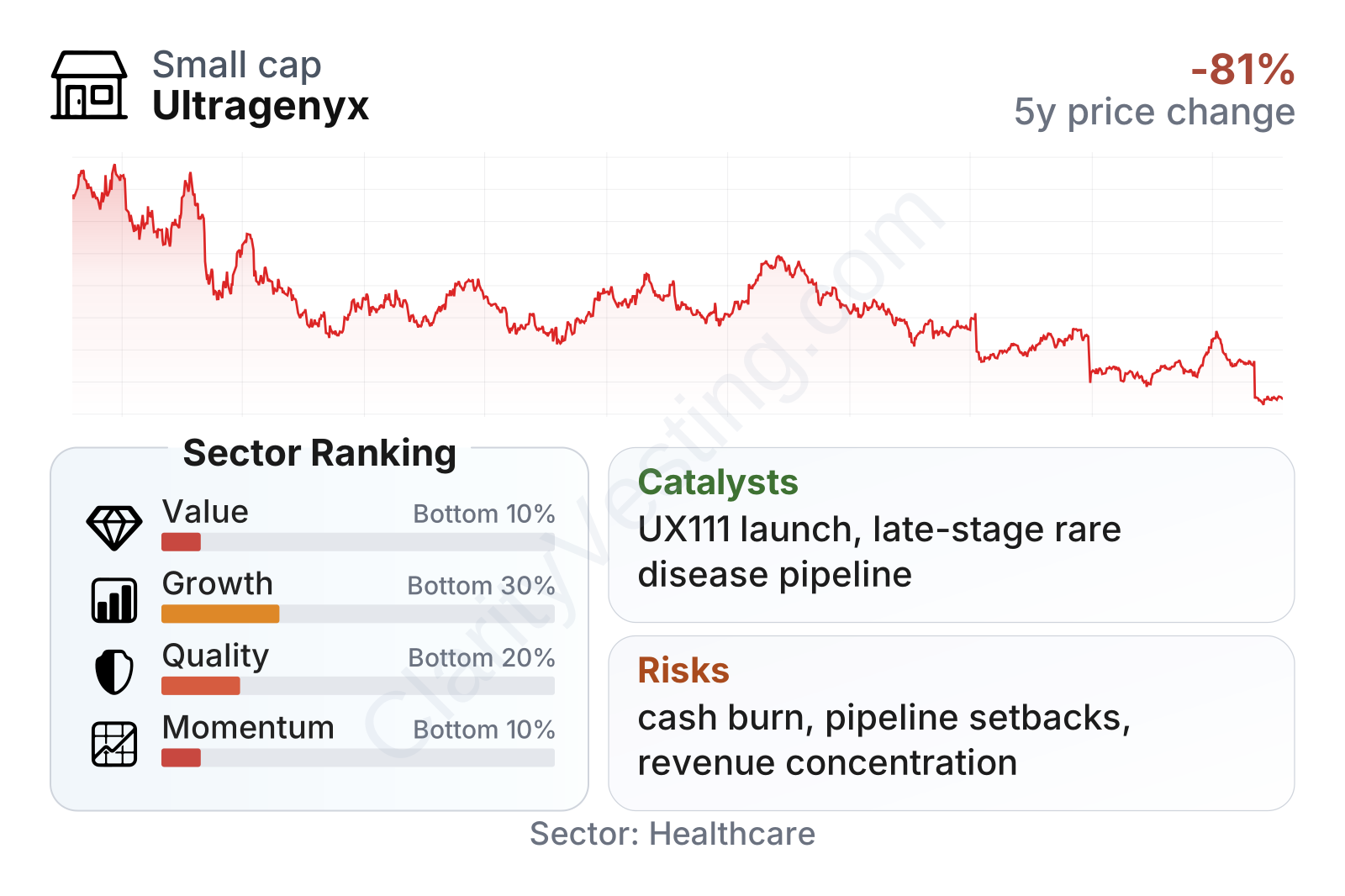
Ultragenyx is a small-cap biotech company with unusually weak factor rankings relative to the broader healthcare sector. The weakest areas are value, quality, and momentum, which is not unusual for a company that is still posting heavy losses and negative free cash flow. Growth is more mixed: recent year-over-year revenue expansion has been stronger than the sector median, but the longer record is less impressive because losses have remained large and earnings trends are still deeply negative.
The stock chart shows a long decline from 2021 into early 2026, followed by a partial rebound. That usually signals a market that is still uncertain about the timing of future approvals, launches, and a path toward better cash generation rather than one that is rewarding current profitability.
Growth
Ultragenyx operates in one of the more attractive corners of biotechnology: rare diseases. This market tends to support premium pricing, focused physician outreach, and longer product life cycles because competition is often narrower than in mass-market drug categories. It also benefits from regulatory incentives such as orphan-drug exclusivity, faster review pathways in some cases, and a clinical development process that can be more targeted because patient populations are well defined.
The company’s strategy for future expansion is logical. It already has multiple marketed products generating recurring sales, which helps fund a broader pipeline that includes biologics, gene therapy, and other genetically targeted approaches. That combination matters: a company with approved rare-disease products is usually in a stronger position than a pure pre-revenue biotech because it has established physician relationships, payer experience, and operational know-how in small patient populations.
Revenue growth has generally been strong, with many reporting periods in the double-digit range and recent annual growth well above the healthcare sector median. Even though one quarter in 2026 dipped slightly, the broader trend still points to an expanding commercial base. This is important because sustained product uptake can gradually reduce dependence on external financing if it continues for long enough.
A major reason the growth case still attracts attention is the company’s late-stage and newly commercial assets. Ultragenyx has continued to advance programs in osteogenesis imperfecta, Angelman syndrome, glycogen storage disease type Ia, and other rare disorders. In rare disease biotech, a single successful approval can materially reshape the company because each new product can add a meaningful amount of revenue on top of an already specialized infrastructure.
Recent company updates have also kept attention on regulatory and clinical catalysts. The approval and rollout of DTX401 for glycogen storage disease type Ia under the brand name UX111 represented an important milestone because it expands Ultragenyx further into gene therapy. At the same time, the company has continued to discuss progress across several programs that could meaningfully change its revenue mix if data or regulatory outcomes are favorable.
Free cash flow remains clearly negative, which shows that growth is still being purchased through continued investment rather than generated through self-funded scale. The better reading is that Ultragenyx has commercial traction; the harder question is whether future launches and pipeline wins can arrive quickly enough to narrow the cash burn in a durable way.
Risks
This article is for informational purposes only and does not constitute financial advice. Some content is AI-generated. See Disclaimer


