Stock Analysis · Rapport Therapeutics Inc (RAPP)
Overview
Rapport Therapeutics is a clinical-stage biotechnology company focused on brain disorders. Its research is built around precision medicines designed to target specific receptor biology in the central nervous system, with the goal of improving treatment for neurological and psychiatric conditions while reducing side effects seen with broader-acting drugs. In simple terms, the company is trying to build more selective medicines for serious brain diseases.
At this stage, Rapport is not a commercial drug company. It does not yet generate product sales from approved medicines, which is a key point for long-term analysis. The business is currently centered on research, clinical development, and building a pipeline that could later create value through approvals, partnerships, or future commercialization.
The current revenue mix is extremely limited and should be viewed as pre-commercial:
- Product revenue: approximately 0%. Rapport has no approved products on the market.
- Collaboration, license, or other operating revenue: currently not meaningful based on recent annual reporting.
- Interest and other non-operating items: this can contribute some reported income from cash balances, but it is not core operating revenue and does not reflect commercial traction.
The financial profile therefore looks like that of a development-stage biotech: operating expenses are dominated by research and development, with administrative costs rising as the company scales clinical operations and public-company infrastructure. Over the last few years, research spending has increased sharply, showing that management is investing heavily in advancing its programs rather than producing near-term earnings.
The expense structure is clear: research and development is the largest use of cash by a wide margin, and total operating losses have expanded as the pipeline has moved forward. That pattern is normal for an early biotech, but it also means future value depends heavily on clinical progress rather than current revenue.
Key Figures
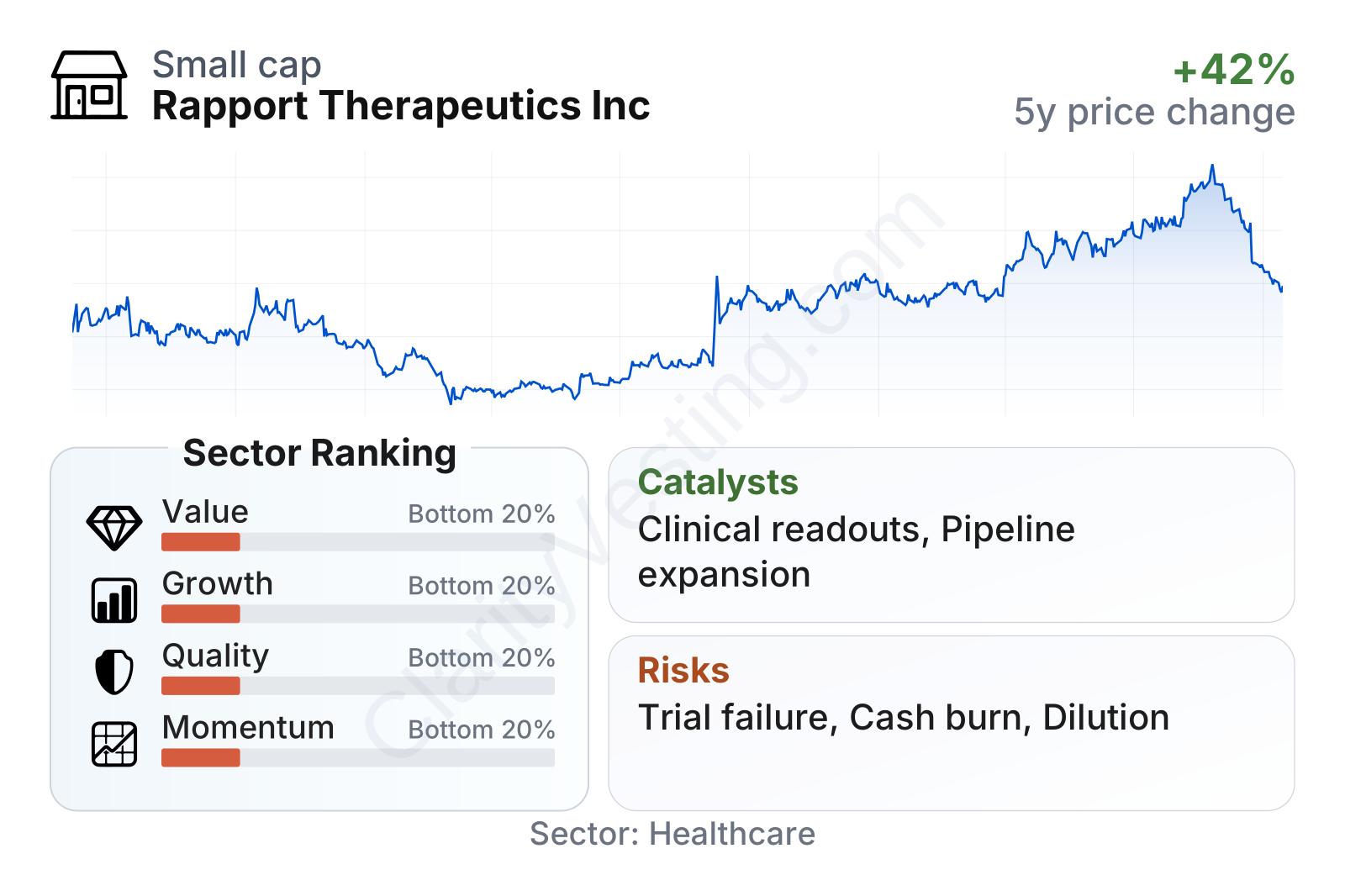
The share price history shows a volatile path typical of clinical-stage biotech companies. After a sharp drop in early 2025, the stock recovered strongly and moved substantially higher through 2026. That kind of move usually signals rising expectations around pipeline progress, but it also shows how quickly sentiment can change when a company has little recurring revenue to anchor valuation.
| Metric | Value | Sector ⓘ |
|---|---|---|
| Date | Oct 17, 2026 | |
| Context | ||
| Sector | Healthcare | |
| Industry | Biotechnology | |
| Market Cap ⓘ | $1.36B | |
| Beta ⓘ | 1.22 | |
Value (Cheapness) | ||
| P/E Ratio ⓘ | N/A | 24.79 |
| P/B Ratio ⓘ | 3.32 | 3.08 |
| FCF Yield ⓘ | -7.15% | 3.15% |
| Dividend Yield ⓘ | N/A | 1.94% |
| EBIT / EV ⓘ | -12.27% | 0.57% |
| PEG ⓘ | N/A | |
Growth (Business expansion) | ||
| Revenue Growth ⓘ | N/A | 7.45% |
| RPS Growth (5Y CAGR) ⓘ | N/A | 8.61% |
| EPS Growth (5Y CAGR) ⓘ | -39.65% | -17.81% |
| BVPS Growth (5Y CAGR) ⓘ | 119.91% | 3.72% |
| Margin Growth (5Y Trend) ⓘ | N/A | -0.62% |
| FCF Growth (5Y CAGR) ⓘ | N/A | 1.04% |
| DPS Growth (5Y CAGR) ⓘ | N/A | 6.77% |
Quality (Business durability) | ||
| ROIC (Latest) ⓘ | -24.64% | 3.24% |
| ROA (Latest) ⓘ | -27.59% | 3.01% |
| ROIC (5Y Median) ⓘ | N/A | 4.60% |
| ROA (5Y Median) ⓘ | -33.30% | 1.89% |
| Net Debt / EBIT (Latest) ⓘ | N/A | 1.34 |
| Net Debt / EBIT (5Y Median) ⓘ | N/A | 1.84 |
| Net Debt / EBITDA (Latest) ⓘ | N/A | 1.00 |
| Net Debt / Assets ⓘ | -11.66% | 5.45% |
| EBITDA / Interest ⓘ | N/A | 9.64 |
| Operating Margin (Latest) ⓘ | -746.62% | 9.27% |
| Operating Margin (5Y Median) ⓘ | N/A | 7.38% |
| Debt to Equity (Latest) ⓘ | 2.39% | 28.58% |
| Profit Margin (Latest) ⓘ | N/A | 3.59% |
| Free Cash Flow (Latest) ⓘ | -$97.15M | |
Momentum (Price trend) | ||
| 3Y Return ⓘ | N/A | +42.80% |
| 12M Return (excl. last month) ⓘ | +72.58% | +18.50% |
| 6M Return ⓘ | -19.45% | +7.57% |
| Price vs. 200-Day MA ⓘ | -17.35% | +5.12% |
The overall picture is mixed but easy to read. Market performance has recently been much stronger than much of the healthcare sector, yet the underlying fundamentals still rank weakly on value, growth, and quality measures. That mismatch is not unusual in biotechnology: the market is often pricing future drug potential rather than present-day profitability. Rapport also stands out for having very low leverage, which reduces balance-sheet risk even though cash burn remains substantial.
Growth
Rapport operates in a large and attractive area of healthcare. Brain disorders remain one of the hardest fields in medicine, but also one of the biggest unmet needs. Successful treatments in epilepsy, psychiatric illness, and other central nervous system conditions can address large patient populations and support meaningful pricing. That creates a strong long-term industry backdrop, even though scientific failure rates are high.
The company’s strategy is logical for future growth because it is built around differentiated biology rather than another broad, undirected central nervous system approach. If Rapport can show that its receptor-focused platform produces better efficacy or tolerability, that would strengthen the case for both standalone value creation and partnership interest from larger pharmaceutical companies. For a company at this stage, clinical proof matters far more than current income statements.
A major catalyst is pipeline execution. In development-stage biotech, the most important inflection points usually come from clinical trial updates, regulatory milestones, and program expansion into additional indications. Rapport’s recent market performance suggests the market sees meaningful optionality in these events. Another positive sign is that the company has been able to attract attention despite having no commercial revenue, which often means the pipeline is seen as relevant in a crowded biotech market.
Cash generation is still deeply negative, and free cash flow has moved further into the red as development spending increased. That is expected for a company funding trials, but the trend highlights an important growth trade-off: advancing the pipeline may increase the company’s long-term opportunity while also increasing the near-term need for capital.
Recent corporate updates from company filings and investor communications indicate continued progress in advancing clinical programs and refining development priorities. For long-term readers, the central question is not whether Rapport is growing revenue today, because it is not, but whether its clinical assets can become valuable enough to justify years of investment before commercialization.
Risks
This article is for informational purposes only and does not constitute financial advice. Some content is AI-generated. See Disclaimer


