Stock Analysis · Ryder System Inc (R)
Overview
Ryder System is a transportation and supply chain company that helps businesses move goods, manage fleets, and run logistics operations. Its activities are broader than a simple truck rental business. Ryder leases commercial vehicles, rents trucks on a short-term basis, performs maintenance, sells used vehicles, arranges transportation, manages warehouses, and provides e-commerce and last-mile fulfillment services. That mix gives the company exposure to both physical assets, such as trucks and trailers, and service-based operations tied to shipping demand.
Based on the company’s recent reporting structure, revenue comes mainly from three operating segments:
- Fleet Management Solutions (FMS): about 55% to 60%. This is Ryder’s largest business. It includes full-service leasing, contract maintenance, commercial rental, and related fleet support services for trucks, tractors, and trailers.
- Supply Chain Solutions (SCS): about 25% to 30%. This segment covers warehousing, distribution, transportation management, dedicated transportation, omnichannel fulfillment, and e-commerce services.
- Dedicated Transportation Solutions (DTS): about 15% to 20%. This business provides dedicated trucks, drivers, routing, and fleet management for customers that want outsourced transportation capacity.
Another important economic contributor, even if it is not always shown as a separate operating segment, is used vehicle sales. This can materially affect earnings from one year to another because resale prices for trucks and tractors are cyclical.
Over the last several years, Ryder’s revenue has stayed around the low-to-mid teens in billions of dollars, while profitability has moved more sharply with the cycle. Gross profit recovered well after 2021, but higher interest expense has also become a bigger drag on earnings as the company continues to fund a large fleet and equipment base.
The business model is relatively diversified for a transport-related company: recurring lease and maintenance income provides stability, while logistics and dedicated transportation add service revenue and customer relationships beyond equipment ownership alone.
Key Figures
| Metric | Value | Sector ⓘ |
|---|---|---|
| Date | Oct 03, 2026 | |
| Context | ||
| Sector | Industrials | |
| Industry | Rental & Leasing Services | |
| Market Cap ⓘ | $8.85B | |
| Beta ⓘ | 1.00 | |
Value (Cheapness) | ||
| P/E Ratio ⓘ | 19.02 | 22.45 |
| P/B Ratio ⓘ | 3.08 | 1.98 |
| FCF Yield ⓘ | 7.76% | 6.31% |
| Dividend Yield ⓘ | 1.56% | 1.96% |
| EBIT / EV ⓘ | 6.07% | 4.81% |
| PEG ⓘ | 0.86 | |
Growth (Business expansion) | ||
| Revenue Growth ⓘ | 5.00% | 9.10% |
| RPS Growth (5Y CAGR) ⓘ | 13.12% | 7.75% |
| EPS Growth (5Y CAGR) ⓘ | -22.58% | -13.59% |
| BVPS Growth (5Y CAGR) ⓘ | 8.70% | 6.22% |
| Margin Growth (5Y Trend) ⓘ | -0.56% | 0.72% |
| FCF Growth (5Y CAGR) ⓘ | N/A | 10.98% |
| DPS Growth (5Y CAGR) ⓘ | 11.10% | 9.48% |
Quality (Business durability) | ||
| ROIC (Latest) ⓘ | 7.47% | 10.92% |
| ROA (Latest) ⓘ | 3.04% | 5.41% |
| ROIC (5Y Median) ⓘ | 7.38% | 9.21% |
| ROA (5Y Median) ⓘ | 3.02% | 4.94% |
| Net Debt / EBIT (Latest) ⓘ | 7.72 | 2.07 |
| Net Debt / EBIT (5Y Median) ⓘ | 7.79 | 2.28 |
| Net Debt / EBITDA (Latest) ⓘ | 3.16 | 1.43 |
| Net Debt / Assets ⓘ | 51.18% | 19.27% |
| EBITDA / Interest ⓘ | 6.57 | 9.53 |
| Operating Margin (Latest) ⓘ | 8.30% | 10.50% |
| Operating Margin (5Y Median) ⓘ | 8.58% | 10.27% |
| Debt to Equity (Latest) ⓘ | 293.61% | 65.48% |
| Profit Margin (Latest) ⓘ | 3.88% | 6.62% |
| Free Cash Flow (Latest) ⓘ | $687.00M | |
Momentum (Price trend) | ||
| 3Y Return ⓘ | +126.81% | +58.56% |
| 12M Return (excl. last month) ⓘ | +32.68% | +15.63% |
| 6M Return ⓘ | +12.20% | +4.19% |
| Price vs. 200-Day MA ⓘ | -0.89% | +0.93% |
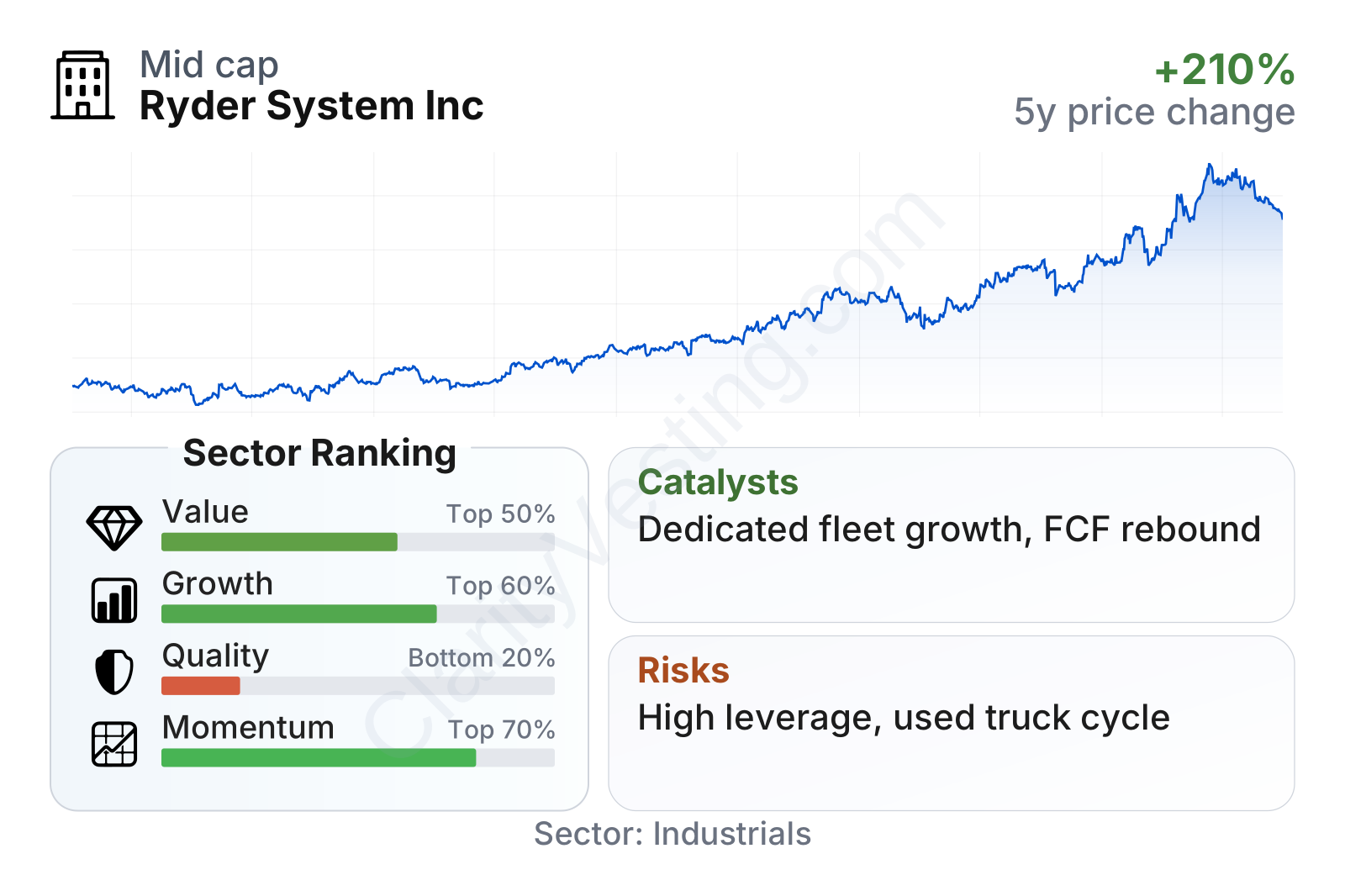
Ryder is a large mid-cap industrial company with stock-price momentum that has been much stronger than the broader sector over the last one, three, and six-year periods. On valuation measures, the picture is mixed but generally constructive: earnings and cash-flow multiples sit around or somewhat below sector norms, while the price-to-book ratio is higher than the sector median, which suggests the market is giving credit to the quality of the fleet platform and improved business mix. The weaker area is quality. Profitability, returns on capital, and balance-sheet leverage compare less favorably with many industrial peers, which is common for an asset-heavy leasing model but still important to watch closely.
Growth
Ryder operates in a sector that should remain relevant for a long time. Trucks, fleet outsourcing, warehousing, dedicated delivery capacity, and e-commerce fulfillment are essential parts of the North American economy. Even when freight markets weaken, many businesses still need to replace aging equipment, maintain vehicles, and outsource logistics to control costs. That gives Ryder some structural support from trends such as supply chain complexity, next-day and same-day delivery expectations, and the increasing appeal of asset-light outsourcing for customers.
The company’s strategy also makes industrial sense. Rather than relying only on renting trucks, Ryder has been shifting toward more contract-based and service-oriented activities, especially dedicated transportation and supply chain management. That matters because these businesses can deepen customer relationships, create switching costs, and reduce reliance on pure vehicle resale conditions. In simple terms, Ryder is trying to become more of an integrated transportation partner and less of a stand-alone equipment provider.
Growth has not been smooth, however. Revenue accelerated strongly in 2021 and 2022, then softened in 2023, recovered in 2024, and turned modest again through parts of 2025 before improving recently. That pattern fits a cyclical company exposed to freight demand, rental activity, and used vehicle pricing. The latest year-over-year growth rate is positive again, but still not especially high compared with the typical industrial company in the sector.
Cash generation has improved meaningfully after a weak stretch. Free cash flow was negative during part of the expansion cycle, then turned clearly positive more recently. For a company like Ryder, that is important because large capital needs can absorb a lot of operating cash. A return to positive free cash flow gives the business more flexibility to fund fleet investment, manage debt, and continue shareholder returns without leaning as heavily on external financing.
A notable catalyst is Ryder’s continued push into higher-value logistics services, including e-commerce fulfillment, last-mile solutions, and outsourced dedicated fleet operations. These areas can benefit from long-term customer demand for reliability and cost control rather than depending only on freight-rate spikes. Another catalyst is the used vehicle market: when resale values are healthy, Ryder can realize strong gains when rotating out older equipment. That is not a permanent growth engine, but it can provide a powerful lift in favorable periods.
Recent company updates have also highlighted ongoing contract wins, fleet outsourcing demand, and investment in digital tools to improve maintenance, routing, visibility, and customer service. None of these changes transforms the business overnight, but together they support a gradual move toward more recurring and service-led earnings.
Risks
This article is for informational purposes only and does not constitute financial advice. Some content is AI-generated. See Disclaimer