Stock Analysis · QXO Inc (QXO)
Overview
QXO Inc is building a large-scale distributor of building products, with a particular focus on roofing, waterproofing, and related exterior construction materials. The company’s current shape is the result of a major transformation: what had been a much smaller operating business was repositioned under the QXO name and then expanded through a very large acquisition in building products distribution. That means today’s investment case is less about a long operating history under one stable model and more about whether management can successfully assemble a bigger platform in a fragmented industry.
Its revenue is now driven primarily by the distribution of construction products sold to professional contractors, builders, and related customers. Based on the latest annual profile, the business is overwhelmingly tied to this distribution activity, while any legacy activities appear immaterial in comparison.
- Building products distribution: approximately 99%+ of revenue. This includes roofing materials, waterproofing systems, and other products used in residential and commercial construction and repair.
- Other / legacy activities: less than 1% of revenue. These operations are not a meaningful driver of the current business profile.
The broader economics of the company reflect the nature of distribution: very large sales volume, relatively thin margins, and heavy importance of scale, purchasing power, logistics, and branch execution. Recent financial flow trends show a dramatic jump in revenue in 2025 after the business combination, but they also show that operating costs and interest expense rose sharply, which helps explain why accounting profits remain under pressure despite the much larger size.
Key Figures
| Metric | Value | Sector ⓘ |
|---|---|---|
| Date | Oct 24, 2026 | |
| Context | ||
| Sector | Industrials | |
| Industry | Industrial Distribution | |
| Market Cap ⓘ | $10.85B | |
| Beta ⓘ | 2.28 | |
Value (Cheapness) | ||
| P/E Ratio ⓘ | N/A | 22.29 |
| P/B Ratio ⓘ | 0.76 | 1.98 |
| FCF Yield ⓘ | 1.30% | 6.26% |
| Dividend Yield ⓘ | N/A | 1.92% |
| EBIT / EV ⓘ | -1.60% | 4.83% |
| PEG ⓘ | 0.96 | |
Growth (Business expansion) | ||
| Revenue Growth ⓘ | 70.30% | 9.30% |
| RPS Growth (5Y CAGR) ⓘ | 202.82% | 7.76% |
| EPS Growth (5Y CAGR) ⓘ | N/A | -13.17% |
| BVPS Growth (5Y CAGR) ⓘ | 380.18% | 6.13% |
| Margin Growth (5Y Trend) ⓘ | N/A | 0.74% |
| FCF Growth (5Y CAGR) ⓘ | 536.99% | 10.79% |
| DPS Growth (5Y CAGR) ⓘ | 104.32% | 9.41% |
Quality (Business durability) | ||
| ROIC (Latest) ⓘ | -1.76% | 10.75% |
| ROA (Latest) ⓘ | -2.60% | 5.41% |
| ROIC (5Y Median) ⓘ | N/A | 9.37% |
| ROA (5Y Median) ⓘ | -1.43% | 4.95% |
| Net Debt / EBIT (Latest) ⓘ | N/A | 2.04 |
| Net Debt / EBIT (5Y Median) ⓘ | N/A | 2.27 |
| Net Debt / EBITDA (Latest) ⓘ | 10.94 | 1.39 |
| Net Debt / Assets ⓘ | 18.81% | 19.27% |
| EBITDA / Interest ⓘ | 2.02 | 9.58 |
| Operating Margin (Latest) ⓘ | -2.91% | 10.49% |
| Operating Margin (5Y Median) ⓘ | -0.86% | 10.30% |
| Debt to Equity (Latest) ⓘ | 67.81% | 64.82% |
| Profit Margin (Latest) ⓘ | -5.17% | 6.67% |
| Free Cash Flow (Latest) ⓘ | $140.60M | |
Momentum (Price trend) | ||
| 3Y Return ⓘ | -52.25% | +67.77% |
| 12M Return (excl. last month) ⓘ | -40.83% | +12.05% |
| 6M Return ⓘ | -54.18% | 0.00% |
| Price vs. 200-Day MA ⓘ | -41.96% | +0.67% |
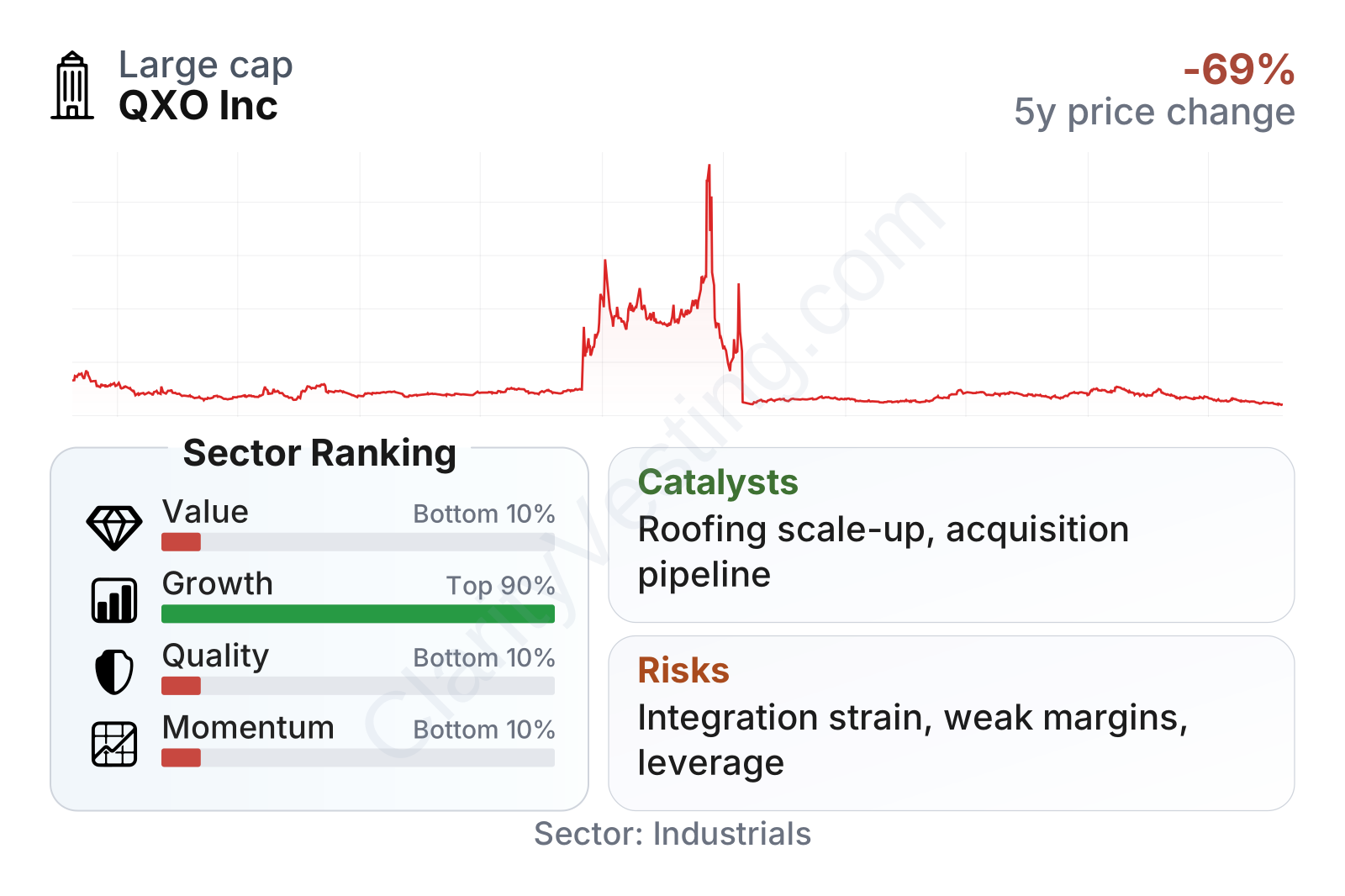
QXO is now a large public company by market value, but its operating profile is still in transition. The growth factor ranks near the top of the industrial sector, largely because reported revenue and cash generation expanded rapidly after the major acquisition. By contrast, value, quality, and momentum rank near the bottom of the sector. That combination usually points to a business that has changed quickly on paper but has not yet translated that scale into strong profitability, stable returns on capital, or durable market confidence.
The stock’s trading history also shows unusually high volatility, which fits with a company undergoing a strategic reset and major integration phase. The beta is elevated, and the share price has moved dramatically over the past two years, suggesting the market is still trying to determine what the enlarged company should earn through a full cycle.
Growth
QXO operates in a market that has long-term appeal. Building products distribution is tied to construction, renovation, reroofing, and repair activity. Roofing in particular has a recurring replacement cycle, which makes demand less dependent on new construction alone. The sector is also fragmented, creating room for consolidation if a well-capitalized acquirer can integrate local and regional distributors effectively.
That strategic logic is the core of the QXO thesis. Management has presented QXO as a platform intended to grow through acquisitions, procurement scale, technology, and operating discipline. In simple terms, the company is trying to do in building products distribution what large distributors have done in other industrial categories: combine many smaller businesses, improve buying power, widen product access, and use a larger network to gain efficiency.
The growth trend looks extraordinary, but it needs to be interpreted carefully. The latest year-over-year revenue increase is roughly 70%, far above the sector median near 9%, yet much of the surge comes from the step-change created by acquisition activity rather than from purely organic expansion. Earlier periods in 2025 showed even more extreme growth rates because the comparison base was small before the acquired business was fully reflected. So the company clearly became much larger very quickly, but the next question is whether it can convert that size into steady same-store growth and better margins.
Cash generation is one of the more encouraging parts of the recent profile. Free cash flow moved from a very small base a few years ago to well over $100 million on a trailing basis, indicating that the enlarged platform can produce real cash even while reported earnings remain weak. For a distributor, that matters because cash can support debt service, branch investment, and additional acquisitions. If management proves it can keep cash flow positive while integrating a much larger operation, that would strengthen the long-term case considerably.
Recent company developments also matter. The enlarged platform gives QXO a much bigger footprint in roofing and related products, and management has been explicit about using that position as a base for further industry consolidation. In a fragmented market, scale itself can become a catalyst: a larger network can attract suppliers, improve freight efficiency, and make future targets easier to integrate than a small standalone buyer could manage.
Risks
This article is for informational purposes only and does not constitute financial advice. Some content is AI-generated. See Disclaimer


