Stock Analysis · Uniqure NV (QURE)
Overview
uniQure N.V. is a biotechnology company focused on gene therapy, a type of medicine designed to address disease by delivering genetic material into a patient’s cells. The company concentrates on severe diseases with high unmet need, especially in neurology and liver-directed conditions. Its best-known commercial asset is its royalty interest tied to HEMGENIX, a gene therapy for hemophilia B that was developed with CSL. Alongside that royalty stream, uniQure’s value is heavily connected to its clinical pipeline, particularly programs in Huntington’s disease and other genetic disorders.
For a non-specialist reader, this is not a typical pharmaceutical company with many products already on the market. It is closer to a research-driven platform business: it spends heavily on development today in the hope that a small number of successful therapies can generate large future payments, milestone income, royalties, or commercialization value.
Its revenue base is relatively narrow and can change sharply from one year to the next depending on collaboration accounting, milestone timing, and royalty activity. Based on recent public filings, the main sources of revenue are:
- Collaboration and license revenue: typically the largest reported source in recent periods, often representing most of total revenue. This includes recognition of upfront and milestone-related amounts from partners and licensing arrangements.
- Royalty revenue from HEMGENIX-related economics: a smaller but strategically important source, linked to commercial sales by partner CSL. This gives uniQure exposure to an approved product without bearing the full cost of global commercialization.
- Other revenue: generally limited, and may include manufacturing or service-related activity when applicable.
The most important point is that uniQure’s current economics are not yet diversified. Revenue is still modest compared with the company’s research spending, so the investment case depends more on future pipeline execution than on a stable operating business today.
The long-term pattern shows how unusual uniQure’s income profile has been: a very strong revenue year earlier in the decade was followed by much smaller annual revenue, while research spending stayed high. That gap explains why the company has continued to post sizable operating losses even as expenses were reduced from peak levels.
Key Figures
| Metric | Value | Sector ⓘ |
|---|---|---|
| Date | Oct 24, 2026 | |
| Context | ||
| Sector | Healthcare | |
| Industry | Biotechnology | |
| Market Cap ⓘ | $1.57B | |
| Beta ⓘ | 1.06 | |
Value (Cheapness) | ||
| P/E Ratio ⓘ | N/A | 25.42 |
| P/B Ratio ⓘ | 4.72 | 3.08 |
| FCF Yield ⓘ | -10.23% | 3.12% |
| Dividend Yield ⓘ | N/A | 1.85% |
| EBIT / EV ⓘ | -8.81% | 0.56% |
| PEG ⓘ | N/A | |
Growth (Business expansion) | ||
| Revenue Growth ⓘ | 11.00% | 7.50% |
| RPS Growth (5Y CAGR) ⓘ | -60.23% | 8.60% |
| EPS Growth (5Y CAGR) ⓘ | -7.95% | -17.73% |
| BVPS Growth (5Y CAGR) ⓘ | -27.79% | 3.72% |
| Margin Growth (5Y Trend) ⓘ | N/A | -0.57% |
| FCF Growth (5Y CAGR) ⓘ | N/A | 0.96% |
| DPS Growth (5Y CAGR) ⓘ | N/A | 6.69% |
Quality (Business durability) | ||
| ROIC (Latest) ⓘ | -55.32% | 3.17% |
| ROA (Latest) ⓘ | -26.92% | 2.98% |
| ROIC (5Y Median) ⓘ | -46.54% | 4.56% |
| ROA (5Y Median) ⓘ | -28.81% | 1.87% |
| Net Debt / EBIT (Latest) ⓘ | N/A | 1.34 |
| Net Debt / EBIT (5Y Median) ⓘ | N/A | 1.86 |
| Net Debt / EBITDA (Latest) ⓘ | N/A | 1.00 |
| Net Debt / Assets ⓘ | -35.55% | 5.06% |
| EBITDA / Interest ⓘ | N/A | 9.55 |
| Operating Margin (Latest) ⓘ | -1047.15% | 9.25% |
| Operating Margin (5Y Median) ⓘ | -639.35% | 7.33% |
| Debt to Equity (Latest) ⓘ | 19.39% | 26.68% |
| Profit Margin (Latest) ⓘ | N/A | 3.34% |
| Free Cash Flow (Latest) ⓘ | -$161.01M | |
Momentum (Price trend) | ||
| 3Y Return ⓘ | +285.17% | +51.61% |
| 12M Return (excl. last month) ⓘ | +227.40% | +19.90% |
| 6M Return ⓘ | +29.98% | +10.10% |
| Price vs. 200-Day MA ⓘ | -22.00% | +6.44% |
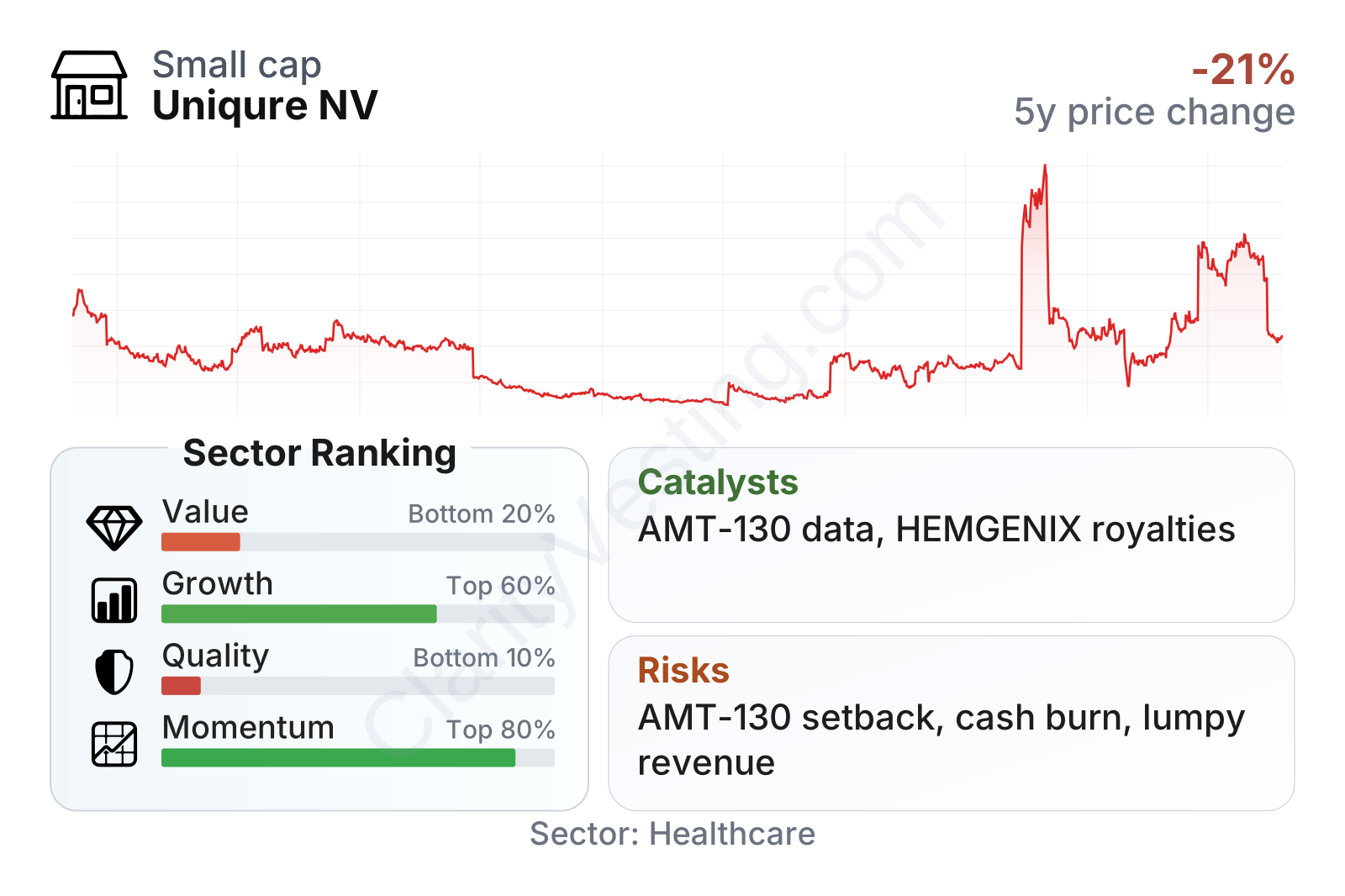
uniQure sits in the biotechnology segment where traditional valuation measures can be hard to interpret, but the broad picture is clear. The company is relatively small by market value, has a share price history marked by sharp swings, and currently ranks weakly on value and quality metrics versus much of the healthcare sector. Growth indicators look better than the quality profile, while price momentum over multi-year and one-year periods has been strong despite recent volatility. In plain English, the market is reacting to clinical and strategic developments more than to current profitability.
Growth
Gene therapy remains one of the more important long-term areas in biotechnology. The sector targets diseases that may be treated with a one-time or limited-course intervention rather than chronic dosing. If a therapy works well and shows durable benefit, it can support premium pricing and attract major pharmaceutical partners. That makes the field attractive, but also highly binary because success depends on clinical proof, safety, and regulatory acceptance.
uniQure’s strategy broadly makes sense for this kind of market. The company has built capabilities in AAV-based gene therapy, manufacturing, and liver-directed delivery, and it has already shown it can create an asset valuable enough to reach approval through a partner. That does not guarantee repeat success, but it does matter: many early-stage biotech companies have never brought any program close to commercialization.
The central growth catalyst is the clinical pipeline, especially AMT-130 for Huntington’s disease. Huntington’s is a serious inherited brain disorder with limited treatment options, so any therapy that can slow progression would be commercially and medically meaningful. Recent company updates have pointed to continued follow-up from treated patients and signs that support advancing the program. If later-stage development confirms these signals, AMT-130 could become a much larger value driver than the company’s current revenue base suggests.
Another growth pillar is the HEMGENIX royalty stream. Because the product is already approved, rising adoption could gradually improve the quality of uniQure’s revenue mix. Royalty income is usually more attractive than internally funded early-stage revenue because it can scale without the company bearing full launch costs. That said, the pace matters: ultra-rare disease launches can be uneven, especially when treatment prices are very high and payer negotiations are complex.
Recent revenue growth has been highly erratic rather than steadily compounding. There are periods of very strong year-over-year expansion followed by steep declines, which is typical for a company dependent on milestones and collaboration accounting. The latest trend shows improvement from depressed levels, but not yet the kind of consistency that would signal a mature commercial engine.
Cash generation remains negative, which is common in clinical-stage biotechnology but still important. Free cash flow has stayed deeply below zero in recent years, showing that progress in the pipeline has not yet translated into self-funding operations. For long-term analysis, this means the main question is not near-term earnings growth, but whether the company can convert scientific progress into durable revenue before capital needs become a larger issue.
A recent strategic positive is the company’s ongoing effort to prioritize high-value programs and manage spending more tightly than during earlier periods. In this industry, disciplined focus can materially improve the odds that cash lasts long enough to reach major clinical milestones.
Risks
This article is for informational purposes only and does not constitute financial advice. Some content is AI-generated. See Disclaimer


