Stock Analysis · Quilter plc (QUILF)
Overview
Quilter plc is a U.K.-based wealth management and advice group. In simple terms, it helps individuals invest, save for retirement, and receive financial advice. Its business is built around three main activities: managing investment platforms and accounts, providing financial advice through advisers, and running investment solutions for client portfolios.
The company’s earnings are mainly linked to assets under management or administration, which means revenue tends to rise when client money grows through new inflows or stronger markets. Based on recent annual reporting, the broad mix of revenue is centered on recurring fees from its platform and wealth businesses, with additional contributions from advice-related income and smaller amounts from other items.
- Platform and wealth administration fees: approximately 55% to 65% of revenue. This includes charges on investment wrappers, pensions, and other administered client assets.
- Investment management and portfolio-related fees: approximately 20% to 30% of revenue. This covers discretionary management, managed portfolios, and multi-asset solutions.
- Advice and distribution income: approximately 10% to 20% of revenue. This includes adviser network activity and related support services.
- Other revenue: a small remainder from legacy items, interest-related income, and miscellaneous sources.
That structure matters for long-term analysis because recurring asset-based fees usually make results more stable than one-off transactional businesses. At the same time, it also means Quilter is closely exposed to market levels and client sentiment.
The overall flow of the business shows a company with large top-line revenue swings but much thinner profit conversion. Revenue has rebounded strongly since the weak 2022 period, yet operating income and net income have remained much less consistent, which highlights how important cost control and operating efficiency are for the investment case.
Key Figures
| Metric | Value | Sector ⓘ |
|---|---|---|
| Date | Oct 03, 2026 | |
| Context | ||
| Sector | Financial Services | |
| Industry | Asset Management | |
| Market Cap ⓘ | $3.26B | |
| Beta ⓘ | 0.82 | |
Value (Cheapness) | ||
| P/E Ratio ⓘ | 22.05 | 12.60 |
| P/B Ratio ⓘ | 3.25 | 1.23 |
| FCF Yield ⓘ | 388.60% | 10.16% |
| Dividend Yield ⓘ | 2.64% | 2.96% |
| EBIT / EV ⓘ | N/A | 7.77% |
| PEG ⓘ | 0.85 | |
Growth (Business expansion) | ||
| Revenue Growth ⓘ | 160.80% | 9.50% |
| RPS Growth (5Y CAGR) ⓘ | 11.28% | 12.10% |
| EPS Growth (5Y CAGR) ⓘ | -1.62% | -9.45% |
| BVPS Growth (5Y CAGR) ⓘ | -10.31% | 5.01% |
| Margin Growth (5Y Trend) ⓘ | 1.61% | -4.07% |
| FCF Growth (5Y CAGR) ⓘ | 18.93% | 4.96% |
| DPS Growth (5Y CAGR) ⓘ | -7.75% | 8.79% |
Quality (Business durability) | ||
| ROIC (Latest) ⓘ | 10.01% | 9.60% |
| ROE (Latest) ⓘ | 8.42% | 13.84% |
| ROA (Latest) ⓘ | 0.16% | 1.53% |
| ROIC (5Y Median) ⓘ | 4.83% | 7.86% |
| ROE (5Y Median) ⓘ | 8.31% | 12.20% |
| ROA (5Y Median) ⓘ | 0.11% | 1.29% |
| Net Debt / EBIT (Latest) ⓘ | -3.74 | 0.91 |
| Net Debt / EBIT (5Y Median) ⓘ | -17.87 | 0.74 |
| Net Debt / EBITDA (Latest) ⓘ | -3.34 | 0.97 |
| Operating Margin (Latest) ⓘ | 3.04% | 22.12% |
| Operating Margin (5Y Median) ⓘ | 2.07% | 24.39% |
| Debt to Equity (Latest) ⓘ | 19.32% | 60.37% |
| Profit Margin (Latest) ⓘ | 0.88% | 26.62% |
| Free Cash Flow (Latest) ⓘ | $12.66B | |
Momentum (Price trend) | ||
| 3Y Return ⓘ | +171.98% | +89.23% |
| 12M Return (excl. last month) ⓘ | +29.01% | +17.35% |
| 6M Return ⓘ | -9.00% | +10.00% |
| Price vs. 200-Day MA ⓘ | -8.79% | +3.73% |
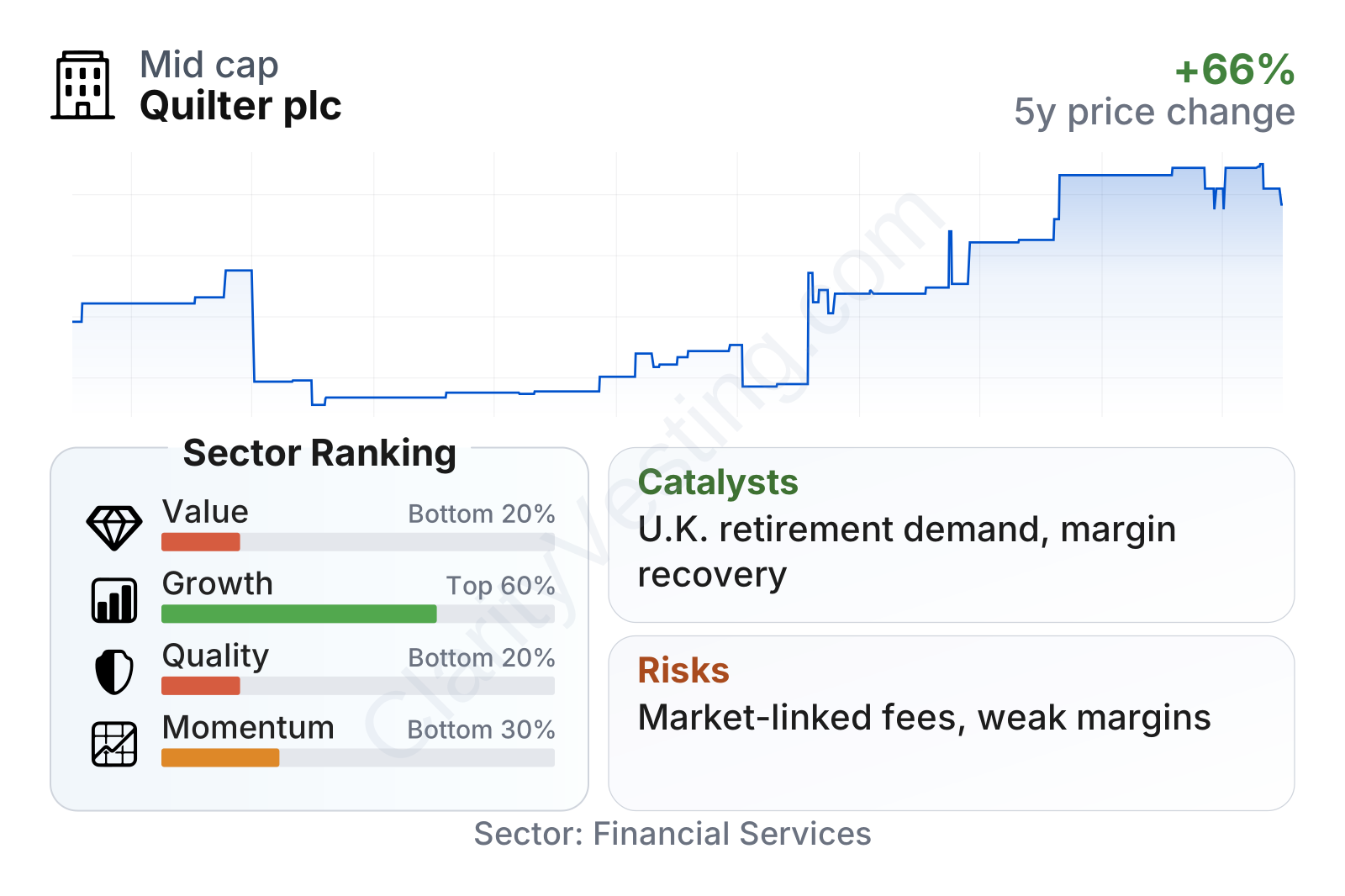
Quilter is a mid-sized financial services company with a relatively low share-price volatility profile, as shown by a beta below 1. The stock has had a strong multi-year recovery from its 2022 lows, although recent months have been softer and the shares currently sit below their 200-day average. That combination suggests the longer trend has improved, but momentum has cooled.
On valuation factors, the company screens as expensive relative to much of the financial sector, especially on earnings and book value multiples. On quality factors, the picture is mixed: balance-sheet leverage looks conservative, but profitability ratios and margins are weaker than many peers. Growth indicators are more encouraging, particularly on recent revenue growth, free cash flow expansion, and a gradual improvement in operating margin over the last five years, even if book value per share and dividends have moved in the wrong direction over that same period.
Growth
Quilter operates in a sector with durable long-term demand drivers. Aging populations, increasing responsibility on households to fund retirement, and the complexity of investment choices all support demand for advice, investment platforms, and managed solutions. In the U.K. market, these trends have been reinforced by the shift from traditional defined-benefit pensions toward defined-contribution savings and self-directed retirement planning.
The company’s strategy also makes sense in that context. It is trying to deepen relationships across advice, platform, and investment management rather than relying on a single product line. This can improve client retention because a customer using several Quilter services is generally harder to lose than one using only a single account. It also gives the business more chances to gather net inflows over time.
A key growth catalyst is operating leverage. Wealth and platform businesses often benefit when assets rise faster than costs. If markets remain constructive and net inflows stay positive, incremental revenue can potentially translate into better margins than the company has shown historically. Another important support is its solid balance-sheet position, which gives management room to invest in technology, distribution, and shareholder returns without the pressure that comes with heavy debt.
Recent operating trends also point to some improvement. Revenue growth has been very strong in the latest year, and free cash flow growth over five years has outpaced the sector median by a wide margin. That does not remove the volatility inherent in market-linked businesses, but it does suggest the franchise has become more productive than headline profit figures alone might imply.
One area to watch closely is book value per share, which has declined over the last five years rather than compounding upward. For a financial company, that is not ideal, because long-term value creation is often easier to demonstrate when book value grows steadily alongside client assets and earnings. The fact that margins have improved while book value per share has fallen suggests Quilter’s recovery is still incomplete rather than fully mature.
As for more recent developments, management has continued to emphasize simplification, efficiency, and focusing on core wealth businesses. For a company like Quilter, any sustained improvement in net client inflows, adviser productivity, and platform scale could become a meaningful earnings opportunity because the business model is built around recurring fees on a large asset base.
Risks
This article is for informational purposes only and does not constitute financial advice. Some content is AI-generated. See Disclaimer