Stock Analysis · Qantas Airways Limited (QUBSF)
Overview
Qantas Airways Limited is one of Australia’s largest airline groups. It operates passenger flights under the Qantas and Jetstar brands, runs a major loyalty program, and also has supporting businesses tied to freight, travel-related services, and aviation operations. For a long-term stock analysis, the key point is that Qantas is not just selling airline tickets. It combines a premium full-service airline, a low-cost carrier, and a rewards ecosystem that connects travel, banks, retailers, and other partners.
The company’s revenue base is mainly built around air travel, with loyalty and related activities providing an important second stream. Based on recent annual disclosures, the mix is approximately as follows:
- Domestic flying: about 40% to 45% — passenger revenue from travel within Australia, mainly through Qantas Domestic and Jetstar domestic operations.
- International flying: about 30% to 35% — long-haul and regional international passenger services operated by Qantas and Jetstar.
- Loyalty: about 10% to 15% — points sold to banks, card issuers, retailers, and other partners, plus member-related redemption and engagement activity.
- Freight and other airline-related activities: about 10% to 15% — cargo, holiday and travel services, engineering or operational support, and other smaller business lines.
That business mix matters because the loyalty division is typically less capital-intensive and less cyclical than airline operations, while domestic air travel gives Qantas strong exposure to its home market. The company has also rebuilt revenue strongly since the pandemic period, although profitability remains sensitive to costs, aircraft availability, and ticket pricing.
The broad trend over recent years has been a sharp recovery from the pandemic low, followed by continued revenue growth and a return to solid profitability. More recently, revenue has kept rising, but margins appear less elevated than the initial rebound phase, which is common in airlines as fuel, labor, fleet, and capacity pressures normalize.
Key Figures
| Metric | Value | Sector ⓘ |
|---|---|---|
| Date | Oct 24, 2026 | |
| Context | ||
| Sector | Industrials | |
| Industry | Airlines | |
| Market Cap ⓘ | $8.40B | |
| Beta ⓘ | 0.63 | |
Value (Cheapness) | ||
| P/E Ratio ⓘ | 9.74 | 22.29 |
| P/B Ratio ⓘ | 5.72 | 1.98 |
| FCF Yield ⓘ | 1.60% | 6.26% |
| Dividend Yield ⓘ | 4.98% | 1.92% |
| EBIT / EV ⓘ | N/A | 4.83% |
| PEG ⓘ | 0.40 | |
Growth (Business expansion) | ||
| Revenue Growth ⓘ | 7.90% | 9.30% |
| RPS Growth (5Y CAGR) ⓘ | 35.92% | 7.76% |
| EPS Growth (5Y CAGR) ⓘ | N/A | -13.17% |
| BVPS Growth (5Y CAGR) ⓘ | 29.12% | 6.13% |
| Margin Growth (5Y Trend) ⓘ | 23.12% | 0.74% |
| FCF Growth (5Y CAGR) ⓘ | -31.39% | 10.79% |
| DPS Growth (5Y CAGR) ⓘ | 10.94% | 9.41% |
Quality (Business durability) | ||
| ROIC (Latest) ⓘ | N/A | 10.75% |
| ROA (Latest) ⓘ | 11.85% | 5.41% |
| ROIC (5Y Median) ⓘ | 22.05% | 9.37% |
| ROA (5Y Median) ⓘ | 6.13% | 4.95% |
| Net Debt / EBIT (Latest) ⓘ | 1.66 | 2.04 |
| Net Debt / EBIT (5Y Median) ⓘ | 2.28 | 2.27 |
| Net Debt / EBITDA (Latest) ⓘ | 0.83 | 1.39 |
| Net Debt / Assets ⓘ | 26.18% | 19.27% |
| EBITDA / Interest ⓘ | 13.48 | 9.58 |
| Operating Margin (Latest) ⓘ | 8.68% | 10.49% |
| Operating Margin (5Y Median) ⓘ | 9.83% | 10.30% |
| Debt to Equity (Latest) ⓘ | 690.59% | 64.82% |
| Profit Margin (Latest) ⓘ | 5.05% | 6.67% |
| Free Cash Flow (Latest) ⓘ | $134.13M | |
Momentum (Price trend) | ||
| 3Y Return ⓘ | +112.95% | +67.77% |
| 12M Return (excl. last month) ⓘ | +0.50% | +12.05% |
| 6M Return ⓘ | -12.94% | 0.00% |
| Price vs. 200-Day MA ⓘ | +13.29% | +0.67% |
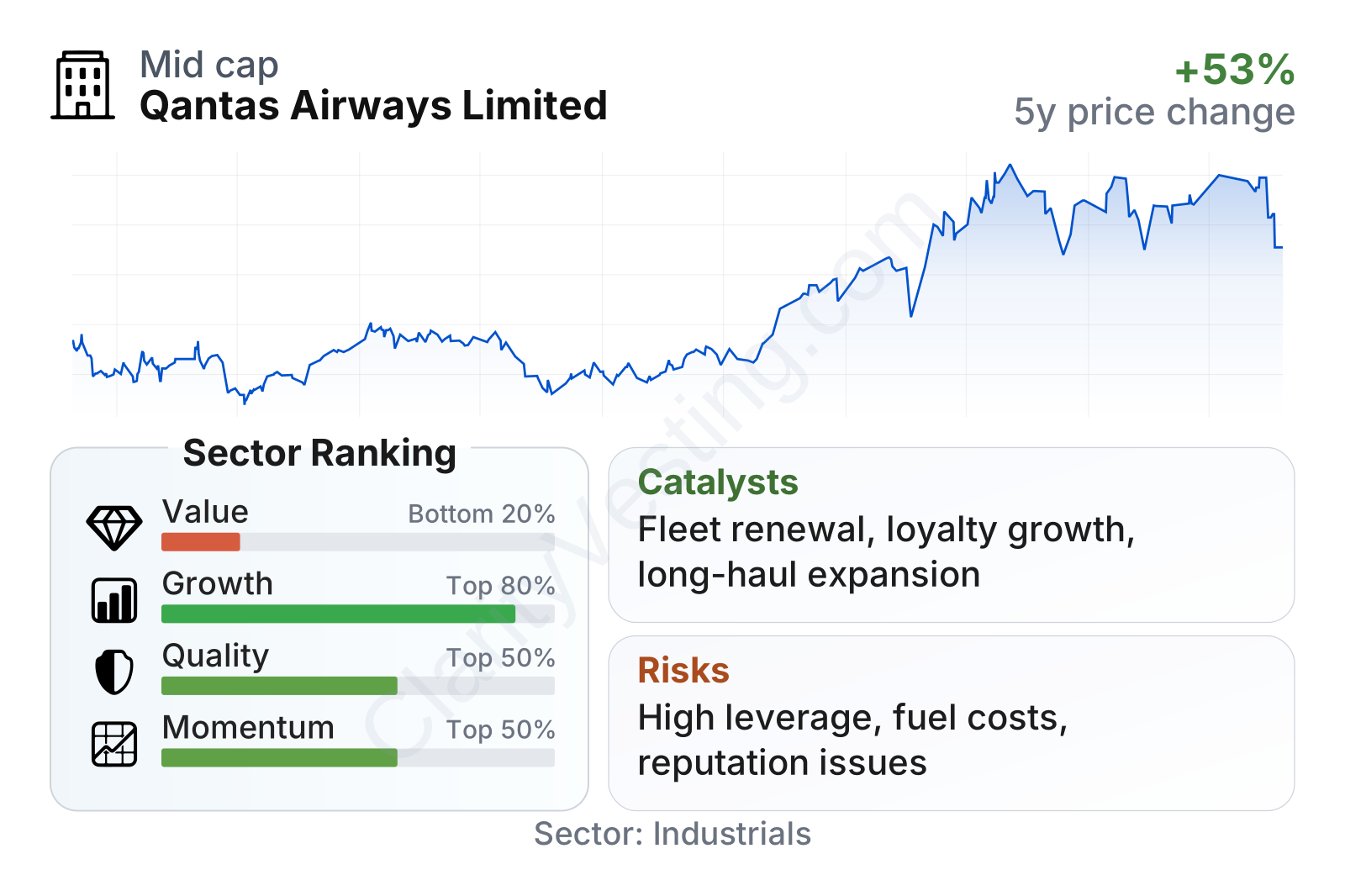
Qantas stands out as a mid-to-large airline group rather than a small niche operator. The recent stock performance has been strong over the past three years, even if shorter-term moves have been more mixed. In the factor breakdown, growth and business quality look better than many sector peers, while value metrics are more uneven. The low earnings multiple suggests the market is not assigning a rich valuation to current profits, but the high price-to-book ratio and relatively modest free cash flow yield show that the picture is not uniformly cheap. Financial strength looks reasonable in several operating debt measures, yet headline leverage based on equity appears unusually high, which is important for understanding the balance sheet.
Growth
Air travel remains a structurally growing market over the long run, supported by population growth, tourism, business travel, and rising demand in Asia-Pacific. Australia is a particularly important aviation market because of geography: flying is essential for many domestic and international routes. That gives Qantas a durable role in transport infrastructure, especially on domestic networks and key long-haul corridors.
Qantas’s strategy for future growth is relatively coherent. It is balancing premium and budget travel through the Qantas and Jetstar brands, while also investing in the loyalty ecosystem, which can grow even when ticket demand is less favorable. This combination is useful because loyalty earnings can provide some diversification from the ups and downs of airline operations. The company has also been renewing its fleet, which can improve fuel efficiency, reliability, and customer experience over time.
Growth has been respectable rather than explosive in the latest period, with year-over-year revenue rising by about 8%, a bit below the broader sector median. Still, the longer view is stronger: five-year revenue per share growth has been far ahead of many industry peers, and operating margins have improved meaningfully compared with the pre-recovery period. That suggests Qantas has not only benefited from the industry rebound but has also converted it into a better earnings base.
One of the stronger catalysts is the company’s long-range fleet and network development, including major aircraft renewal and long-haul expansion initiatives. These projects can increase efficiency and open higher-value international routes over time. Another catalyst is loyalty monetization: Qantas Frequent Flyer has become a broad consumer platform, not just a travel rewards program, which can deepen partner relationships and create recurring cash generation. Capacity discipline in the Australian market also remains relevant, since a relatively concentrated domestic industry can support pricing better than highly fragmented markets.
Recent company updates have also pointed to continued investment in fleet modernization and customer proposition upgrades. For a long-term view, these are significant because airlines that fail to renew fleets can lose cost competitiveness for many years.
Risks
This article is for informational purposes only and does not constitute financial advice. Some content is AI-generated. See Disclaimer


