Stock Analysis · Quantinuum Inc (QNT)
Overview
Quantinuum is a quantum computing company formed from the combination of Honeywell Quantum Solutions and Cambridge Quantum. Its business sits at the intersection of advanced computing hardware and software. In simple terms, the company is trying to build computers that can solve certain problems far more efficiently than conventional machines, while also selling software tools, cybersecurity products, and access to its systems through cloud-based platforms.
The company is still at an early commercial stage. Public information indicates that revenue is generated from a mix of quantum computing access, software and cybersecurity offerings, research collaborations, and government or enterprise development contracts. Because Quantinuum does not yet provide a detailed public segment breakdown in the same way as a mature public company filing full SEC operating segment disclosures, any split should be treated as approximate rather than exact.
A practical way to think about its revenue sources is the following:
- Quantum computing access and hardware-related services: likely the largest category. This includes cloud access to quantum systems, usage fees, and work tied to the company’s trapped-ion hardware platform.
- Software and cybersecurity products: a meaningful share. This includes quantum software tools and encryption or security offerings developed from the company’s quantum expertise.
- Research, partnership, and government contract work: also meaningful. This includes funded projects with public agencies, national labs, and large enterprise partners.
What is clearer than the exact mix is the current economic profile: revenue remains small relative to operating spending, and research and development is by far the dominant cost center. That is typical for a frontier-technology company still trying to convert technical leadership into scaled commercial demand.
The business flow also shows a notable shift between 2024 and 2025. Revenue moved up from roughly $23 million to about $31 million, but operating expenses expanded much faster, especially in research and development. Gross profit improved, yet losses remained very large because the company continued to spend aggressively to build technology, products, and market presence.
Key Figures
| Metric | Value | Sector ⓘ |
|---|---|---|
| Date | Oct 24, 2026 | |
| Context | ||
| Sector | Technology | |
| Industry | Software - Application | |
| Market Cap ⓘ | $9.28B | |
| Beta ⓘ | N/A | |
Value (Cheapness) | ||
| P/E Ratio ⓘ | N/A | 29.68 |
| FCF Yield ⓘ | -2.93% | 4.28% |
| Dividend Yield ⓘ | N/A | 1.30% |
| EBIT / EV ⓘ | N/A | 2.70% |
| PEG ⓘ | N/A | |
Growth (Business expansion) | ||
| Revenue Growth ⓘ | 279.40% | 15.80% |
| RPS Growth (5Y CAGR) ⓘ | N/A | 8.56% |
| EPS Growth (5Y CAGR) ⓘ | N/A | -11.54% |
| Margin Growth (5Y Trend) ⓘ | N/A | 0.46% |
| FCF Growth (5Y CAGR) ⓘ | N/A | 9.76% |
| DPS Growth (5Y CAGR) ⓘ | N/A | 7.79% |
Quality (Business durability) | ||
| ROIC (Latest) ⓘ | N/A | 9.38% |
| ROIC (5Y Median) ⓘ | N/A | 8.32% |
| Net Debt / EBIT (Latest) ⓘ | N/A | 0.52 |
| Net Debt / EBIT (5Y Median) ⓘ | N/A | 0.46 |
| Net Debt / EBITDA (Latest) ⓘ | N/A | 0.28 |
| Net Debt / Assets ⓘ | -64.30% | 3.44% |
| EBITDA / Interest ⓘ | N/A | 13.20 |
| Operating Margin (Latest) ⓘ | -2234.48% | 9.70% |
| Operating Margin (5Y Median) ⓘ | N/A | 8.51% |
| Debt to Equity (Latest) ⓘ | 7.23% | 33.40% |
| Profit Margin (Latest) ⓘ | N/A | 7.14% |
| Free Cash Flow (Latest) ⓘ | -$271.76M | |
Momentum (Price trend) | ||
| 3Y Return ⓘ | N/A | +55.43% |
| 12M Return (excl. last month) ⓘ | N/A | +10.33% |
| 6M Return ⓘ | N/A | +7.97% |
| Price vs. 200-Day MA ⓘ | N/A | +5.41% |
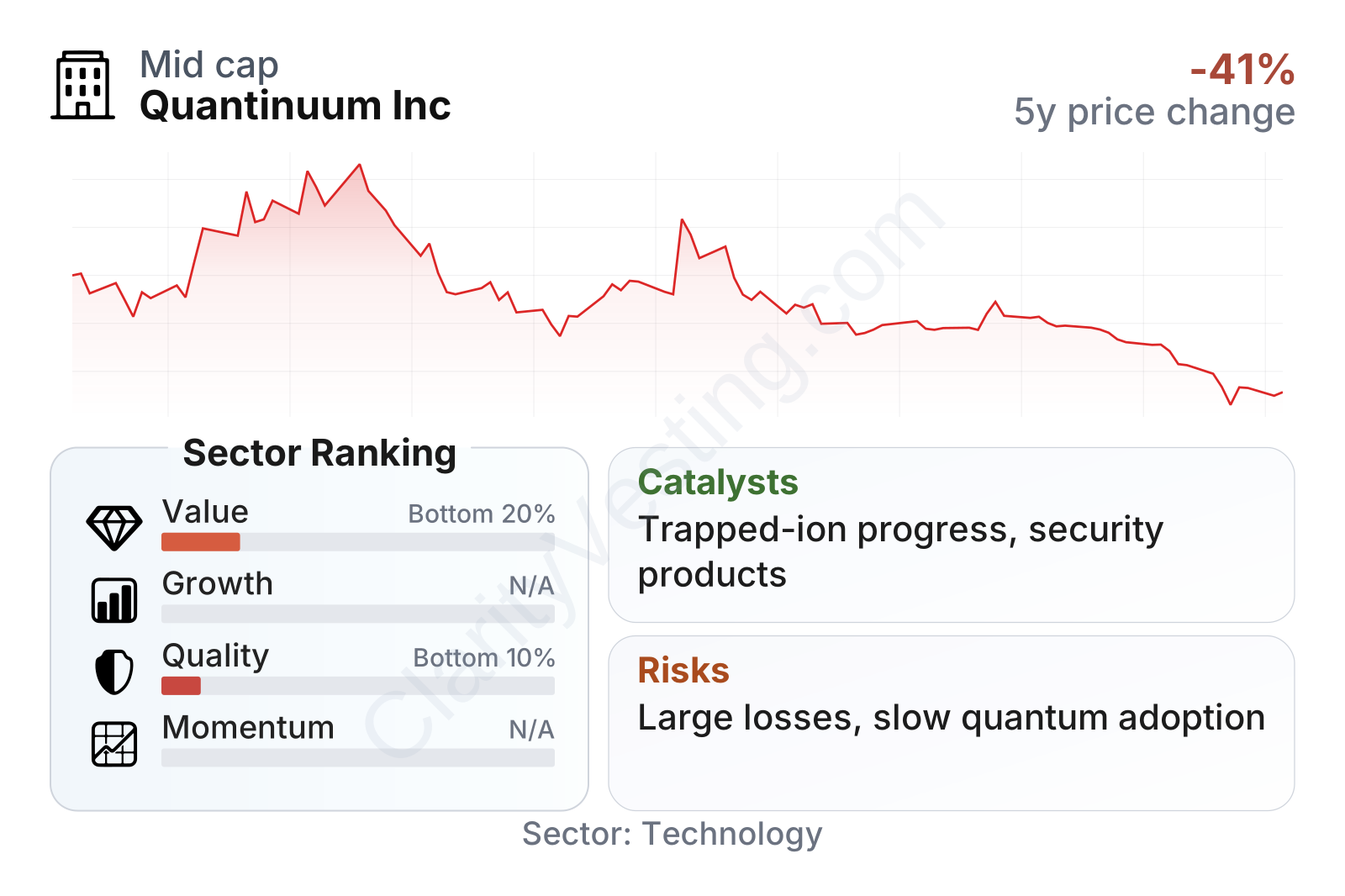
The picture is unusual and very polarized. On one side, growth is exceptionally strong compared with the broader software sector, with year-over-year revenue expansion far above the sector median. On the other side, profitability and cash generation remain weak, which pushes the company into the lowest part of the sector on valuation-related measures. The balance sheet appears relatively clean, with very low debt-to-equity and net cash characteristics, but that financial strength mainly buys time for execution rather than proving the business model is already mature.
The recent share-price move also points to volatility. The stock has pulled back materially from early June to early September 2026, which is common for companies whose valuation depends heavily on future expectations rather than current earnings. In short, the market is assigning meaningful value to long-term potential, while the near-term numbers still reflect a business in investment mode.
Growth
Quantinuum operates in a sector with very large long-term potential. Quantum computing is still early, but it attracts sustained interest from governments, defense organizations, pharmaceutical companies, materials researchers, and major technology platforms because it could eventually improve optimization, simulation, cryptography, and machine learning workflows. That does not mean broad commercial adoption is immediate, but it does mean the addressable market could expand substantially if technical performance keeps improving.
The company’s strategy is coherent for that setting. It is not relying on a single product. Instead, it combines hardware development, software tools, cloud access, and security applications. That matters because fully scaled quantum computing may still take time, while software and cybersecurity offerings can create earlier commercial relationships and help customers build familiarity with the platform. This diversified approach can strengthen customer engagement before the hardware opportunity reaches larger scale.
A major growth catalyst is Quantinuum’s trapped-ion architecture. Among quantum computing approaches, trapped-ion systems are often recognized for strong qubit fidelity and quality, which are important if customers want useful and reproducible results rather than just larger qubit counts. The company has also emphasized error correction, system performance benchmarks, and a roadmap toward more capable machines, all of which are central to whether demand broadens beyond experimentation.
Another important catalyst is strategic backing. Quantinuum has benefited from Honeywell roots and from support tied to large institutional and industrial relationships. In the quantum industry, credibility matters because customers often commit first through pilot projects and long development cycles. A company that can show technical progress, ecosystem partnerships, and repeat access agreements has a better chance of converting scientific interest into recurring revenue.
Recent public developments have also reinforced the opportunity set. Quantinuum has continued to announce work around quantum error correction, commercial partnerships, and product expansion in security and software. None of this guarantees near-term scale, but it does indicate that the company is not standing still in a research lab; it is trying to build a broader commercial platform around its core technology.
Risks
This article is for informational purposes only and does not constitute financial advice. Some content is AI-generated. See Disclaimer


