Stock Analysis · Qingdao Port International Co. Ltd (QNDPF)
Overview
Qingdao Port International Co. Ltd operates one of China’s major coastal port systems, centered on Qingdao in Shandong Province. Its business is straightforward: it helps move cargo in and out of China, stores it, and provides the logistics services needed around port activity. That makes the company an infrastructure operator tied to trade volumes, industrial production, commodity flows, and regional manufacturing.
The company’s revenue comes from several port-related activities. Based on the company’s annual reporting structure, the largest sources are typically cargo handling and related services, followed by logistics and port value-added services, with smaller contributions from port ancillary activities. The exact mix can shift by year depending on commodity throughput, container traffic, and pricing.
- Metal ore, coal and other bulk cargo handling: the core activity, covering loading, unloading, stacking, and storage for major industrial commodities.
- Container handling: services for containerized imports and exports, including terminal operations.
- Liquid bulk and general cargo: handling for oil, chemicals, and other non-container goods.
- Logistics and port ancillary services: warehousing, towing, agency services, and other support activities around the port ecosystem.
For a simple long-term view, the important point is that this is not a speculative technology business or a cyclical shipowner. It is a port operator with assets that are hard to replicate, a local strategic role, and cash generation that comes from physical trade moving through its network.
Over the last several years, revenue has stayed in a fairly stable range overall, while net income remained strong. One notable pattern is that profitability has held up better than sales growth, suggesting disciplined operations and a favorable business mix even when trade activity has been uneven.
The business has translated a large share of revenue into operating profit and net income, which is unusual in a transport-related industry where margins are often much thinner. That helps explain why the company stands out on profitability and cash generation despite only moderate top-line expansion.
Key Figures
| Metric | Value | Sector ⓘ |
|---|---|---|
| Date | Oct 24, 2026 | |
| Context | ||
| Sector | Industrials | |
| Industry | Marine Shipping | |
| Market Cap ⓘ | $5.67B | |
| Beta ⓘ | 0.54 | |
Value (Cheapness) | ||
| P/E Ratio ⓘ | 7.94 | 22.29 |
| P/B Ratio ⓘ | 0.12 | 1.98 |
| FCF Yield ⓘ | 46.71% | 6.26% |
| Dividend Yield ⓘ | 38.80% | 1.92% |
| EBIT / EV ⓘ | N/A | 4.83% |
| PEG ⓘ | N/A | |
Growth (Business expansion) | ||
| Revenue Growth ⓘ | 14.60% | 9.30% |
| RPS Growth (5Y CAGR) ⓘ | 3.90% | 7.76% |
| EPS Growth (5Y CAGR) ⓘ | -33.39% | -13.17% |
| BVPS Growth (5Y CAGR) ⓘ | 4.24% | 6.13% |
| Margin Growth (5Y Trend) ⓘ | -2.87% | 0.74% |
| FCF Growth (5Y CAGR) ⓘ | 164.62% | 10.79% |
| DPS Growth (5Y CAGR) ⓘ | 11.73% | 9.41% |
Quality (Business durability) | ||
| ROIC (Latest) ⓘ | N/A | 10.75% |
| ROA (Latest) ⓘ | 7.31% | 5.41% |
| ROIC (5Y Median) ⓘ | 11.28% | 9.37% |
| ROA (5Y Median) ⓘ | 7.93% | 4.95% |
| Net Debt / EBIT (Latest) ⓘ | N/A | 2.04 |
| Net Debt / EBIT (5Y Median) ⓘ | -1.07 | 2.27 |
| Net Debt / EBITDA (Latest) ⓘ | -1.34 | 1.39 |
| Net Debt / Assets ⓘ | -12.72% | 19.27% |
| EBITDA / Interest ⓘ | 51.05 | 9.58 |
| Operating Margin (Latest) ⓘ | N/A | 10.49% |
| Operating Margin (5Y Median) ⓘ | 30.53% | 10.30% |
| Debt to Equity (Latest) ⓘ | 10.82% | 64.82% |
| Profit Margin (Latest) ⓘ | 26.18% | 6.67% |
| Free Cash Flow (Latest) ⓘ | $2.65B | |
Momentum (Price trend) | ||
| 3Y Return ⓘ | +97.20% | +67.77% |
| 12M Return (excl. last month) ⓘ | +8.52% | +12.05% |
| 6M Return ⓘ | +5.95% | 0.00% |
| Price vs. 200-Day MA ⓘ | +4.11% | +0.67% |
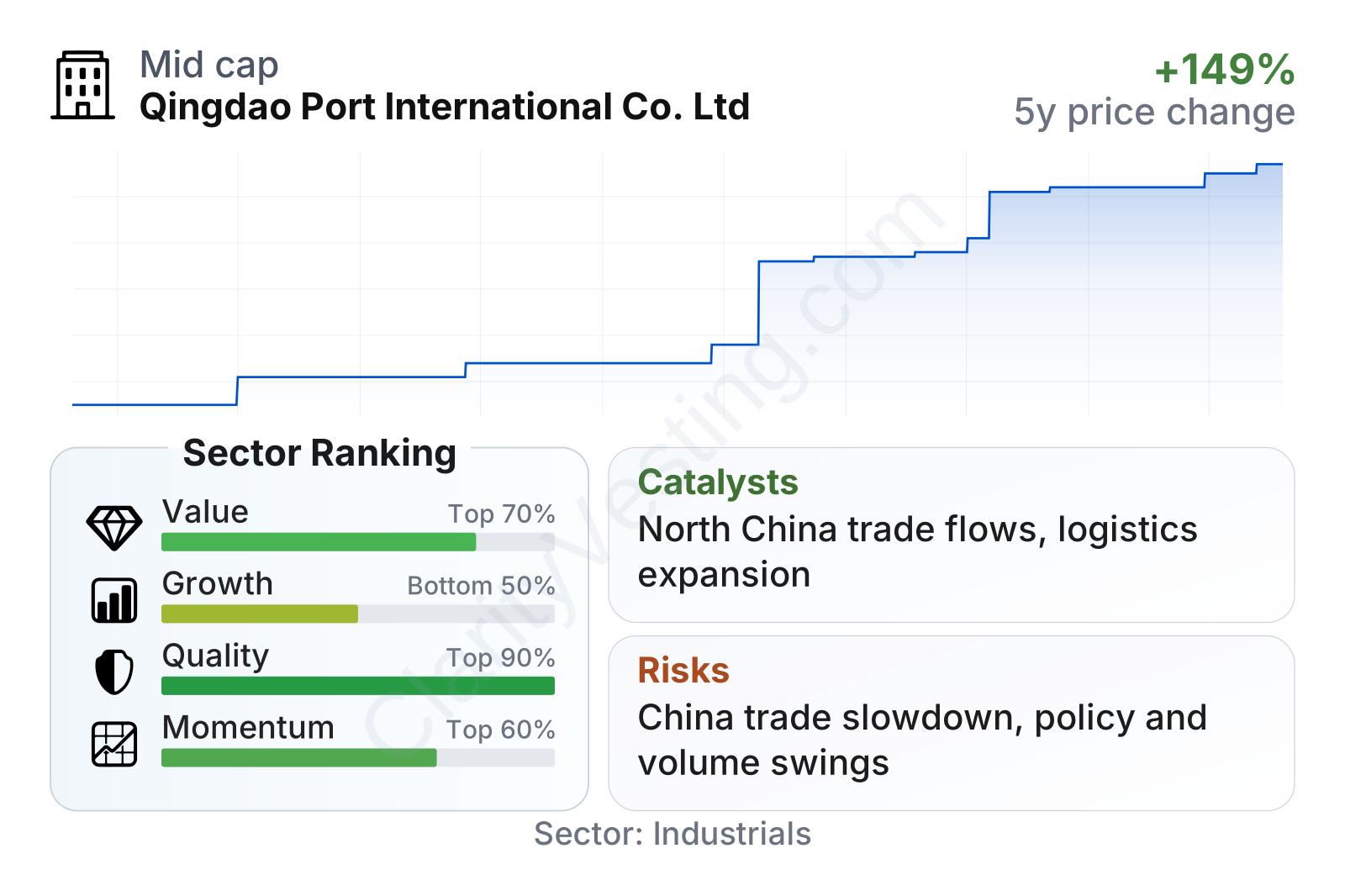
The table points to an unusual combination: very strong quality metrics, moderate growth, and low headline valuation multiples. Qingdao Port appears financially conservative, with low market sensitivity, strong returns on assets, and balance-sheet leverage well below the sector norm. Growth has been less impressive over a five-year view, especially for earnings per share, but cash generation and distributions have remained notable strengths.
The share price trend has been positive over the last three years, although the recent pace has been calmer than the broader sector. That profile fits a mature infrastructure business better than a high-growth transport name.
Growth
Port infrastructure is part of a sector with long-term relevance rather than rapid disruption. Global trade patterns can fluctuate, but large ports remain essential links in supply chains. In China, major coastal ports also benefit from industrial clustering, export activity, and inland distribution networks. For Qingdao Port, this means growth is likely to come less from dramatic reinvention and more from throughput gains, efficiency improvements, logistics integration, and mix upgrades toward higher-value cargo and services.
The company’s strategy broadly makes sense for that environment. A port operator grows by attracting more cargo, improving turnaround efficiency, expanding logistics services around the port, and deepening links with shipping lines and industrial customers. Because Qingdao is an important northern Chinese gateway, the company has a structural position that can support incremental expansion over time even if annual growth remains uneven.
Recent revenue growth has been volatile, which is normal for a trade-linked business. There were periods of contraction followed by renewed acceleration, and the latest readings show a return to double-digit year-over-year growth. That suggests the company is still capable of benefiting when trade conditions and cargo mix improve, even though the longer-term growth profile remains moderate compared with faster-moving industrial segments.
Cash generation is one of the most encouraging parts of the picture. Free cash flow rose sharply through 2025 before pulling back in the most recent period, but it still remains substantial in absolute terms. For a capital-intensive company, that matters more than revenue growth alone because it shows the business can fund operations, maintain infrastructure, and support shareholder distributions without relying heavily on debt.
A meaningful catalyst is the company’s exposure to large-scale commodity and container flows tied to northern China. If industrial demand, imports of raw materials, or regional logistics activity stay firm, Qingdao Port can benefit from rising throughput. Another positive factor is that port businesses often gain from operating leverage: once infrastructure is in place, additional volume can support profits efficiently.
Recent public company communications have also highlighted ongoing operational development and capacity utilization efforts, which fit the broader theme of steady infrastructure-led growth rather than transformational expansion.
Risks
This article is for informational purposes only and does not constitute financial advice. Some content is AI-generated. See Disclaimer


