Stock Analysis · Qiagen NV (QGEN)
Overview
Qiagen NV is a life sciences and diagnostics company focused on sample and assay technologies. In simple terms, it provides the tools that help laboratories isolate biological material such as DNA and RNA, analyze it, and turn that analysis into research findings or medical testing results. Its products are used by pharmaceutical companies, hospitals, public health agencies, academic labs, and forensic teams.
The business is built around consumables, instruments, and bioinformatics. Consumables are especially important because they are used repeatedly in lab workflows, which can create recurring demand once a customer adopts Qiagen’s platform. The company is active in molecular diagnostics, genomics research, and clinical testing, with a presence in areas such as cancer testing, infectious disease testing, and syndromic testing.
Based on the company’s reporting structure, revenue mainly comes from the following sources:
- Consumables and related products: approximately 80% to 85% of revenue. This includes sample preparation kits, assay consumables, reagents, and testing cartridges used repeatedly in laboratories and diagnostic settings.
- Instruments and automation systems: approximately 15% to 20% of revenue. These are the machines and platforms that run the company’s assays and support laboratory workflows.
Qiagen also reports revenue by customer class, which helps explain where demand comes from:
- Molecular Diagnostics: roughly 45% to 50% of sales in recent years, including clinical testing applications and regulated diagnostic products.
- Life Sciences: roughly 40% to 45% of sales, serving academic, biotech, and pharmaceutical research customers.
- Applied Testing: roughly 10% to 15% of sales, including forensics, food, veterinary, and other non-clinical uses.
Geographically, Qiagen is diversified, with revenue spread across the Americas, Europe/Middle East/Africa, and Asia-Pacific rather than relying on a single market. That helps reduce dependence on any one healthcare system or research budget.
The profit structure shows a business with high gross margins and meaningful spending on research and development, which is typical for a diagnostics tools company. Revenue and operating profit weakened after the pandemic testing boom faded, but the business recovered in 2025 with better profitability and lower interest expense, suggesting the company remains operationally resilient despite uneven growth.
Key Figures
| Metric | Value | Sector ⓘ |
|---|---|---|
| Date | Oct 24, 2026 | |
| Context | ||
| Sector | Healthcare | |
| Industry | Diagnostics & Research | |
| Market Cap ⓘ | $10.32B | |
| Beta ⓘ | 0.61 | |
Value (Cheapness) | ||
| P/E Ratio ⓘ | 25.38 | 25.42 |
| P/B Ratio ⓘ | 3.11 | 3.08 |
| FCF Yield ⓘ | 4.34% | 3.12% |
| Dividend Yield ⓘ | 0.74% | 1.85% |
| EBIT / EV ⓘ | 5.08% | 0.56% |
| PEG ⓘ | 1.17 | |
Growth (Business expansion) | ||
| Revenue Growth ⓘ | 0.30% | 7.50% |
| RPS Growth (5Y CAGR) ⓘ | 0.12% | 8.60% |
| EPS Growth (5Y CAGR) ⓘ | -19.70% | -17.73% |
| BVPS Growth (5Y CAGR) ⓘ | 7.20% | 3.72% |
| Margin Growth (5Y Trend) ⓘ | -5.16% | -0.57% |
| FCF Growth (5Y CAGR) ⓘ | 1.18% | 0.96% |
| DPS Growth (5Y CAGR) ⓘ | -37.52% | 6.69% |
Quality (Business durability) | ||
| ROIC (Latest) ⓘ | 8.38% | 3.17% |
| ROA (Latest) ⓘ | 6.58% | 2.98% |
| ROIC (5Y Median) ⓘ | 8.73% | 4.56% |
| ROA (5Y Median) ⓘ | 6.81% | 1.87% |
| Net Debt / EBIT (Latest) ⓘ | 1.75 | 1.34 |
| Net Debt / EBIT (5Y Median) ⓘ | 2.12 | 1.86 |
| Net Debt / EBITDA (Latest) ⓘ | 1.24 | 1.00 |
| Net Debt / Assets ⓘ | 14.86% | 5.06% |
| EBITDA / Interest ⓘ | 17.84 | 9.55 |
| Operating Margin (Latest) ⓘ | 23.87% | 9.25% |
| Operating Margin (5Y Median) ⓘ | 25.05% | 7.33% |
| Debt to Equity (Latest) ⓘ | 48.95% | 26.68% |
| Profit Margin (Latest) ⓘ | 19.49% | 3.34% |
| Free Cash Flow (Latest) ⓘ | $447.70M | |
Momentum (Price trend) | ||
| 3Y Return ⓘ | +48.03% | +51.61% |
| 12M Return (excl. last month) ⓘ | +1.58% | +19.90% |
| 6M Return ⓘ | +26.78% | +10.10% |
| Price vs. 200-Day MA ⓘ | +18.80% | +6.44% |
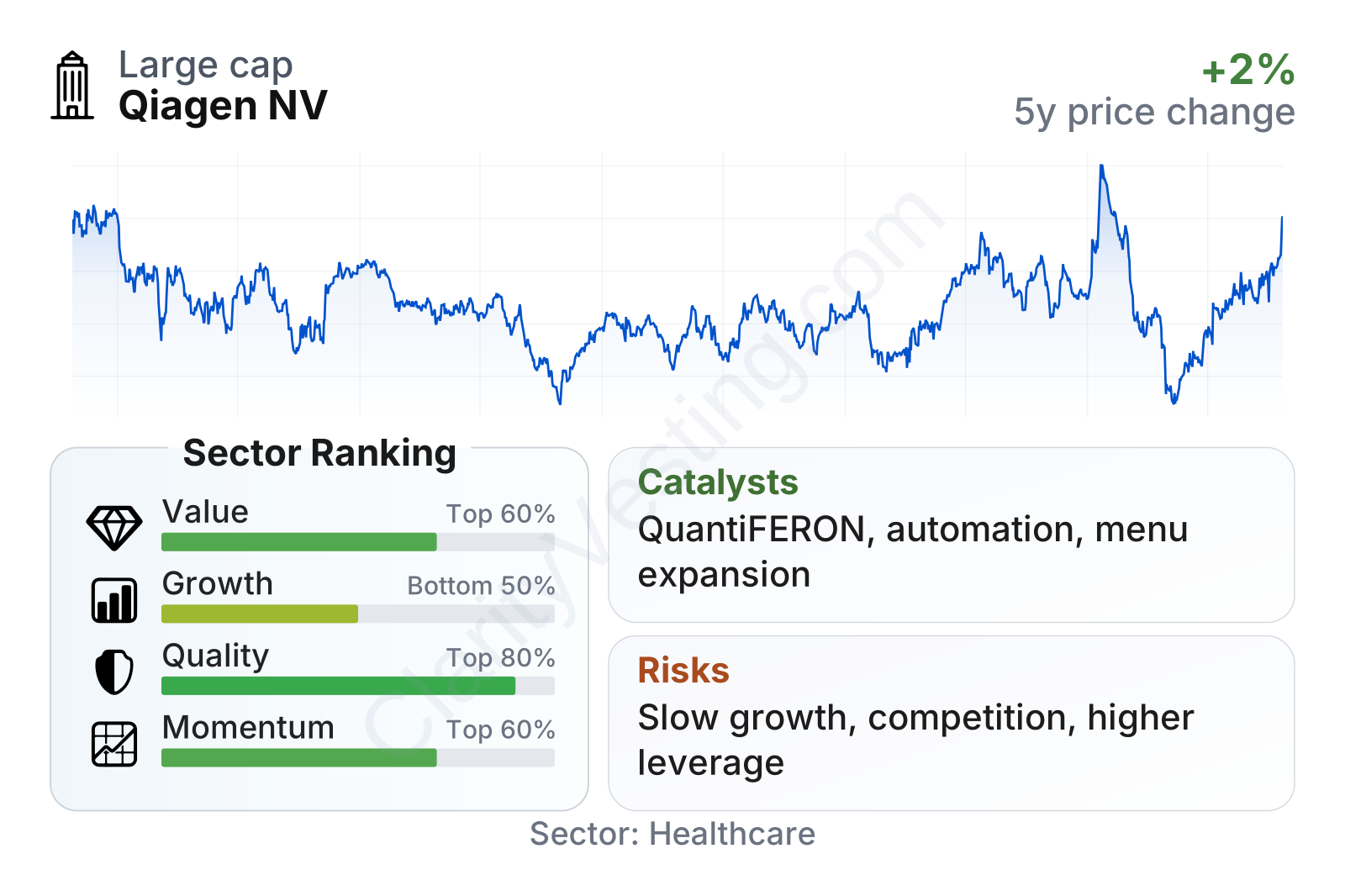
Qiagen is a mid-sized healthcare company with a relatively low beta, meaning its stock has historically moved less than the broader market. The overall profile is mixed in a useful way for long-term analysis: quality metrics are strong, value metrics are around the better half of the sector, while growth and momentum are weaker. Profitability stands out clearly, with returns on capital, operating margin, and profit margin well above sector medians. Free cash flow generation is also solid, which supports flexibility for acquisitions, debt service, and share repurchases. The weaker area is growth, where recent revenue expansion has been modest compared with many healthcare peers.
Growth
Qiagen operates in attractive long-term markets. Molecular diagnostics, genomics, precision medicine, and laboratory automation are all areas supported by durable structural demand. Healthcare systems continue to move toward earlier detection, more targeted therapies, and broader use of genetic information in both research and clinical practice. Those trends support demand for the kind of testing workflows and consumables that Qiagen sells.
The company’s strategy also makes industrial sense. A large installed base of instruments can lead to recurring sales of consumables, while bioinformatics and workflow integration can make customer relationships stickier. This is particularly relevant in regulated or validated lab settings, where switching costs can be meaningful once a protocol is established.
Recent growth has been real, but not especially fast. After a difficult post-pandemic reset in 2022 and 2023, revenue growth turned positive again through 2024 and 2025, then slowed back to around flat levels by mid-2026. That pattern suggests the business has stabilized, but it has not yet shown the kind of broad acceleration seen in stronger growth names across healthcare tools.
Cash generation remains an important support for the growth case. Free cash flow has stayed in the several-hundred-million-dollar range even through a choppy period, which indicates the core business still converts earnings into cash at a healthy rate. That gives Qiagen room to invest in new product launches, menu expansion, software capabilities, and selective acquisitions without relying heavily on external financing.
One of the more important catalysts is the company’s exposure to QuantiFERON, its blood-based test for tuberculosis infection, which management has highlighted as a growth driver in recent years. The broader syndromic testing and oncology-related portfolio also matters, especially as labs seek faster and more comprehensive testing solutions. In addition, continued adoption of automation and integrated sample-to-insight workflows could support a steadier recurring revenue mix over time.
Recent company updates have also pointed to product launches and regulatory progress in areas tied to clinical testing and laboratory efficiency. For a business like Qiagen, those developments matter because even modest menu expansion can improve utilization of existing platforms and strengthen recurring revenue from consumables.
Risks
This article is for informational purposes only and does not constitute financial advice. Some content is AI-generated. See Disclaimer


