Stock Analysis · QCR Holdings Inc (QCRH)
Overview
QCR Holdings Inc. is a regional bank holding company that operates community-focused banking franchises in the Midwest. Through brands such as Quad City Bank & Trust, Cedar Rapids Bank & Trust, Community State Bank, Guaranty Bank, and Springfield First Community Bank, it provides traditional banking services to businesses and consumers. Its business is centered on gathering deposits, making commercial and consumer loans, offering treasury and payment services, and earning fees from wealth management and other banking activities.
Like most regional banks, QCR Holdings makes most of its money from the spread between what it earns on loans and securities and what it pays on deposits and other funding. Based on recent annual reporting, the revenue mix is still overwhelmingly banking-driven, with noninterest income playing a supporting role.
- Net interest income: approximately 75% to 80% of total revenue. This is the core banking engine and comes mainly from commercial real estate loans, commercial and industrial loans, residential real estate lending, and investment securities, minus funding costs.
- Wealth management and trust fees: approximately 5% to 8%. This includes advisory, fiduciary, and related account fees.
- Card, treasury management, and deposit service charges: approximately 4% to 7%. This includes payment-related fees, service charges on deposit accounts, and cash-management services for business clients.
- Mortgage banking, capital markets, and other fee income: approximately 8% to 12%. This generally includes gains on loan sales, swap fee activity tied to commercial clients, and other miscellaneous banking fees.
QCR Holdings is not a national banking giant. It is a smaller regional player with a market value in the lower mid-cap range, which makes local execution, credit discipline, and deposit gathering especially important to its results. Over the last several years, total revenue has expanded materially, while net income has remained comparatively steady before improving again in 2025, showing both growth potential and the effect of changing interest-rate conditions on bank profitability.
Revenue has risen strongly since 2021, while operating expenses have grown at a slower pace than the top line in the most recent two years. At the same time, funding costs and interest expense climbed sharply during the higher-rate period, which helps explain why profit growth was steadier than revenue growth.
Key Figures
| Metric | Value | Sector ⓘ |
|---|---|---|
| Date | Oct 17, 2026 | |
| Context | ||
| Sector | Financial Services | |
| Industry | Banks - Regional | |
| Market Cap ⓘ | $1.59B | |
| Beta ⓘ | 0.75 | |
Value (Cheapness) | ||
| P/E Ratio ⓘ | 11.50 | 12.26 |
| P/B Ratio ⓘ | 1.42 | 1.23 |
| FCF Yield ⓘ | 49.80% | 10.40% |
| Dividend Yield ⓘ | 0.33% | 3.02% |
| EBIT / EV ⓘ | N/A | 8.14% |
| PEG ⓘ | 1.02 | |
Growth (Business expansion) | ||
| Revenue Growth ⓘ | 15.60% | 9.35% |
| RPS Growth (5Y CAGR) ⓘ | 17.91% | 12.19% |
| EPS Growth (5Y CAGR) ⓘ | -12.14% | -9.53% |
| BVPS Growth (5Y CAGR) ⓘ | -35.00% | 4.99% |
| Margin Growth (5Y Trend) ⓘ | -18.57% | -3.86% |
| FCF Growth (5Y CAGR) ⓘ | 47.78% | 4.81% |
| DPS Growth (5Y CAGR) ⓘ | 0.47% | 8.79% |
Quality (Business durability) | ||
| ROIC (Latest) ⓘ | N/A | 9.49% |
| ROE (Latest) ⓘ | 12.70% | 13.90% |
| ROA (Latest) ⓘ | 1.49% | 1.55% |
| ROIC (5Y Median) ⓘ | 9.35% | 7.86% |
| ROE (5Y Median) ⓘ | 12.06% | 12.17% |
| ROA (5Y Median) ⓘ | 1.38% | 1.30% |
| Net Debt / EBIT (Latest) ⓘ | N/A | 0.96 |
| Net Debt / EBIT (5Y Median) ⓘ | 3.98 | 0.73 |
| Net Debt / EBITDA (Latest) ⓘ | 1.76 | 0.92 |
| Operating Margin (Latest) ⓘ | N/A | 22.30% |
| Operating Margin (5Y Median) ⓘ | 23.64% | 24.63% |
| Debt to Equity (Latest) ⓘ | 34.99% | 58.56% |
| Profit Margin (Latest) ⓘ | 37.45% | 26.57% |
| Free Cash Flow (Latest) ⓘ | $792.76M | |
Momentum (Price trend) | ||
| 3Y Return ⓘ | +106.75% | +88.33% |
| 12M Return (excl. last month) ⓘ | +31.54% | +19.38% |
| 6M Return ⓘ | +8.84% | +4.75% |
| Price vs. 200-Day MA ⓘ | +5.88% | +3.50% |
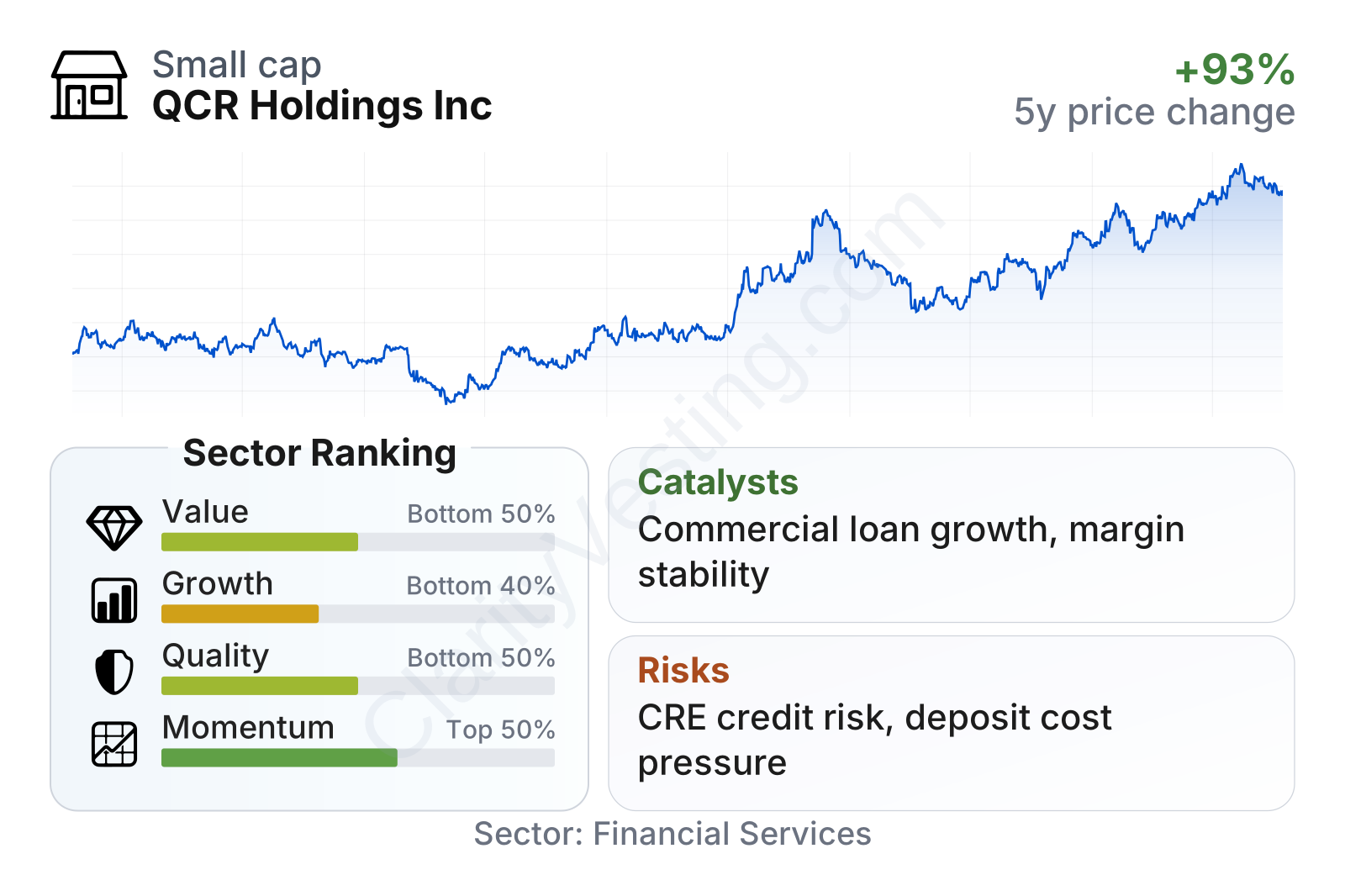
QCR Holdings combines decent market performance with mixed fundamentals. Valuation is close to the regional bank range on earnings, but somewhat richer on book value. Revenue growth has been better than many peers, while quality measures are solid rather than standout. Profitability remains healthy for a regional bank, yet the broader factor picture suggests the market is recognizing progress without treating the company as a clear sector leader.
The share price trend has been strong since the 2023 banking stress period, with the stock moving well above prior lows and reaching new highs in 2026. That recovery indicates improved confidence in the bank’s earnings power, deposit stability, and balance-sheet positioning.
Growth
QCR Holdings operates in a mature industry, but not a stagnant one. Regional banking can still grow when a bank gains share in attractive local markets, expands commercial relationships, adds treasury and fee-based services, and manages funding costs well. The company’s Midwest footprint gives it exposure to business clients that often value local decision-making more than a one-size-fits-all national model.
The company’s strategy appears coherent for long-term expansion. It focuses heavily on commercial banking, relationship-driven deposits, and specialized services that deepen customer ties. That matters because regional banks with strong business relationships can generate not only loan growth, but also treasury management fees, wealth activity, and better deposit retention. This can make growth more resilient than relying only on plain-vanilla lending.
Earnings per share have shown a gradual upward trend from 2021 through 2025, which points to a business that has managed to grow despite a difficult interest-rate environment for many banks. The pace has not been explosive, but it has been persistent, and that is often more meaningful for a lender than a single unusually strong year.
Book value per share has also climbed clearly in recent years after a distorted older base period, which is important for a bank because book value reflects the capital cushion supporting future growth. Rising book value, together with steady earnings, suggests that the company has been building internal financial strength rather than only depending on balance-sheet expansion.
One of the clearer growth catalysts is the possibility of improved net interest margin if funding pressure eases or asset yields stay favorable. Another is continued expansion in commercial banking and specialty finance capabilities across its local markets. In addition, QCR Holdings has historically used acquisitions selectively, so future consolidation in community and regional banking could create expansion opportunities if pricing and integration remain disciplined.
Recent company updates in 2026 have generally pointed to ongoing operating momentum rather than a dramatic strategic shift. The more relevant opportunity is not a headline event, but the combination of loan production, core deposit growth, and fee-income expansion in existing markets. For a bank of this size, that kind of steady execution can matter more than a one-time announcement.
Risks
This article is for informational purposes only and does not constitute financial advice. Some content is AI-generated. See Disclaimer


