Stock Analysis · PayPal Holdings Inc (PYPL)
Overview
PayPal Holdings is a global digital payments company. It helps consumers and merchants send money, receive money, pay online, pay in apps, and increasingly pay in physical stores. Its best-known brands are PayPal, Venmo, Braintree, Xoom, and Honey. In simple terms, PayPal sits between buyers and sellers and earns fees for making payments easier, faster, and more secure.
The business is mainly built around payment volume rather than lending. When a customer checks out with PayPal or Venmo, or when a merchant uses Braintree to process card payments, PayPal usually takes a small percentage of the transaction plus, in some cases, fixed fees or service-related charges. Interest and other value-added income exist, but transaction activity remains the core of the model.
Based on company reporting, PayPal’s revenue is heavily concentrated in transaction revenue, with a much smaller contribution from other value-added and interest-related streams.
- Transaction revenue: about 91% to 93% of total revenue. This includes fees charged for payment processing across PayPal checkout, Venmo monetization, Braintree enterprise processing, cross-border payments, and merchant services.
- Revenue from other value-added services and interest: about 7% to 9%. This includes interest earned on certain customer balances and funds, referral or service-related income, and other ancillary products.
Another useful way to understand PayPal is by customer type rather than accounting line items. A large share of activity comes from merchants using branded checkout and unbranded processing, while consumers drive engagement through the PayPal wallet, Venmo transfers and payments, and cross-border remittances. This creates a two-sided network: the more consumers use PayPal, the more useful it becomes for merchants, and vice versa.
Over the last several years, revenue has kept rising from roughly $25 billion in 2021 to above $33 billion in 2025, while net income and operating income recovered after a weaker 2022. That pattern suggests a business that is no longer in its earlier hypergrowth phase, but still has meaningful scale and room to improve profitability.
The revenue base has expanded steadily, and profitability improved notably after 2022. Operating income and net income rebounded as expense growth became more controlled, which matters because PayPal’s long-term case depends less on explosive sales growth and more on better monetization and cost discipline.
Key Figures
| Metric | Value | Sector ⓘ |
|---|---|---|
| Date | Nov 02, 2026 | |
| Context | ||
| Sector | Financial Services | |
| Industry | Credit Services | |
| Market Cap ⓘ | $47.36B | |
| Beta ⓘ | 1.28 | |
Value (Cheapness) | ||
| P/E Ratio ⓘ | 10.88 | 12.21 |
| P/B Ratio ⓘ | 2.51 | 1.26 |
| FCF Yield ⓘ | 13.30% | 9.99% |
| Dividend Yield ⓘ | 0.98% | 2.87% |
| EBIT / EV ⓘ | 12.86% | 8.24% |
| PEG ⓘ | 0.91 | |
Growth (Business expansion) | ||
| Revenue Growth ⓘ | 2.00% | 8.20% |
| RPS Growth (5Y CAGR) ⓘ | 12.50% | 12.31% |
| EPS Growth (5Y CAGR) ⓘ | 0.26% | -3.82% |
| BVPS Growth (5Y CAGR) ⓘ | 3.38% | 4.96% |
| Margin Growth (5Y Trend) ⓘ | 3.23% | -4.14% |
| FCF Growth (5Y CAGR) ⓘ | 3.29% | 4.70% |
| DPS Growth (5Y CAGR) ⓘ | -56.88% | 8.85% |
Quality (Business durability) | ||
| ROIC (Latest) ⓘ | 17.16% | 9.35% |
| ROE (Latest) ⓘ | 23.79% | 14.02% |
| ROA (Latest) ⓘ | 5.84% | 1.57% |
| ROIC (5Y Median) ⓘ | 14.71% | 7.78% |
| ROE (5Y Median) ⓘ | 20.00% | 12.12% |
| ROA (5Y Median) ⓘ | 5.28% | 1.28% |
| Net Debt / EBIT (Latest) ⓘ | 0.97 | 0.99 |
| Net Debt / EBIT (5Y Median) ⓘ | 0.58 | 0.73 |
| Net Debt / EBITDA (Latest) ⓘ | 0.84 | 0.77 |
| Operating Margin (Latest) ⓘ | 18.96% | 22.64% |
| Operating Margin (5Y Median) ⓘ | 17.96% | 24.52% |
| Debt to Equity (Latest) ⓘ | 69.15% | 58.67% |
| Profit Margin (Latest) ⓘ | 13.78% | 26.18% |
| Free Cash Flow (Latest) ⓘ | $6.30B | |
Momentum (Price trend) | ||
| 3Y Return ⓘ | +11.29% | +95.38% |
| 12M Return (excl. last month) ⓘ | -20.79% | +16.18% |
| 6M Return ⓘ | +14.36% | +7.10% |
| Price vs. 200-Day MA ⓘ | +14.52% | +5.51% |
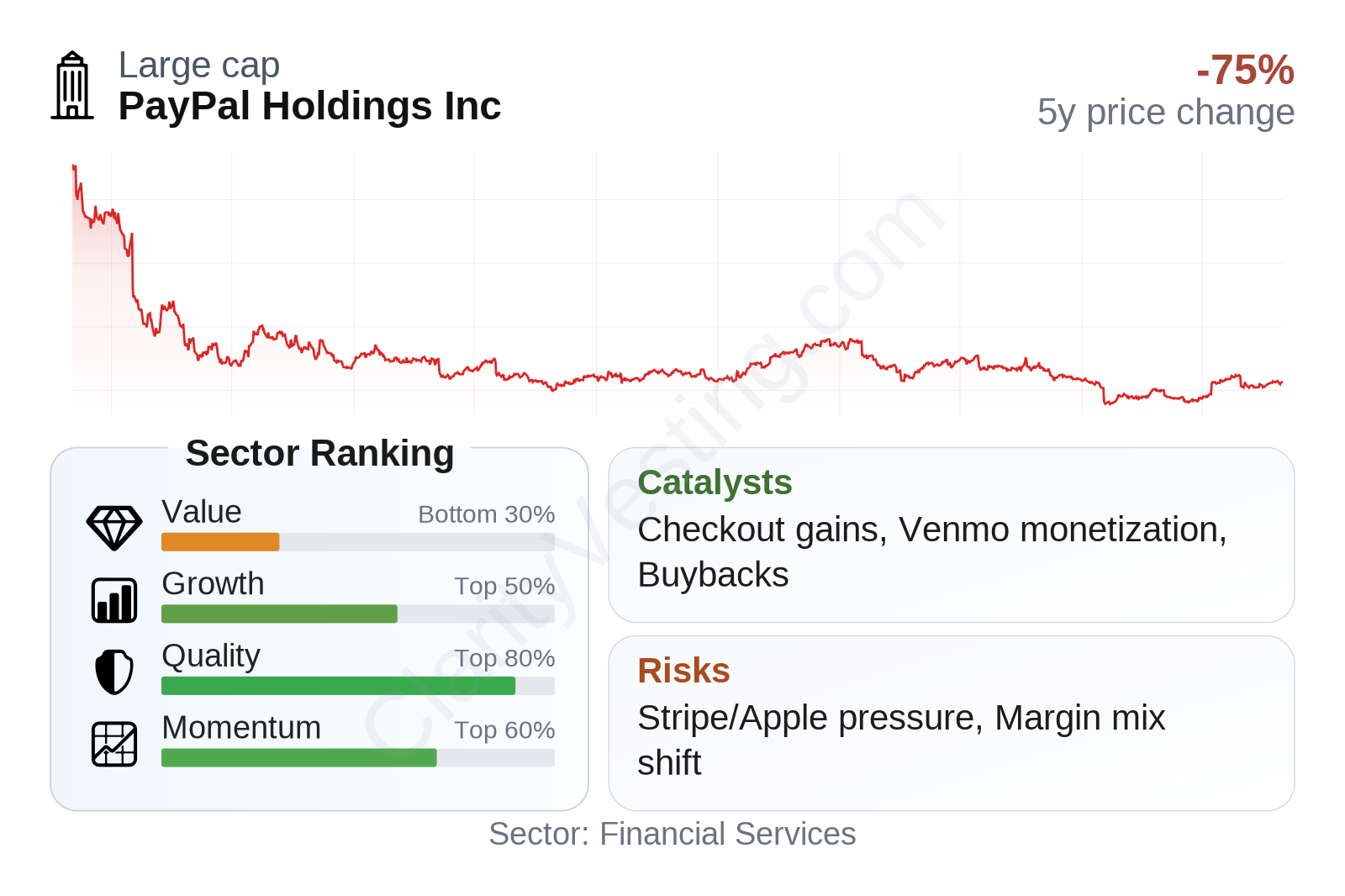
PayPal is a large financial technology platform with above-average profitability metrics for its sector, especially on returns on capital and assets. The growth profile is more mixed: long-term per-share revenue growth has been solid, but recent year-over-year sales growth has been modest. On valuation, earnings and cash flow measures look comparatively undemanding, while book-value multiples remain above the sector because PayPal is a high-return asset-light platform rather than a traditional balance-sheet-heavy finance company. Share price behavior also shows a company that went through a major rerating after 2021 and is still rebuilding market confidence.
Growth
PayPal operates in digital payments, a sector with durable long-term support from e-commerce, mobile commerce, digital wallets, tap-to-pay habits, and the continuing shift away from cash. That is still an attractive backdrop. The challenge is that digital payments is now a more mature market than it was a few years ago, so growth increasingly depends on execution, checkout conversion, merchant adoption, and monetization rather than simply riding industry expansion.
Its current strategy is broadly logical for that environment. Management has been pushing on three fronts: improving branded checkout performance, expanding Venmo monetization, and growing merchant processing through unbranded services such as Braintree. Branded checkout generally carries better economics, while Braintree helps PayPal stay relevant with large merchants that want flexible payment infrastructure. Venmo is important because it gives PayPal a strong consumer brand with room to convert engagement into commerce revenue.
A notable positive is that earnings have held up better than the market once feared. After pressure in 2022, profit per share recovered and remains on a generally improved path, helped by operating discipline and share repurchases.
Book value per share has also trended upward over time, which indicates that the company has continued to build equity even while the stock market’s view of the business changed sharply. That does not by itself create growth, but it supports the idea that the underlying business remained financially productive during a volatile period for the share price.
One of the strongest catalysts is checkout improvement powered by better integration and newer features, including streamlined guest checkout, passkey use, and faster payment flows. If these changes lift conversion for merchants, PayPal can grow revenue without needing dramatic user growth. Another catalyst is Venmo’s expansion from peer-to-peer transfers into card, debit, and merchant payments. A further opportunity comes from using PayPal’s broad installed base and data to add more services for merchants, such as fraud tools and payment optimization.
Recent company updates have also emphasized capital returns and efficiency. With free cash flow running at a strong level, PayPal has flexibility to repurchase shares while still funding product development. For a business at this stage, that can help offset slower top-line growth and improve per-share results even when revenue expansion is moderate.
Risks
This article is for informational purposes only and does not constitute financial advice. Some content is AI-generated. See Disclaimer