Stock Analysis · Quanta Services Inc (PWR)
Overview
Quanta Services is a large engineering, procurement, and construction company focused on infrastructure. In simple terms, it builds, upgrades, and maintains the systems that move electricity, data, oil, gas, and renewable power across the United States and selected international markets. Its customers are mainly electric utilities, pipeline operators, energy companies, communications providers, and public-sector clients.
The business is increasingly centered on the power grid and energy transition. Quanta works on high-voltage transmission lines, local distribution networks, substations, renewable energy connections, battery storage-related infrastructure, and specialized projects tied to grid reliability. It also provides underground utility work, communications infrastructure services, and certain pipeline and industrial solutions.
Based on recent company reporting, revenue is mainly generated from two operating segments.
- Electric Infrastructure Solutions: about 75% to 85% of revenue. This includes transmission and distribution work for utilities, substation construction, storm restoration, renewable interconnections, and grid modernization projects.
- Underground Utility and Infrastructure Solutions: about 15% to 25% of revenue. This covers pipeline and gas utility work, directional drilling, communications infrastructure, and other underground and industrial services.
This mix matters because the larger segment is tied to long-duration utility spending, which tends to be more visible than purely cyclical construction demand. Over the last several years, the company’s revenue, gross profit, and net income have all moved materially higher, showing that scale has increased without losing overall profitability.
The business has clearly expanded: revenue rose from roughly $13 billion in 2021 to more than $28 billion in 2025, while net income also more than doubled over that span. At the same time, costs remain heavy, which is normal in this industry, so execution discipline remains central to the investment case.
Key Figures
| Metric | Value | Sector ⓘ |
|---|---|---|
| Date | Oct 03, 2026 | |
| Context | ||
| Sector | Industrials | |
| Industry | Engineering & Construction | |
| Market Cap ⓘ | $97.99B | |
| Beta ⓘ | 1.20 | |
Value (Cheapness) | ||
| P/E Ratio ⓘ | 73.57 | 22.45 |
| P/B Ratio ⓘ | 10.27 | 1.98 |
| FCF Yield ⓘ | 2.44% | 6.31% |
| Dividend Yield ⓘ | 0.07% | 1.96% |
| EBIT / EV ⓘ | 2.04% | 4.81% |
| PEG ⓘ | 1.45 | |
Growth (Business expansion) | ||
| Revenue Growth ⓘ | 41.10% | 9.10% |
| RPS Growth (5Y CAGR) ⓘ | 20.28% | 7.75% |
| EPS Growth (5Y CAGR) ⓘ | 1.03% | -13.59% |
| BVPS Growth (5Y CAGR) ⓘ | 13.51% | 6.22% |
| Margin Growth (5Y Trend) ⓘ | 0.57% | 0.72% |
| FCF Growth (5Y CAGR) ⓘ | 69.65% | 10.98% |
| DPS Growth (5Y CAGR) ⓘ | 14.22% | 9.48% |
Quality (Business durability) | ||
| ROIC (Latest) ⓘ | 10.58% | 10.92% |
| ROA (Latest) ⓘ | 5.24% | 5.41% |
| ROIC (5Y Median) ⓘ | 9.14% | 9.21% |
| ROA (5Y Median) ⓘ | 4.72% | 4.94% |
| Net Debt / EBIT (Latest) ⓘ | 2.94 | 2.07 |
| Net Debt / EBIT (5Y Median) ⓘ | 3.58 | 2.28 |
| Net Debt / EBITDA (Latest) ⓘ | 2.01 | 1.43 |
| Net Debt / Assets ⓘ | 21.55% | 19.27% |
| EBITDA / Interest ⓘ | 10.31 | 9.53 |
| Operating Margin (Latest) ⓘ | 6.32% | 10.50% |
| Operating Margin (5Y Median) ⓘ | 5.54% | 10.27% |
| Debt to Equity (Latest) ⓘ | 68.51% | 65.48% |
| Profit Margin (Latest) ⓘ | 4.03% | 6.62% |
| Free Cash Flow (Latest) ⓘ | $2.39B | |
Momentum (Price trend) | ||
| 3Y Return ⓘ | +244.57% | +58.56% |
| 12M Return (excl. last month) ⓘ | +60.76% | +15.63% |
| 6M Return ⓘ | +17.07% | +4.19% |
| Price vs. 200-Day MA ⓘ | +6.51% | +0.93% |
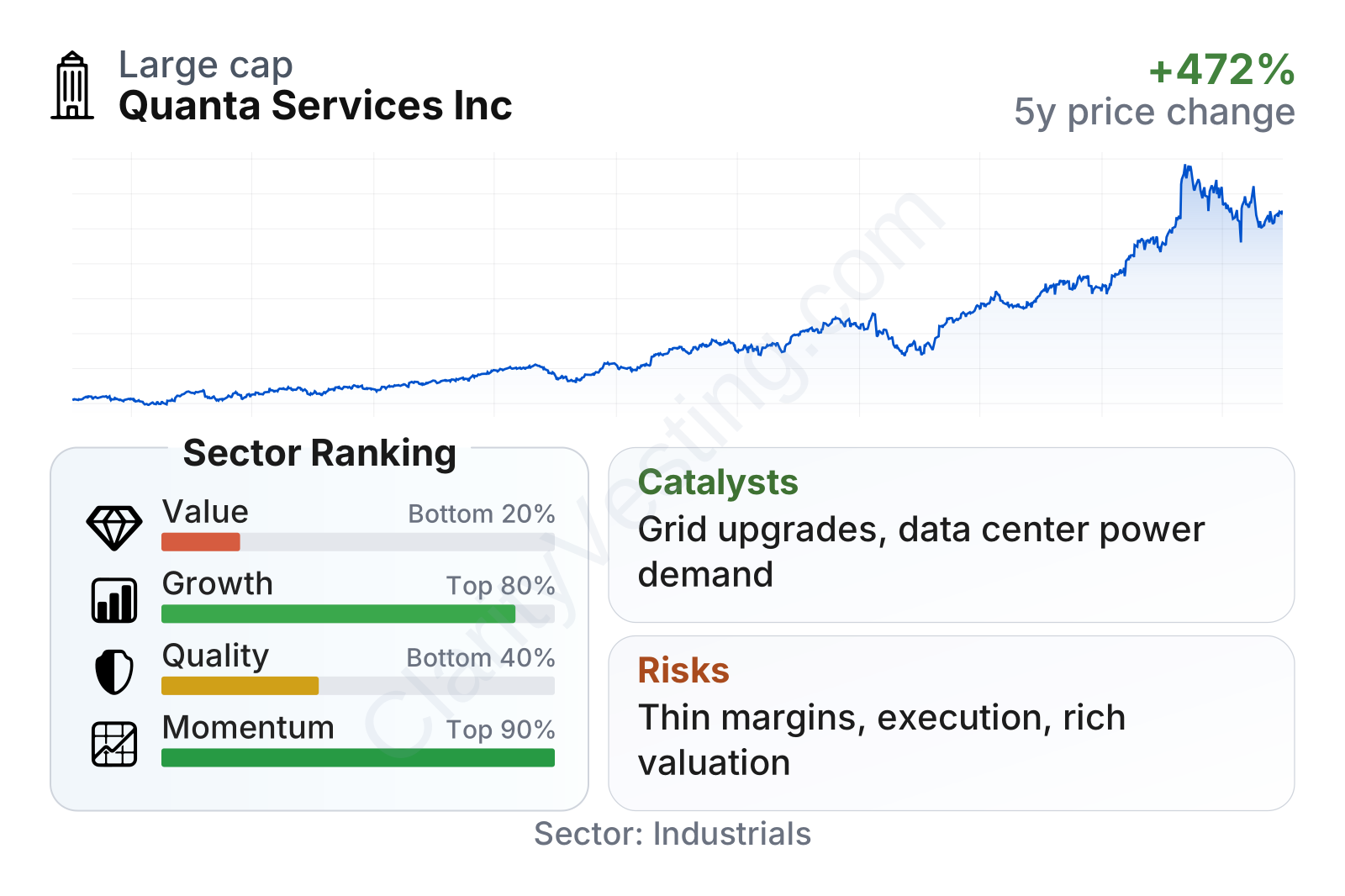
Quanta is now a very large industrial company, and the market has rewarded it strongly over the last three years. Growth and price momentum rank well above most sector peers, but valuation is much richer than the sector median. Quality metrics are more mixed: returns on capital are around sector norms, while leverage and margins are somewhat less favorable than many peers. In short, the market is paying a premium for growth, backlog visibility, and strategic exposure to electrification.
Growth
Quanta operates in a part of the economy with durable demand drivers. Electric grids in North America need expansion and modernization after years of underinvestment. Utilities are spending on transmission capacity, wildfire mitigation, storm hardening, substation upgrades, and the connection of solar, wind, battery storage, and new large loads such as data centers. That broader backdrop supports multi-year demand for the kinds of services Quanta provides.
The company’s strategy is also aligned with these trends. Rather than depending on one narrow market, Quanta spans transmission, distribution, substations, underground utility work, and selected industrial and communications projects. That breadth helps it participate in several major themes at once: grid reliability, renewable interconnection, electrification, and rising power demand.
Recent revenue growth has been well above the sector median, and the latest year-over-year pace accelerated back above 40%. That kind of growth is unusually strong for a company of this size and suggests that demand is being converted into actual project activity, not just management commentary.
Cash generation has also improved sharply over the last few years. Free cash flow moved from a relatively modest level in 2022 to well above $1.5 billion more recently, which is important because engineering and construction companies can report accounting profits while cash remains tied up in working capital. In Quanta’s case, the cash trend supports the view that expansion has real substance behind it.
A major catalyst is the buildout required to serve fast-growing electricity demand from data centers and artificial intelligence infrastructure. Utilities and developers need more transmission capacity, more substation work, and faster interconnection of generation assets. Quanta is one of the few scaled contractors with the workforce, technical capabilities, and customer relationships to address these needs across multiple regions. The continuing rollout of U.S. infrastructure and clean-energy funding programs also adds support, even though project timing can vary.
Recent company communications have also emphasized a large backlog and strong visibility tied to utility and renewable-related work. For long-term analysis, that matters more than a single quarter because it suggests that customers are committing to projects that can extend over several years.
Risks
This article is for informational purposes only and does not constitute financial advice. Some content is AI-generated. See Disclaimer