Stock Analysis · Perella Weinberg Partners (PWP)
Overview
Perella Weinberg Partners is an independent advisory firm focused on high-end corporate and asset management advice rather than traditional lending. In simple terms, it helps large companies, financial sponsors, governments, and other institutions make major financial decisions. That includes mergers and acquisitions, restructurings, capital structure advice, shareholder matters, and fundraising-related assignments. The firm also has an asset management business, but advisory work is the core of the company.
Its revenue is mainly driven by fees earned when clients complete or progress on transactions and strategic assignments. This makes results more cyclical than those of a bank with recurring interest income, because activity depends heavily on deal volume, market confidence, and financing conditions.
Based on recent annual disclosures, revenue comes from two main sources:
- Advisory fees: approximately 90% to 95% of total revenue. This includes M&A advice, restructuring, liability management, capital markets-related strategic advice, and other transaction or strategic assignments.
- Asset management and other revenues: approximately 5% to 10% of total revenue. This includes management fees and performance-related income tied to investment strategies managed by the firm, plus smaller ancillary items.
That mix matters because advisory fees can be very profitable in strong deal markets, but they can also swing sharply from year to year. The business is therefore less about steady balance-sheet growth and more about attracting senior rainmakers, preserving reputation, and being present in large, complex transactions.
The recent financial flow also shows how uneven this model can be. Revenue rebounded strongly after softer years, but profitability did not move in a straight line because compensation and operating expenses remained high. That pattern is common in advisory firms where pay tracks talent retention and deal activity, but it also means shareholders are exposed to sizable earnings volatility.
Key Figures
| Metric | Value | Sector ⓘ |
|---|---|---|
| Date | Nov 14, 2026 | |
| Context | ||
| Sector | Financial Services | |
| Industry | Capital Markets | |
| Market Cap ⓘ | $1.40B | |
| Beta ⓘ | 1.65 | |
Value (Cheapness) | ||
| P/E Ratio ⓘ | 35.56 | 12.38 |
| P/B Ratio ⓘ | 23.30 | 1.54 |
| FCF Yield ⓘ | 7.24% | 8.62% |
| Dividend Yield ⓘ | 2.02% | 2.91% |
| EBIT / EV ⓘ | 4.27% | 8.22% |
| PEG ⓘ | N/A | |
Growth (Business expansion) | ||
| Revenue Growth ⓘ | 52.70% | 7.00% |
| RPS Growth (5Y CAGR) ⓘ | -11.21% | 12.30% |
| EPS Growth (5Y CAGR) ⓘ | -5.14% | -0.81% |
| BVPS Growth (5Y CAGR) ⓘ | N/A | 4.87% |
| Margin Growth (5Y Trend) ⓘ | N/A | -4.00% |
| FCF Growth (5Y CAGR) ⓘ | -39.89% | 4.68% |
| DPS Growth (5Y CAGR) ⓘ | -32.20% | 8.77% |
Quality (Business durability) | ||
| ROIC (Latest) ⓘ | N/A | 9.69% |
| ROE (Latest) ⓘ | N/A | 14.05% |
| ROA (Latest) ⓘ | 4.15% | 1.58% |
| ROIC (5Y Median) ⓘ | -28.23% | 7.79% |
| ROE (5Y Median) ⓘ | -9.40% | 12.05% |
| ROA (5Y Median) ⓘ | -1.49% | 1.28% |
| Net Debt / EBIT (Latest) ⓘ | 0.59 | 0.97 |
| Net Debt / EBIT (5Y Median) ⓘ | N/A | 0.73 |
| Net Debt / EBITDA (Latest) ⓘ | 0.40 | 0.75 |
| Operating Margin (Latest) ⓘ | 6.33% | 23.57% |
| Operating Margin (5Y Median) ⓘ | -7.56% | 24.30% |
| Debt to Equity (Latest) ⓘ | 279.08% | 59.34% |
| Profit Margin (Latest) ⓘ | 4.35% | 26.53% |
| Free Cash Flow (Latest) ⓘ | $101.42M | |
Momentum (Price trend) | ||
| 3Y Return ⓘ | +35.66% | +85.82% |
| 12M Return (excl. last month) ⓘ | -32.96% | +16.88% |
| 6M Return ⓘ | -27.38% | +8.29% |
| Price vs. 200-Day MA ⓘ | -21.71% | +5.17% |
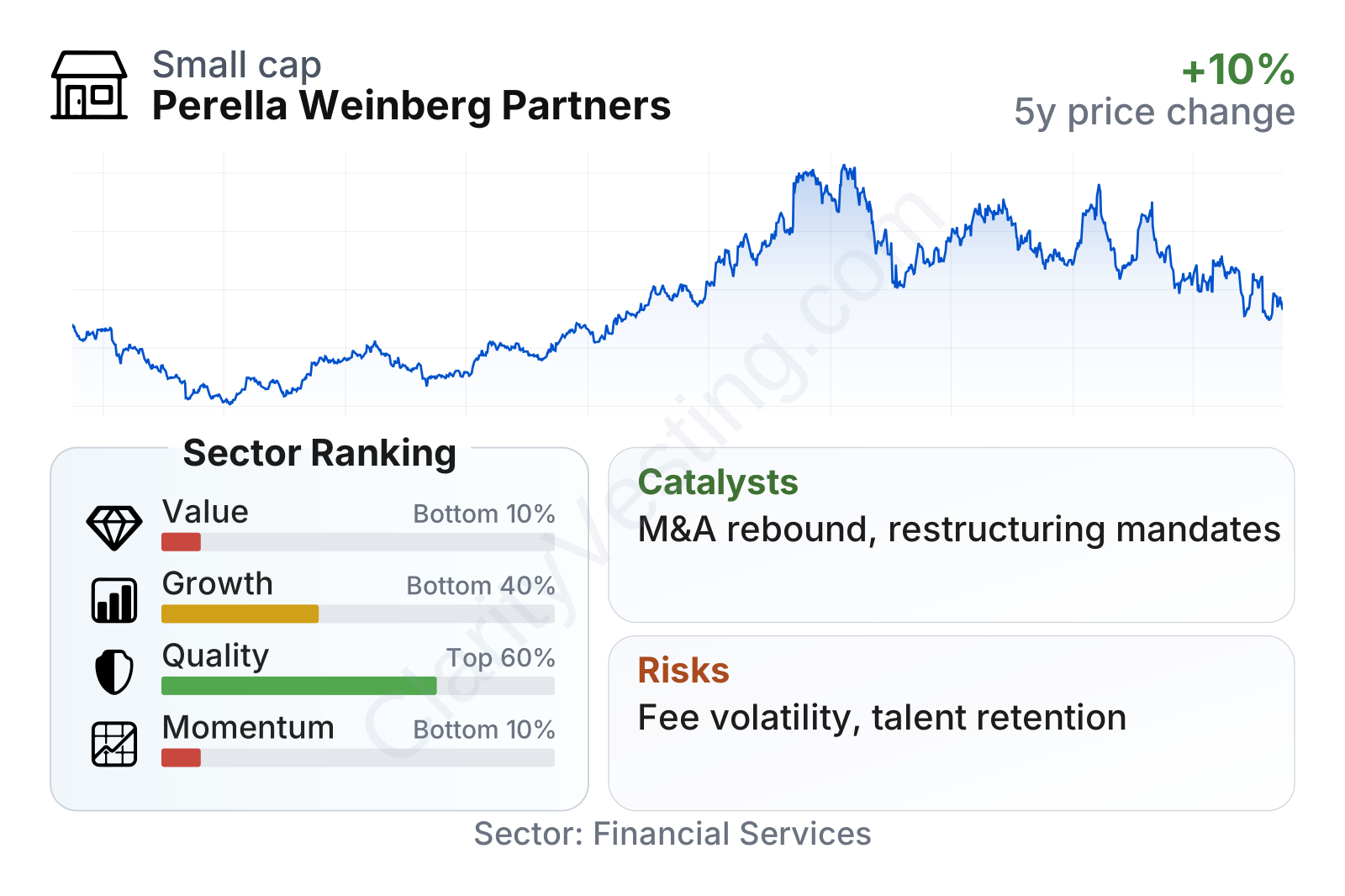
Perella Weinberg Partners is a relatively small public company within the broader financial services sector, and its share price has been volatile since listing. After a powerful run through 2024, the stock gave back a meaningful part of those gains in 2025 and 2026. The latest metric profile also paints a mixed picture: recent revenue growth looks strong, but value, momentum, and long-term growth measures rank weakly versus much of the sector. Quality is more balanced, helped by low net debt relative to earnings and a positive free cash flow profile, but margins remain thin for the industry.
The table also highlights an important tension. On one hand, the company has generated a meaningful year-over-year rebound in revenue and currently carries moderate leverage on an earnings basis. On the other hand, profitability ratios and valuation multiples look demanding compared with sector medians, especially when set against inconsistent long-term earnings and book value trends.
Growth
Perella Weinberg operates in a part of financial services that should remain structurally relevant over the long run. Large companies will continue to merge, divest assets, refinance, defend against activist pressure, and restructure when conditions become difficult. That gives independent advisers an enduring role, especially firms with strong senior relationships and credibility in complex situations.
The strategy is sensible for future growth if management can keep attracting top bankers and expand the firm’s share of large, high-fee mandates. Independent advisory firms can benefit when clients want conflict-free advice rather than services bundled with lending. That positioning can be particularly valuable in restructuring, special committee work, and contested situations, where independence carries extra weight.
A near-term catalyst for the sector is a broader recovery in M&A and capital markets activity if interest rates stabilize and boardroom confidence improves. When financing becomes more predictable, transaction pipelines usually improve. For PWP, that can translate into larger fee realizations without the balance-sheet risk that lending banks take on.
There is also some evidence of operating recovery. Revenue growth over the last year has been very strong, far above the sector median, suggesting the firm has participated in a better advisory environment. However, longer-term growth measures remain weaker, showing that the business has not yet established a consistent multi-year compounding pattern.
Earnings per share underline that point. The company has stayed profitable on a reported basis in several periods, but earnings have moved up and down rather than advancing steadily. That is not unusual for transaction-driven advisory firms, yet it limits visibility. For a long-term shareholder, the key question is less whether one good year can happen and more whether earnings can become more durable across market cycles.
Book value per share is less useful than usual here because partner compensation structures, distributions, accounting adjustments, and the economics of an advisory partnership can distort stated equity. That makes this company better understood through fee generation, margins, franchise strength, and cash production than through book value alone. Even so, the unusual book value pattern helps explain why valuation measures tied to book equity can appear extreme.
As for recent developments, the most important opportunity remains industry normalization rather than a single headline event. If the backlog of delayed corporate transactions continues to unlock, firms like Perella Weinberg can show sharp operating leverage. The company’s brand in strategic advisory and restructuring gives it a credible path to benefit if that recovery broadens.
Risks
This article is for informational purposes only and does not constitute financial advice. Some content is AI-generated. See Disclaimer