Stock Analysis · Palvella Therapeutics Inc (PVLA)
Overview
Palvella Therapeutics is a clinical-stage biotechnology company focused on rare genetic skin diseases. Its lead programs target conditions with high unmet medical need, especially diseases where patients have very limited approved treatment options. The company’s approach centers on developing therapies for serious dermatology indications that affect small patient populations but can still support meaningful pricing if a treatment reaches the market.
At this stage, Palvella is not operating like a mature pharmaceutical business. Based on recent filings, the company is primarily funding operations through equity financing rather than product sales. Its economic profile is therefore driven much more by research spending, cash runway, and clinical progress than by recurring commercial revenue.
Recent annual results indicate that revenue is currently 0% from marketed product sales and 0% from recurring licensing or collaboration revenue in the latest full-year period. Historically, the predecessor business had revenue several years ago, but the current Palvella profile is best understood as a pre-commercial biotech with no ongoing operating revenue.
- Product revenue: 0% — no approved commercial product generating recurring sales in the latest annual period.
- Licensing/collaboration revenue: 0% — no meaningful recurring partner revenue recently reported.
- Financing activities: effectively the main funding source — cash has mainly come from share issuance and capital raises rather than operations.
The expense base is dominated by research and development, which is typical for a biotech still proving its lead assets in clinical studies. Over the last few years, operating losses have widened again as development activity increased, while revenue disappeared. That makes the company’s investment case heavily dependent on whether its pipeline can convert scientific promise into regulatory and commercial progress.
The financial flow shows a clean pre-revenue biotech profile: essentially no current revenue, meaningful research spending, and a renewed rise in operating expenses in the latest year as pipeline investment accelerated.
Key Figures
| Metric | Value | Sector ⓘ |
|---|---|---|
| Date | Oct 17, 2026 | |
| Context | ||
| Sector | Healthcare | |
| Industry | Biotechnology | |
| Market Cap ⓘ | $1.77B | |
| Beta ⓘ | N/A | |
Value (Cheapness) | ||
| P/E Ratio ⓘ | N/A | 24.79 |
| P/B Ratio ⓘ | 8.43 | 3.08 |
| FCF Yield ⓘ | -2.07% | 3.15% |
| Dividend Yield ⓘ | N/A | 1.94% |
| EBIT / EV ⓘ | -2.84% | 0.57% |
| PEG ⓘ | N/A | |
Growth (Business expansion) | ||
| Revenue Growth ⓘ | N/A | 7.45% |
| RPS Growth (5Y CAGR) ⓘ | N/A | 8.61% |
| EPS Growth (5Y CAGR) ⓘ | -49.80% | -17.81% |
| BVPS Growth (5Y CAGR) ⓘ | -55.41% | 3.72% |
| Margin Growth (5Y Trend) ⓘ | N/A | -0.62% |
| FCF Growth (5Y CAGR) ⓘ | N/A | 1.04% |
| DPS Growth (5Y CAGR) ⓘ | N/A | 6.77% |
Quality (Business durability) | ||
| ROIC (Latest) ⓘ | -32.72% | 3.24% |
| ROA (Latest) ⓘ | -38.51% | 3.01% |
| ROIC (5Y Median) ⓘ | N/A | 4.60% |
| ROA (5Y Median) ⓘ | -36.40% | 1.89% |
| Net Debt / EBIT (Latest) ⓘ | N/A | 1.34 |
| Net Debt / EBIT (5Y Median) ⓘ | N/A | 1.84 |
| Net Debt / EBITDA (Latest) ⓘ | N/A | 1.00 |
| Net Debt / Assets ⓘ | -73.87% | 5.45% |
| EBITDA / Interest ⓘ | N/A | 9.64 |
| Operating Margin (Latest) ⓘ | N/A | 9.27% |
| Operating Margin (5Y Median) ⓘ | N/A | 7.38% |
| Debt to Equity (Latest) ⓘ | 0.25% | 28.58% |
| Profit Margin (Latest) ⓘ | N/A | 3.59% |
| Free Cash Flow (Latest) ⓘ | -$36.51M | |
Momentum (Price trend) | ||
| 3Y Return ⓘ | +478.82% | +42.80% |
| 12M Return (excl. last month) ⓘ | +176.81% | +18.50% |
| 6M Return ⓘ | -1.00% | +7.57% |
| Price vs. 200-Day MA ⓘ | +1.79% | +5.12% |
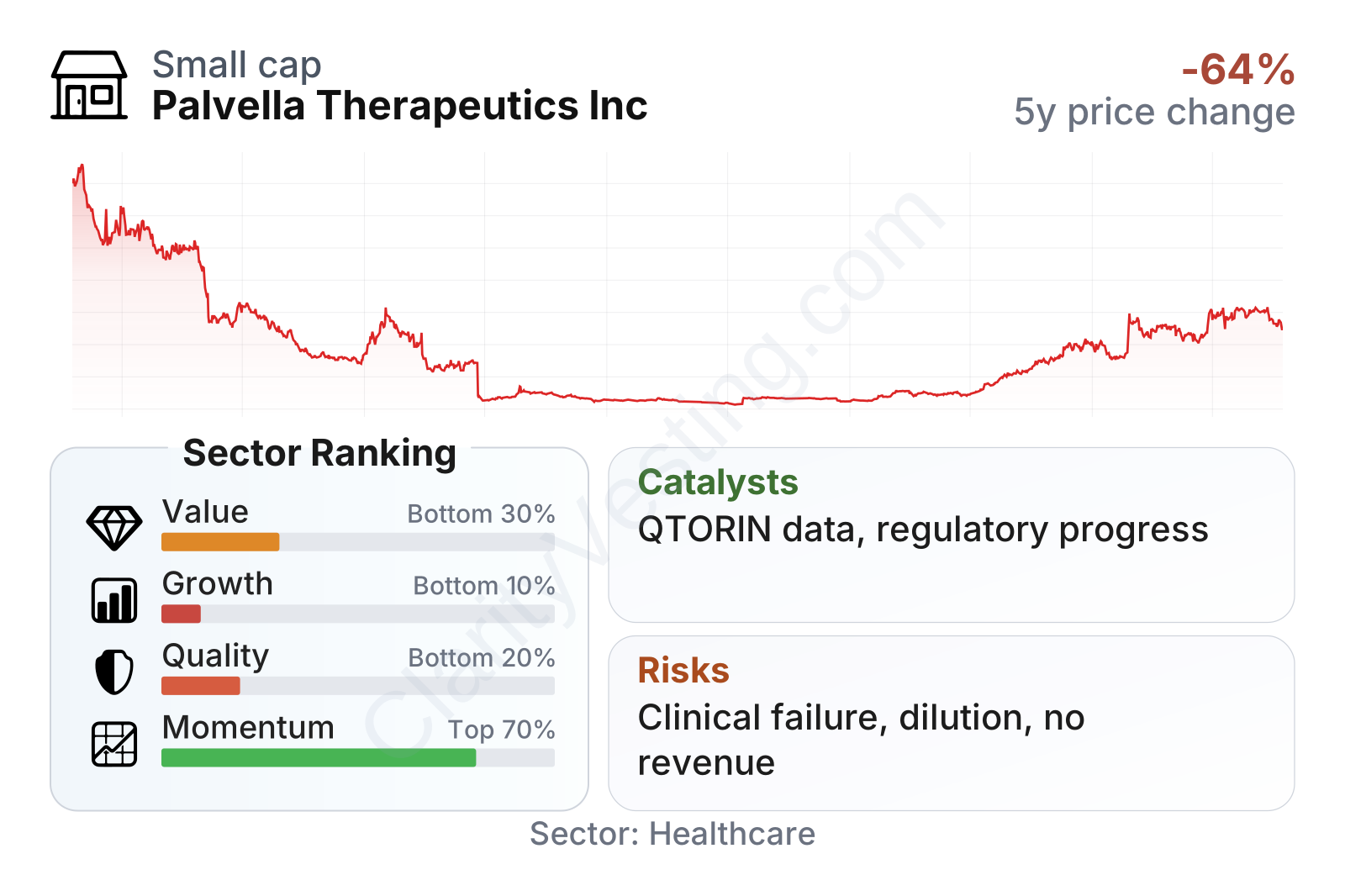
Palvella is now a mid-sized biotech by public-market standards, with a market value around $2 billion. The stock has shown exceptionally strong momentum over the last year and over three years, far ahead of the broader healthcare sector, which suggests the market is increasingly pricing in pipeline potential. At the same time, most fundamental categories still look weak: value, growth, and quality rank in the lower end of the sector because the company has no meaningful revenue, negative cash flow, and negative returns on capital. The balance sheet is one of the brighter spots, with extremely low debt relative to equity and net cash rather than net debt.
Growth
Palvella operates in a part of healthcare that can create substantial value if a company reaches approval: rare disease therapeutics. This remains an attractive area because patient populations are small but treatment need is often urgent, competition can be limited, and regulators sometimes provide incentives such as orphan-drug benefits, market exclusivity, and potentially streamlined development paths. In dermatology, rare genetic diseases are also an area where successful products may face less commercial crowding than mass-market categories like psoriasis or acne.
The company’s strategy is coherent for long-term growth because it is not trying to compete broadly across many diseases. Instead, it is concentrating resources on a narrow set of rare skin conditions where clinical endpoints can be highly meaningful to patients and physicians. That focus can be an advantage for a small biotech, since it avoids the overhead and dilution of pursuing too many unrelated programs at once.
Palvella’s most important growth catalyst is clinical and regulatory progress for its lead candidate, QTORIN rapamycin, which the company is developing for rare dermatologic indications including microcystic lymphatic malformations. Public company communications in 2026 highlighted continued advancement of this program, and the market response suggests that upcoming trial execution, data readouts, and regulatory interactions are being treated as potentially value-changing events.
Historical revenue growth is not very useful for judging future expansion here because the company has transitioned into a pre-commercial model with no current sales base. For that reason, future growth depends far more on pipeline milestones than on past revenue trends.
Cash generation remains negative, which is normal for a clinical-stage biotech, but the direction still matters. Free cash outflow remains sizeable, reflecting ongoing development expenses. The key question is not near-term profitability; it is whether current spending is buying progress toward approval, partnering leverage, or eventual commercialization.
A second potential growth opportunity is strategic optionality. If Palvella produces strong data in a rare disease setting, it could gain leverage for licensing, co-development, or even broader platform expansion into related skin disorders. In small biotech, one well-executed rare disease program can reshape the company much faster than gradual organic growth in most industries.
Risks
This article is for informational purposes only and does not constitute financial advice. Some content is AI-generated. See Disclaimer


