Stock Analysis · ProPetro Holding Corp (PUMP)
Overview
ProPetro Holding Corp is a U.S. oilfield services company focused mainly on hydraulic fracturing, often called pressure pumping. In simple terms, it provides the equipment, crews, and related services that help oil and gas producers complete wells, especially in unconventional shale basins. The company is heavily concentrated in the Permian Basin, the largest U.S. oil-producing region, where it serves exploration and production companies that need wells stimulated before they can produce at commercial levels.
Its business model is straightforward: customers pay ProPetro to supply fleets, pumps, power systems, chemicals, and field support needed to fracture wells and, in some cases, provide additional completion-related services. That makes revenue closely tied to drilling and completion activity, customer budgets, oil prices, and natural gas prices.
Based on recent company filings, ProPetro’s revenue is dominated by one line of business, with smaller contributions from adjacent services.
- Hydraulic fracturing services: approximately 85% to 90% of revenue. This is the core business and includes pressure pumping fleets, field crews, and related well completion activity.
- Wireline services: approximately 5% to 10% of revenue. This generally covers perforating and other well-completion support services that work alongside fracturing jobs.
- Pumping and power-related or other complementary services: approximately 3% to 7% of revenue. This includes newer offerings tied to equipment, power solutions, and other field support activities.
One important point for long-term readers is that ProPetro is still much more of a specialized service provider than a diversified energy company. That creates operating focus, but it also means results can swing sharply when customer activity slows. Over the last several years, revenue expanded strongly into 2023, then weakened in 2024 and 2025 as industry conditions became less favorable and profitability compressed.
The long-term pattern is clear: revenue climbed from under $1 billion in 2021 to more than $1.6 billion in 2023, then fell back to roughly the low-$1 billion range by 2025. Just as important, the company moved from losses in 2021 to strong profits in 2023, then back toward very thin earnings and losses as margins narrowed. That shows how sensitive the business is to industry pricing and fleet utilization.
Key Figures
| Metric | Value | Sector ⓘ |
|---|---|---|
| Date | Oct 17, 2026 | |
| Context | ||
| Sector | Energy | |
| Industry | Oil & Gas Equipment & Services | |
| Market Cap ⓘ | $1.08B | |
| Beta ⓘ | 0.88 | |
Value (Cheapness) | ||
| P/E Ratio ⓘ | N/A | 15.44 |
| P/B Ratio ⓘ | 1.05 | 1.73 |
| FCF Yield ⓘ | -2.08% | 8.20% |
| Dividend Yield ⓘ | N/A | 3.59% |
| EBIT / EV ⓘ | 0.06% | 7.46% |
| PEG ⓘ | N/A | |
Growth (Business expansion) | ||
| Revenue Growth ⓘ | -6.20% | 26.90% |
| RPS Growth (5Y CAGR) ⓘ | 9.04% | 6.90% |
| EPS Growth (5Y CAGR) ⓘ | N/A | -15.73% |
| BVPS Growth (5Y CAGR) ⓘ | -0.55% | 6.07% |
| Margin Growth (5Y Trend) ⓘ | 9.02% | 0.58% |
| FCF Growth (5Y CAGR) ⓘ | 39.59% | 1.86% |
| DPS Growth (5Y CAGR) ⓘ | N/A | 16.79% |
Quality (Business durability) | ||
| ROIC (Latest) ⓘ | -0.35% | 11.40% |
| ROA (Latest) ⓘ | -0.80% | 6.06% |
| ROIC (5Y Median) ⓘ | 0.19% | 10.30% |
| ROA (5Y Median) ⓘ | 0.07% | 5.42% |
| Net Debt / EBIT (Latest) ⓘ | 97.15 | 1.64 |
| Net Debt / EBIT (5Y Median) ⓘ | 0.95 | 1.83 |
| Net Debt / EBITDA (Latest) ⓘ | 0.44 | 1.08 |
| Net Debt / Assets ⓘ | 3.59% | 17.29% |
| EBITDA / Interest ⓘ | 16.18 | 9.64 |
| Operating Margin (Latest) ⓘ | 0.07% | 16.27% |
| Operating Margin (5Y Median) ⓘ | 0.70% | 20.39% |
| Debt to Equity (Latest) ⓘ | 89.60% | 54.76% |
| Profit Margin (Latest) ⓘ | -1.15% | 8.82% |
| Free Cash Flow (Latest) ⓘ | -$22.48M | |
Momentum (Price trend) | ||
| 3Y Return ⓘ | -21.04% | +67.38% |
| 12M Return (excl. last month) ⓘ | +125.32% | +49.19% |
| 6M Return ⓘ | -39.87% | +7.07% |
| Price vs. 200-Day MA ⓘ | -35.36% | +9.56% |
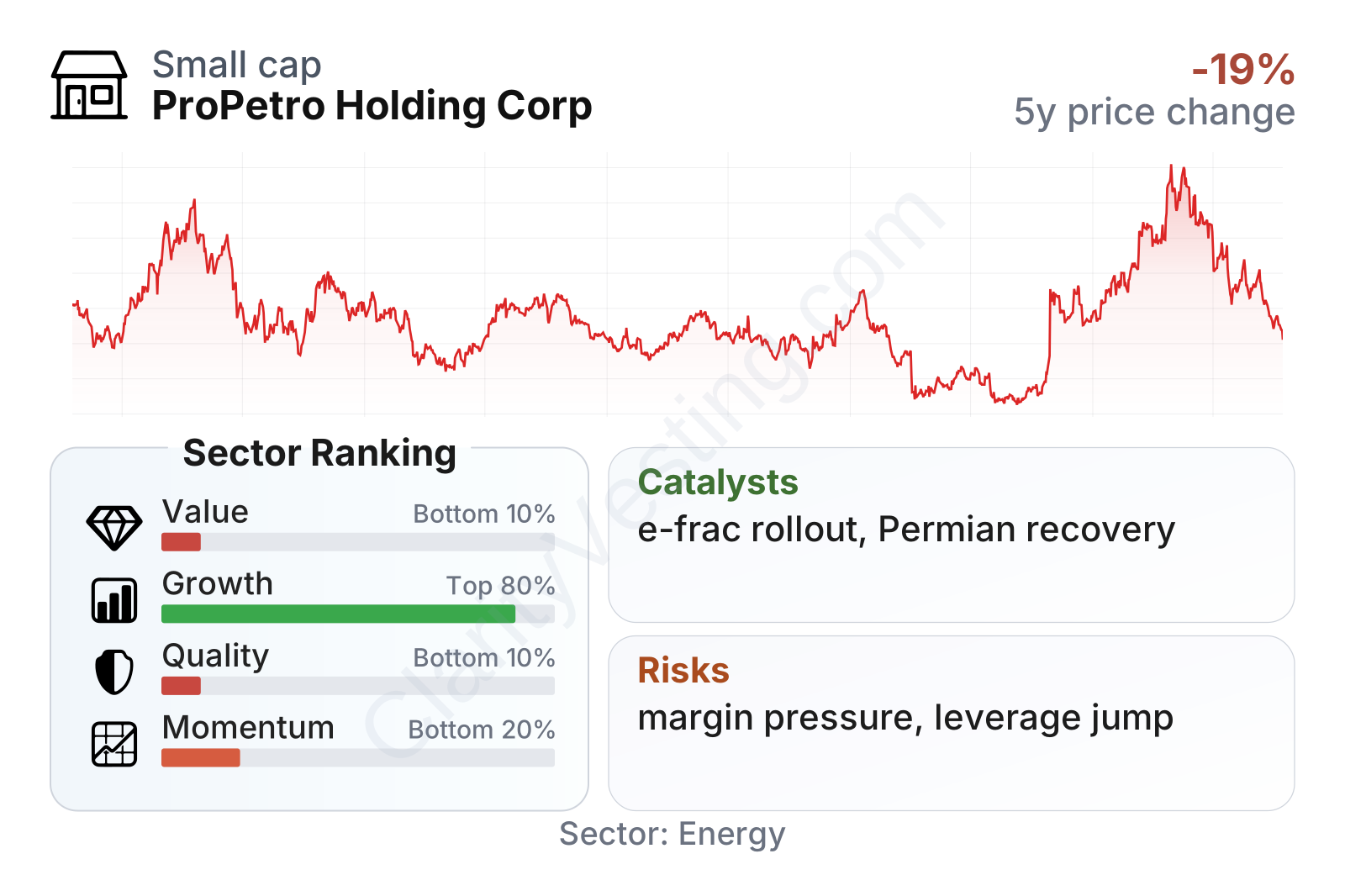
ProPetro is a mid-sized energy services company with a market value around $1 billion and a stock that has been volatile, although its beta remains below 1. On valuation metrics, it screens weakly versus the sector because current earnings and cash generation are subdued. On growth, the picture is mixed: recent revenue has been declining, but the longer five-year record still shows better-than-median expansion in revenue per share and especially free cash flow growth from a low base. Quality metrics are currently soft, with returns on capital, returns on assets, and margins sitting well below typical sector levels. Price momentum has also been uneven, with a strong rebound over twelve months before a weaker shorter-term trend.
Growth
ProPetro operates in a sector that has a future, but not a smooth one. U.S. shale development still needs completion services, and the Permian Basin remains one of the most resilient oil-producing regions in North America. As long as operators keep developing wells there, demand for pressure pumping does not disappear. The challenge is that this is not a steady growth market in the usual sense. It follows commodity cycles, customer spending plans, and service pricing.
The company’s strategy for future growth is more sensible than a simple “more fleets” approach. Management has been working on upgrading the fleet mix, including electric and lower-emission equipment, and adding complementary services around completions. That matters because large customers increasingly care about fuel efficiency, emissions, and integrated service quality, not only headline pumping capacity. If ProPetro can keep modernizing its fleet and protect utilization, it has a clearer path to staying relevant even in a competitive market.
The revenue trend shows why the long-term case requires caution. Growth was very strong through 2022 and much of 2023, but then turned negative and has remained under pressure into 2026. That suggests ProPetro is no longer benefiting from the same favorable cycle that helped it earlier. Even so, a weaker revenue period after a strong upcycle is normal in this industry, and the key question is whether the company is positioning itself to recover better than before when activity improves.
Cash generation also shows a business in transition. Free cash flow turned strongly positive around 2024 and 2025, then slipped back into negative territory on a trailing basis. For a capital-intensive service company, that is significant because fleet upgrades and maintenance consume cash. A durable long-term improvement would require not just revenue stabilization, but a return to healthier margins and more consistent free cash flow after capital spending.
One notable catalyst is the company’s push into next-generation power and completion equipment. ProPetro has highlighted investments in electric fracturing and other power-related solutions designed to reduce diesel use and improve efficiency for customers. In an industry where large producers are paying more attention to emissions, fuel logistics, and operating consistency, that type of equipment can help the company defend pricing and strengthen customer relationships. Another catalyst is simple industry normalization: if Permian completion activity steadies after a weaker patch, utilization and margins can recover quickly because much of the operating base is already in place.
Risks
This article is for informational purposes only and does not constitute financial advice. Some content is AI-generated. See Disclaimer


