Stock Analysis · Vale Indonesia (PTNDY)
Overview
Vale Indonesia is a nickel mining and processing company operating in Indonesia. It is part of the broader Vale group, but its assets and results are tied specifically to Indonesian nickel operations. The company produces nickel in matte, an intermediate product mainly used as feedstock for refined nickel and battery-related supply chains. That places the business at the intersection of traditional stainless-steel demand and the longer-term expansion of electric-vehicle batteries.
The business model is relatively simple: mine laterite nickel ore, process it using smelters, and sell nickel matte to industrial customers. Compared with diversified miners, Vale Indonesia is much more concentrated, so company performance depends heavily on nickel prices, production volumes, and operating efficiency at a limited number of sites.
Revenue is highly concentrated. Public company materials indicate that sales are overwhelmingly tied to nickel matte, with only limited contribution from other items such as services or by-products when disclosed.
- Nickel in matte: approximately 95% to 100% of revenue. This is the company’s core product and the main driver of earnings, cash generation, and exposure to global nickel pricing.
- Other revenue: typically 0% to 5%. This may include ancillary items, but it is not a meaningful profit driver compared with nickel sales.
Over the last several years, the income structure shows a business that can be very profitable when nickel pricing and operations are favorable, but also highly cyclical. Revenue climbed strongly through 2023, then weakened in 2024 and remained under pressure in 2025. Gross profit and operating income compressed much more sharply than sales, which highlights how sensitive the company is to price swings and cost absorption in a commodity business.
The visual breakdown makes that operating sensitivity clear: revenue and profit expanded materially between 2021 and 2023, then margins narrowed sharply in 2024 and stayed subdued in 2025. Costs of revenue remained high relative to sales, so even modest pressure on realized prices had an outsized impact on operating income.
Key Figures
| Metric | Value | Sector ⓘ |
|---|---|---|
| Date | Oct 17, 2026 | |
| Context | ||
| Sector | Basic Materials | |
| Industry | Other Industrial Metals & Mining | |
| Market Cap ⓘ | $3.53B | |
| Beta ⓘ | 1.06 | |
Value (Cheapness) | ||
| P/E Ratio ⓘ | 17.47 | 16.90 |
| P/B Ratio ⓘ | 0.95 | 1.65 |
| FCF Yield ⓘ | -9.49% | 5.76% |
| Dividend Yield ⓘ | 1.70% | 2.13% |
| EBIT / EV ⓘ | 6.46% | 6.30% |
| PEG ⓘ | N/A | |
Growth (Business expansion) | ||
| Revenue Growth ⓘ | 31.90% | 11.10% |
| RPS Growth (5Y CAGR) ⓘ | -0.58% | 4.49% |
| EPS Growth (5Y CAGR) ⓘ | -18.08% | -13.47% |
| BVPS Growth (5Y CAGR) ⓘ | 4.99% | 5.51% |
| Margin Growth (5Y Trend) ⓘ | -18.86% | -1.54% |
| FCF Growth (5Y CAGR) ⓘ | N/A | 0.37% |
| DPS Growth (5Y CAGR) ⓘ | -0.29% | 6.08% |
Quality (Business durability) | ||
| ROIC (Latest) ⓘ | N/A | 9.26% |
| ROA (Latest) ⓘ | 4.48% | 4.91% |
| ROIC (5Y Median) ⓘ | 8.04% | 7.70% |
| ROA (5Y Median) ⓘ | 6.93% | 3.86% |
| Net Debt / EBIT (Latest) ⓘ | -0.62 | 1.40 |
| Net Debt / EBIT (5Y Median) ⓘ | -2.25 | 1.70 |
| Net Debt / EBITDA (Latest) ⓘ | -0.32 | 0.95 |
| Net Debt / Assets ⓘ | -3.22% | 13.69% |
| EBITDA / Interest ⓘ | 64.99 | 12.34 |
| Operating Margin (Latest) ⓘ | 15.91% | 13.20% |
| Operating Margin (5Y Median) ⓘ | 23.44% | 11.80% |
| Debt to Equity (Latest) ⓘ | 0.06% | 40.56% |
| Profit Margin (Latest) ⓘ | 14.03% | 6.43% |
| Free Cash Flow (Latest) ⓘ | -$334.98M | |
Momentum (Price trend) | ||
| 3Y Return ⓘ | -27.57% | +68.89% |
| 12M Return (excl. last month) ⓘ | +25.50% | +30.21% |
| 6M Return ⓘ | -21.21% | -4.16% |
| Price vs. 200-Day MA ⓘ | -14.22% | -1.27% |
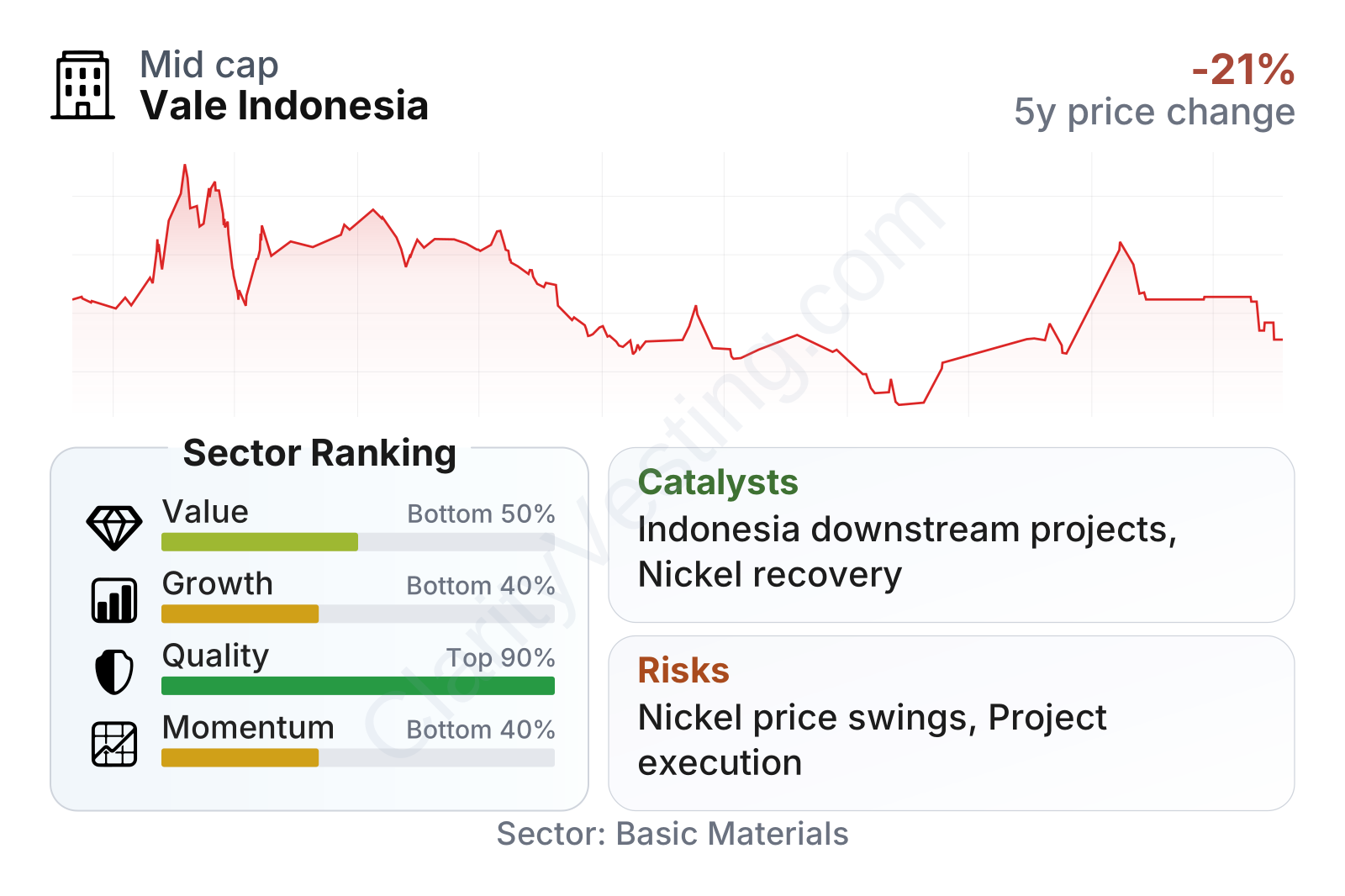
Vale Indonesia sits in the mid-sized range for a mining company and shows a mixed profile. Quality is the strongest area: profitability remains above many sector peers, leverage is exceptionally low, and interest coverage is very strong. Growth looks weaker on a multi-year basis despite a recent rebound in sales, because earnings and revenue per share have been inconsistent through the cycle. On valuation, the shares do not look obviously cheap on earnings, while balance-sheet strength and a relatively low price-to-book ratio provide some support. Momentum is mixed as well: the shorter-term stock trend has been softer, even though the longer 12-month picture had improved earlier.
Growth
Nickel is part of a sector with credible long-term demand drivers, but it is not a straight-line growth market. Stainless steel remains the largest end market globally, while batteries create the most visible long-term expansion opportunity. For Vale Indonesia, that combination matters because it offers exposure to an industrial metal with both mature demand and energy-transition relevance. The challenge is that nickel markets can swing between tightness and oversupply, especially as Indonesian supply growth has been very large in recent years.
Vale Indonesia’s strategy still makes industrial sense for future growth. The company has been developing additional processing capacity in Indonesia and positioning itself more deeply in the domestic downstream nickel chain. That is important because Indonesia has been pushing miners to process more material locally rather than export raw ore, and companies aligned with that policy can be better placed for long-duration projects and strategic partnerships.
Recent revenue growth has improved again after a weak stretch in 2023 and 2024. The latest year-over-year readings show a return to double-digit expansion, including growth near 32% most recently. That suggests operating recovery is underway, although the earlier declines are a reminder that commodity producers rarely deliver smooth progress.
The weaker point is cash generation. Free cash flow has turned clearly negative on a trailing basis after being positive in earlier periods. For a miner, that usually reflects a combination of capital spending, working-capital swings, and cyclical earnings pressure. In Vale Indonesia’s case, negative free cash flow is not automatically alarming because the balance sheet is very strong, but it does mean near-term growth is being funded during a softer part of the cycle rather than from abundant excess cash.
A notable catalyst is the company’s role in Indonesia’s downstream nickel buildout. New smelting and processing projects, if executed on time and at reasonable cost, could lift production capacity and deepen links to higher-value parts of the battery materials chain. That does not remove cyclicality, but it can improve strategic relevance over time.
Risks
This article is for informational purposes only and does not constitute financial advice. Some content is AI-generated. See Disclaimer


