Stock Analysis · Phillips 66 (PSX)
Overview
Phillips 66 is a large U.S. energy company best known for refining crude oil into fuels, but it is broader than a pure refinery operator. The company runs refineries, pipelines, terminals, natural gas liquids infrastructure, and fuel marketing operations, and it also has a growing position in renewable fuels. Its business is built around moving hydrocarbons from raw inputs to finished products such as gasoline, diesel, jet fuel, feedstocks, and specialty products.
That mix matters for long-term analysis because refining earnings can swing sharply with fuel margins, while midstream and marketing activities can add steadier cash generation. Phillips 66 has spent the last several years reshaping its portfolio toward higher-return operations, including chemicals, infrastructure, and value-added fuels rather than relying only on commodity refining spreads.
Based on recent company reporting, Phillips 66’s revenue is still overwhelmingly tied to refining and fuel sales. A simple way to think about the business is:
- Refining: approximately 85% to 90% of revenue. This includes the sale of gasoline, diesel, jet fuel, and other refined petroleum products produced at the company’s refineries.
- Marketing and Specialties: approximately 8% to 12% of revenue. This covers branded and unbranded fuel distribution, lubricants, and other specialty products sold through wholesale and retail channels.
- Midstream: typically a low-single-digit percentage of revenue, but an outsized contributor to operating stability. This segment includes pipelines, terminals, fractionation, and natural gas liquids transportation and processing.
- Chemicals: usually a small percentage of revenue, with earnings coming through Chevron Phillips Chemical, the company’s joint venture in petrochemicals.
- Renewables and other activities: currently a very small share of revenue, though strategically important for future fuel standards and lower-carbon product demand.
Revenue is not the same as profit for Phillips 66. Refining creates most of the sales dollars, but lower-margin fuel sales mean profitability depends heavily on market conditions, plant utilization, crude differentials, and operating execution. The company’s midstream, chemicals, and branded marketing operations are therefore important because they can support cash flow even when refining conditions weaken.
The multi-year financial flow shows how sensitive this business is to margin cycles. Revenue stayed very large even as profit moved sharply up and down, which is normal for refiners. After the unusually strong 2022 environment, earnings compressed in 2023 and 2024 before improving again in 2025, highlighting that Phillips 66 is a scale operator in a cyclical industry rather than a consistently high-margin business.
Key Figures
| Metric | Value | Sector ⓘ |
|---|---|---|
| Date | Oct 24, 2026 | |
| Context | ||
| Sector | Energy | |
| Industry | Oil & Gas Refining & Marketing | |
| Market Cap ⓘ | $116.13B | |
| Beta ⓘ | 0.70 | |
Value (Cheapness) | ||
| P/E Ratio ⓘ | 16.63 | 15.40 |
| P/B Ratio ⓘ | 3.85 | 1.71 |
| FCF Yield ⓘ | 5.51% | 8.24% |
| Dividend Yield ⓘ | 1.70% | 3.52% |
| EBIT / EV ⓘ | 8.45% | 7.45% |
| PEG ⓘ | 0.82 | |
Growth (Business expansion) | ||
| Revenue Growth ⓘ | 53.10% | 26.85% |
| RPS Growth (5Y CAGR) ⓘ | 6.25% | 6.78% |
| EPS Growth (5Y CAGR) ⓘ | -15.43% | -14.41% |
| BVPS Growth (5Y CAGR) ⓘ | 15.93% | 6.08% |
| Margin Growth (5Y Trend) ⓘ | 2.81% | 0.55% |
| FCF Growth (5Y CAGR) ⓘ | -9.99% | 2.75% |
| DPS Growth (5Y CAGR) ⓘ | 6.96% | 16.79% |
Quality (Business durability) | ||
| ROIC (Latest) ⓘ | 15.88% | 11.30% |
| ROA (Latest) ⓘ | 8.98% | 6.00% |
| ROIC (5Y Median) ⓘ | 11.21% | 10.35% |
| ROA (5Y Median) ⓘ | 6.02% | 5.46% |
| Net Debt / EBIT (Latest) ⓘ | 1.64 | 1.64 |
| Net Debt / EBIT (5Y Median) ⓘ | 3.37 | 1.82 |
| Net Debt / EBITDA (Latest) ⓘ | 1.28 | 1.08 |
| Net Debt / Assets ⓘ | 20.13% | 17.29% |
| EBITDA / Interest ⓘ | 11.11 | 9.53 |
| Operating Margin (Latest) ⓘ | 6.53% | 16.21% |
| Operating Margin (5Y Median) ⓘ | 4.89% | 20.55% |
| Debt to Equity (Latest) ⓘ | 65.27% | 52.27% |
| Profit Margin (Latest) ⓘ | 4.66% | 8.79% |
| Free Cash Flow (Latest) ⓘ | $6.39B | |
Momentum (Price trend) | ||
| 3Y Return ⓘ | +182.04% | +68.93% |
| 12M Return (excl. last month) ⓘ | +107.76% | +42.90% |
| 6M Return ⓘ | +84.29% | +9.18% |
| Price vs. 200-Day MA ⓘ | +50.60% | +9.87% |
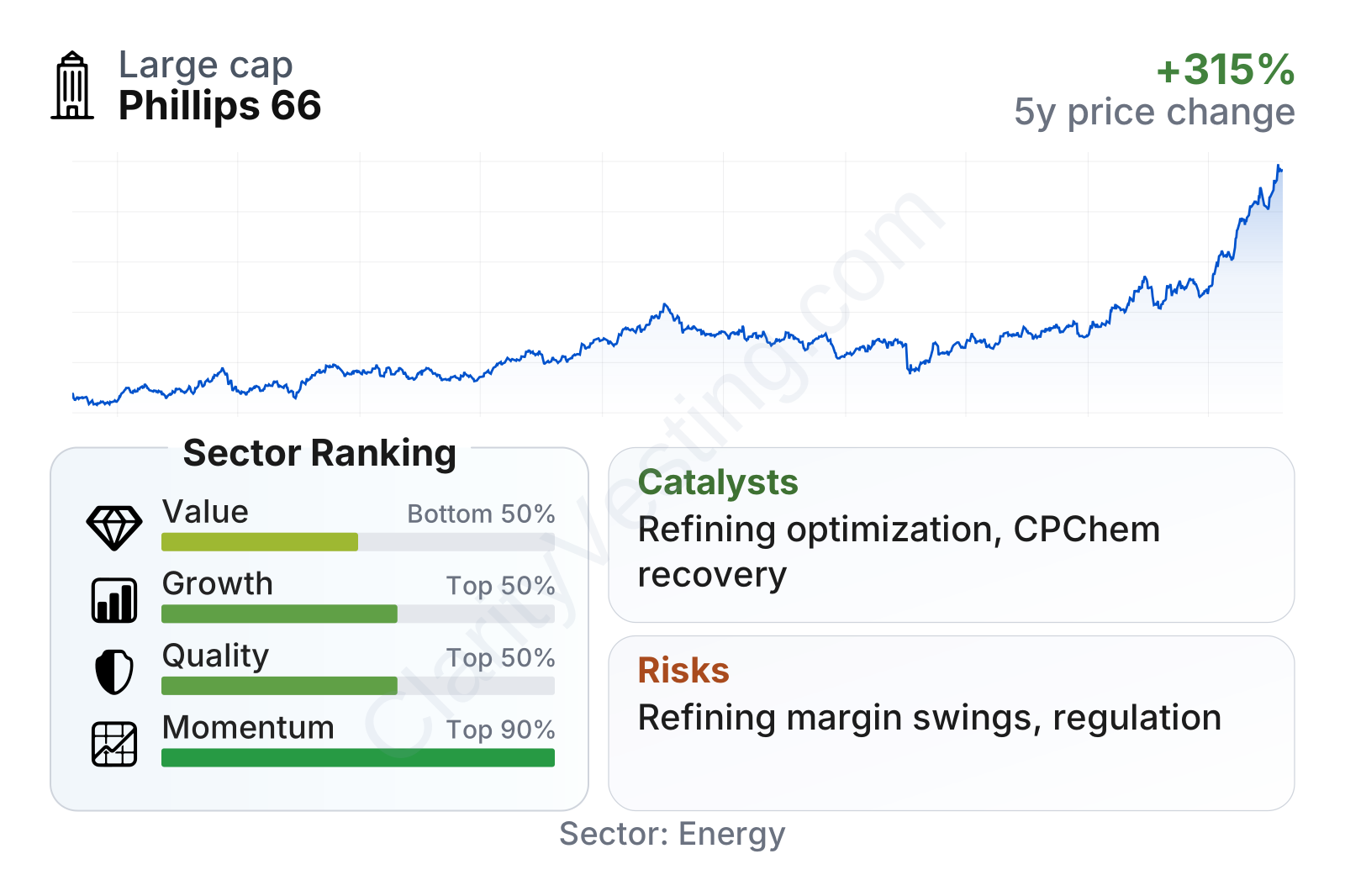
Phillips 66 is a very large energy company with a market value above $100 billion, and its recent share-price performance has been much stronger than the sector median. The quality profile looks better than average, helped by returns on capital and asset efficiency that exceed many peers. Growth metrics are more mixed: recent revenue growth has rebounded strongly, but five-year earnings and free cash flow trends remain uneven, which reflects the cyclicality of refining. On valuation, the stock does not look obviously cheap across all measures, yet its EBIT-to-enterprise-value ratio stands above the sector median, suggesting the market is still giving some credit to the company’s operating earnings power.
Growth
Phillips 66 operates in a sector that is mature in developed markets but still structurally important. Oil demand growth is slower than it once was, and energy transition policies create long-term uncertainty, yet liquid fuels remain essential for transportation, aviation, freight, and industrial activity. That means the company is not in a classic high-growth industry, but it can still grow through better asset utilization, portfolio upgrades, cost discipline, and selective expansion in advantaged niches such as midstream, chemicals, and renewable fuels.
The company’s strategy makes sense in that context. Management has emphasized running refineries more efficiently, improving returns rather than simply chasing volume, and building businesses that are less volatile than pure refining. Its integrated setup gives it several levers: refining captures fuel demand, midstream supports fee-based infrastructure income, chemicals provide exposure to petrochemical demand, and branded marketing adds downstream reach.
Revenue growth has been volatile, which is normal for a refiner because sales are influenced by both commodity prices and throughput. The latest pattern points to a meaningful rebound after a stretch of weaker comparisons. That recovery is encouraging, but long-term readers should remember that top-line growth in this industry often says more about market conditions than about durable structural expansion.
Free cash flow has been less smooth than revenue and recently weakened sharply from earlier peaks. This is one of the most important points in the long-term picture. Phillips 66 can generate substantial cash in favorable environments, but that cash generation is not linear. The more constructive interpretation is that the company has already shown it can produce multi-billion-dollar free cash flow when margins normalize, and management’s asset optimization plan is aimed at making those cash flows more resilient over time.
Several catalysts could support future performance. The company has continued to focus on refining improvement programs, shareholder returns, and simplification of its portfolio. Ongoing optimization of its refining system, contributions from midstream assets, and stronger utilization rates can all help earnings. Chevron Phillips Chemical also gives the company optionality if petrochemical markets recover. In addition, renewable diesel and other lower-carbon fuel initiatives may become more meaningful over time as regulations and customer demand evolve.
Recent company communications have also highlighted efforts to improve returns and reduce costs across the system. For a business like Phillips 66, relatively small improvements in utilization, reliability, and capture rates can have a sizable effect on profit because the revenue base is so large.
Risks
This article is for informational purposes only and does not constitute financial advice. Some content is AI-generated. See Disclaimer


