Stock Analysis · Personalis Inc (PSNL)
Overview
Personalis is a molecular diagnostics and genomics company focused on advanced DNA sequencing for cancer. In simple terms, it analyzes tumor and blood samples to help biopharmaceutical companies, healthcare providers, and researchers detect cancer-related genetic signals and monitor how disease changes over time. The company built its reputation in whole-genome and tumor-normal sequencing, and more recently it has been emphasizing its minimal residual disease, or MRD, testing platform called NeXT Personal.
Its business is not yet broadly diversified. Based on recent annual reporting, revenue mainly comes from laboratory testing and sequencing services tied to oncology, with biopharma and research customers still representing the largest commercial base while clinical testing is becoming more important. The mix can move meaningfully from one period to another because contract timing and testing volumes can be uneven.
The main revenue sources can be summarized as follows:
- Precision oncology products and services: the large majority of revenue, roughly more than 80%. This includes sequencing, bioinformatics analysis, and cancer monitoring services sold to biopharma partners, research organizations, and increasingly clinical customers.
- Clinical oncology testing, including MRD: a growing portion within the oncology business, but the company does not disclose a clean standalone percentage for every period. Recent company updates suggest this is becoming one of the key strategic growth drivers.
- Other and legacy population sequencing-related work: a smaller share, likely below 20% in recent periods, including residual revenue from non-core or less emphasized programs.
Over the last several years, the income structure shows a business that can generate respectable gross profit when volumes improve, but operating expenses remain much larger than gross profit. Research and development has stayed high because Personalis is still investing in its cancer testing platform, while selling and administrative costs also absorb a substantial share of revenue. That pattern helps explain why the company has remained deeply unprofitable even in years when sales recovered.
The broader financial picture is a company trying to transition from a sequencing-service model toward a higher-value oncology testing platform. That can eventually improve economics, but the transition is still incomplete.
Key Figures
| Metric | Value | Sector ⓘ |
|---|---|---|
| Date | Oct 17, 2026 | |
| Context | ||
| Sector | Healthcare | |
| Industry | Diagnostics & Research | |
| Market Cap ⓘ | $1.70B | |
| Beta ⓘ | 2.32 | |
Value (Cheapness) | ||
| P/E Ratio ⓘ | N/A | 24.79 |
| P/B Ratio ⓘ | 7.14 | 3.08 |
| FCF Yield ⓘ | -5.95% | 3.15% |
| Dividend Yield ⓘ | N/A | 1.94% |
| EBIT / EV ⓘ | -6.80% | 0.57% |
| PEG ⓘ | N/A | |
Growth (Business expansion) | ||
| Revenue Growth ⓘ | 30.00% | 7.45% |
| RPS Growth (5Y CAGR) ⓘ | -20.44% | 8.61% |
| EPS Growth (5Y CAGR) ⓘ | -31.83% | -17.81% |
| BVPS Growth (5Y CAGR) ⓘ | -19.79% | 3.72% |
| Margin Growth (5Y Trend) ⓘ | N/A | -0.62% |
| FCF Growth (5Y CAGR) ⓘ | -0.76% | 1.04% |
| DPS Growth (5Y CAGR) ⓘ | N/A | 6.77% |
Quality (Business durability) | ||
| ROIC (Latest) ⓘ | -35.99% | 3.24% |
| ROA (Latest) ⓘ | -38.62% | 3.01% |
| ROIC (5Y Median) ⓘ | -33.24% | 4.60% |
| ROA (5Y Median) ⓘ | -32.82% | 1.89% |
| Net Debt / EBIT (Latest) ⓘ | N/A | 1.34 |
| Net Debt / EBIT (5Y Median) ⓘ | N/A | 1.84 |
| Net Debt / EBITDA (Latest) ⓘ | N/A | 1.00 |
| Net Debt / Assets ⓘ | -17.93% | 5.45% |
| EBITDA / Interest ⓘ | N/A | 9.64 |
| Operating Margin (Latest) ⓘ | -153.49% | 9.27% |
| Operating Margin (5Y Median) ⓘ | -116.36% | 7.38% |
| Debt to Equity (Latest) ⓘ | 16.16% | 28.58% |
| Profit Margin (Latest) ⓘ | -153.84% | 3.59% |
| Free Cash Flow (Latest) ⓘ | -$100.97M | |
Momentum (Price trend) | ||
| 3Y Return ⓘ | +1285.22% | +42.80% |
| 12M Return (excl. last month) ⓘ | +171.50% | +18.50% |
| 6M Return ⓘ | +140.27% | +7.57% |
| Price vs. 200-Day MA ⓘ | +46.41% | +5.12% |
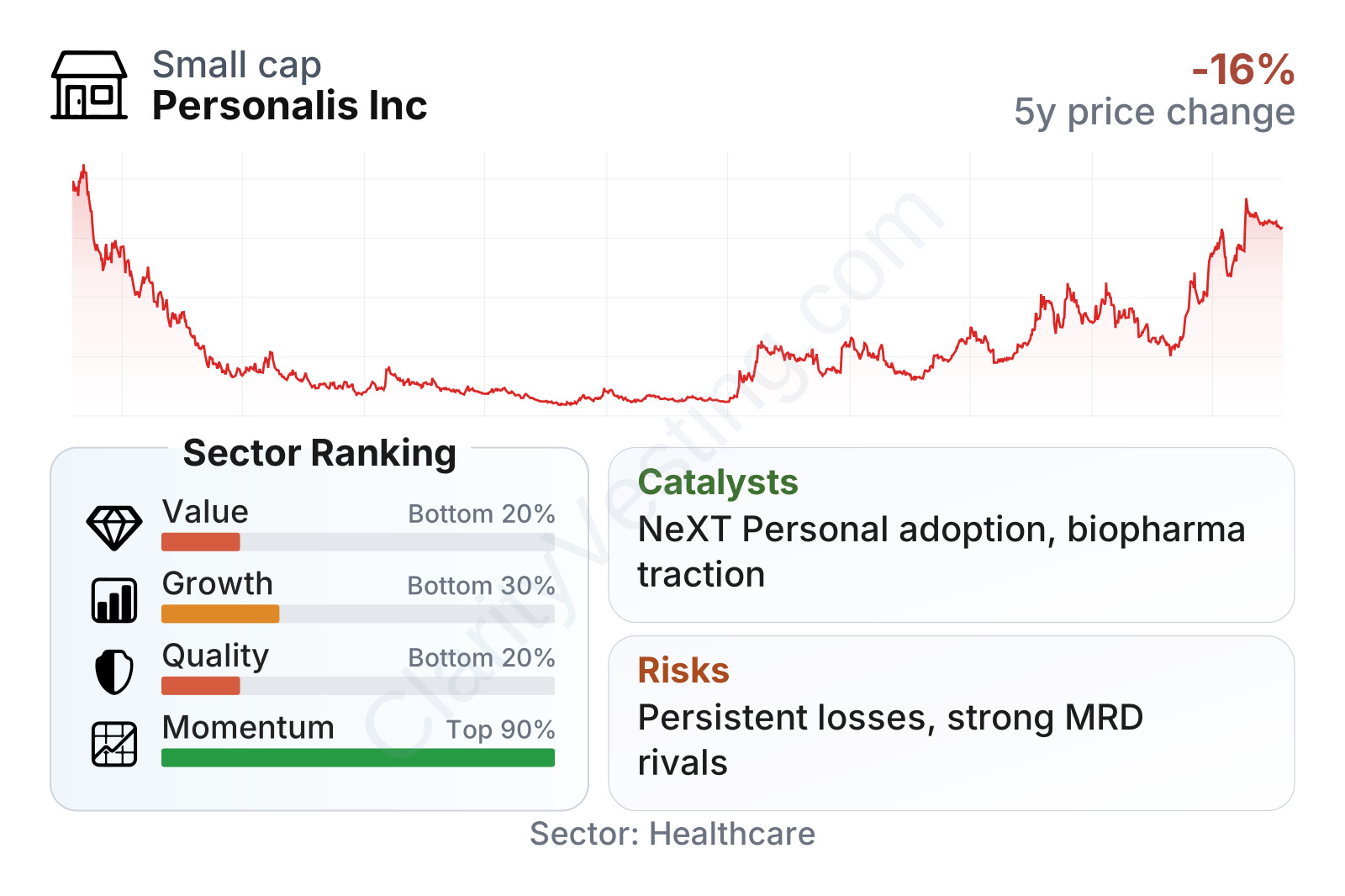
Personalis is still a relatively small healthcare company by market value, and the stock has been highly volatile. After a severe decline from 2021 into 2023, the share price rebounded sharply through parts of 2024 to 2026, which explains why momentum ranks unusually high versus much of the sector. That strong stock performance does not reflect strong profitability, however. On value, quality, and long-term growth measures, the company sits near the lower end of the healthcare peer group.
The table points to a mixed profile: recent revenue growth has improved versus the sector median, but profitability, returns on capital, and free cash flow remain weak. The balance sheet is less burdened by debt than many peers, which matters because it gives the company more time to pursue its strategy, but the current valuation still assumes that the oncology platform can scale materially from here.
Growth
Cancer genomics is a growing area of healthcare. Demand is supported by several long-term trends: more use of precision medicine, growing adoption of blood-based cancer monitoring, rising interest in earlier relapse detection, and broader use of genomic data in drug development. Personalis operates in a part of the market where the scientific need is real and where successful platforms can become deeply embedded in clinical and pharmaceutical workflows.
Its strategy is centered on turning technical depth in sequencing into a commercially valuable oncology platform. The most important piece is MRD testing, where Personalis is trying to detect tiny traces of cancer left after treatment or emerging again later. This matters because MRD can help guide treatment decisions, support clinical trials, and potentially improve patient monitoring. If NeXT Personal gains broader acceptance among oncologists and biopharma companies, it could move the company toward more recurring, higher-value revenue.
Revenue growth has been uneven rather than consistently linear. There were periods of contraction followed by strong rebounds, and the latest year-over-year trend again shows a sharp swing. That volatility reflects the company’s dependence on program timing, customer concentration, and the early-stage nature of its commercial buildout. Even so, the most recent annual growth rate is well above the sector median, showing that the business can accelerate when demand lines up.
Cash generation remains the main missing piece in the growth case. Free cash flow improved meaningfully from the worst levels seen a few years ago, but it is still negative and has recently weakened again. That means revenue growth alone is not enough; Personalis also needs better cost absorption and stronger operating discipline for growth to translate into lasting financial improvement.
Recent company updates have pointed to expanding traction for NeXT Personal, clinical validation work, and partnerships tied to oncology applications. Those developments are important because in this market, commercial momentum often follows evidence generation. A strong catalyst would be broader adoption by large cancer centers, deeper integration into biopharma trials, or data that clearly shows the test performs well against competing MRD approaches.
Risks
This article is for informational purposes only and does not constitute financial advice. Some content is AI-generated. See Disclaimer


