Stock Analysis · PriceSmart Inc (PSMT)
Overview
PriceSmart Inc. operates membership-based warehouse clubs in Latin America, the Caribbean, and Central America. Its model is often compared to a smaller regional version of Costco: customers and small businesses pay an annual membership fee to access a limited-selection, high-volume retail format focused on value. The company sells groceries, household essentials, fresh food, health and beauty products, electronics, tires, and some general merchandise, while also offering a growing set of complementary services such as pharmacy, optical, food court, and e-commerce pickup or delivery options in selected markets.
Revenue is overwhelmingly driven by merchandise sales through warehouse clubs, while membership income is a much smaller but important profit contributor because it tends to carry very high margins. Based on recent annual reporting, the business mix is approximately:
- Net merchandise sales: about 98% to 99% — food and beverages, fresh produce, meat, household consumables, appliances, electronics, apparel, and other club merchandise.
- Membership income: about 2% — annual fees paid by consumer and business members for access to the clubs.
- Other income: below 1% — smaller service-related and ancillary activities.
Geographically, PriceSmart is diversified across multiple emerging consumer markets rather than relying on the United States. That gives it exposure to rising consumption in regions where modern organized retail still has room to expand, but it also adds currency, logistics, and political complexity.
The business structure shows a straightforward retail profile: a very large share of revenue goes to inventory costs, while operating expenses remain controlled enough to produce steady operating income growth. Over the last several years, sales, gross profit, operating income, and net income have all moved upward, even though retail margins remain naturally thin.
Key Figures
| Metric | Value | Sector ⓘ |
|---|---|---|
| Date | Oct 17, 2026 | |
| Context | ||
| Sector | Consumer Defensive | |
| Industry | Discount Stores | |
| Market Cap ⓘ | $5.22B | |
| Beta ⓘ | 0.74 | |
Value (Cheapness) | ||
| P/E Ratio ⓘ | 32.55 | 17.88 |
| P/B Ratio ⓘ | 3.73 | 1.29 |
| FCF Yield ⓘ | 1.41% | 12.39% |
| Dividend Yield ⓘ | 0.79% | 2.85% |
| EBIT / EV ⓘ | 4.61% | 6.43% |
| PEG ⓘ | 1.83 | |
Growth (Business expansion) | ||
| Revenue Growth ⓘ | 12.50% | 4.10% |
| RPS Growth (5Y CAGR) ⓘ | 10.15% | 6.18% |
| EPS Growth (5Y CAGR) ⓘ | 5.52% | -13.59% |
| BVPS Growth (5Y CAGR) ⓘ | 8.37% | 3.20% |
| Margin Growth (5Y Trend) ⓘ | -0.13% | -0.15% |
| FCF Growth (5Y CAGR) ⓘ | 64.79% | 4.10% |
| DPS Growth (5Y CAGR) ⓘ | 15.53% | 6.79% |
Quality (Business durability) | ||
| ROIC (Latest) ⓘ | 11.74% | 12.34% |
| ROA (Latest) ⓘ | 6.50% | 6.30% |
| ROIC (5Y Median) ⓘ | 10.16% | 10.49% |
| ROA (5Y Median) ⓘ | 5.88% | 5.44% |
| Net Debt / EBIT (Latest) ⓘ | 0.48 | 1.96 |
| Net Debt / EBIT (5Y Median) ⓘ | 0.35 | 2.35 |
| Net Debt / EBITDA (Latest) ⓘ | 0.34 | 1.38 |
| Net Debt / Assets ⓘ | 4.49% | 21.51% |
| EBITDA / Interest ⓘ | 21.71 | 9.46 |
| Operating Margin (Latest) ⓘ | 4.33% | 8.87% |
| Operating Margin (5Y Median) ⓘ | 4.14% | 9.53% |
| Debt to Equity (Latest) ⓘ | 23.37% | 72.35% |
| Profit Margin (Latest) ⓘ | 2.82% | 5.40% |
| Free Cash Flow (Latest) ⓘ | $73.73M | |
Momentum (Price trend) | ||
| 3Y Return ⓘ | +147.79% | +20.92% |
| 12M Return (excl. last month) ⓘ | +50.33% | +2.13% |
| 6M Return ⓘ | +9.09% | +1.26% |
| Price vs. 200-Day MA ⓘ | +5.18% | +1.39% |
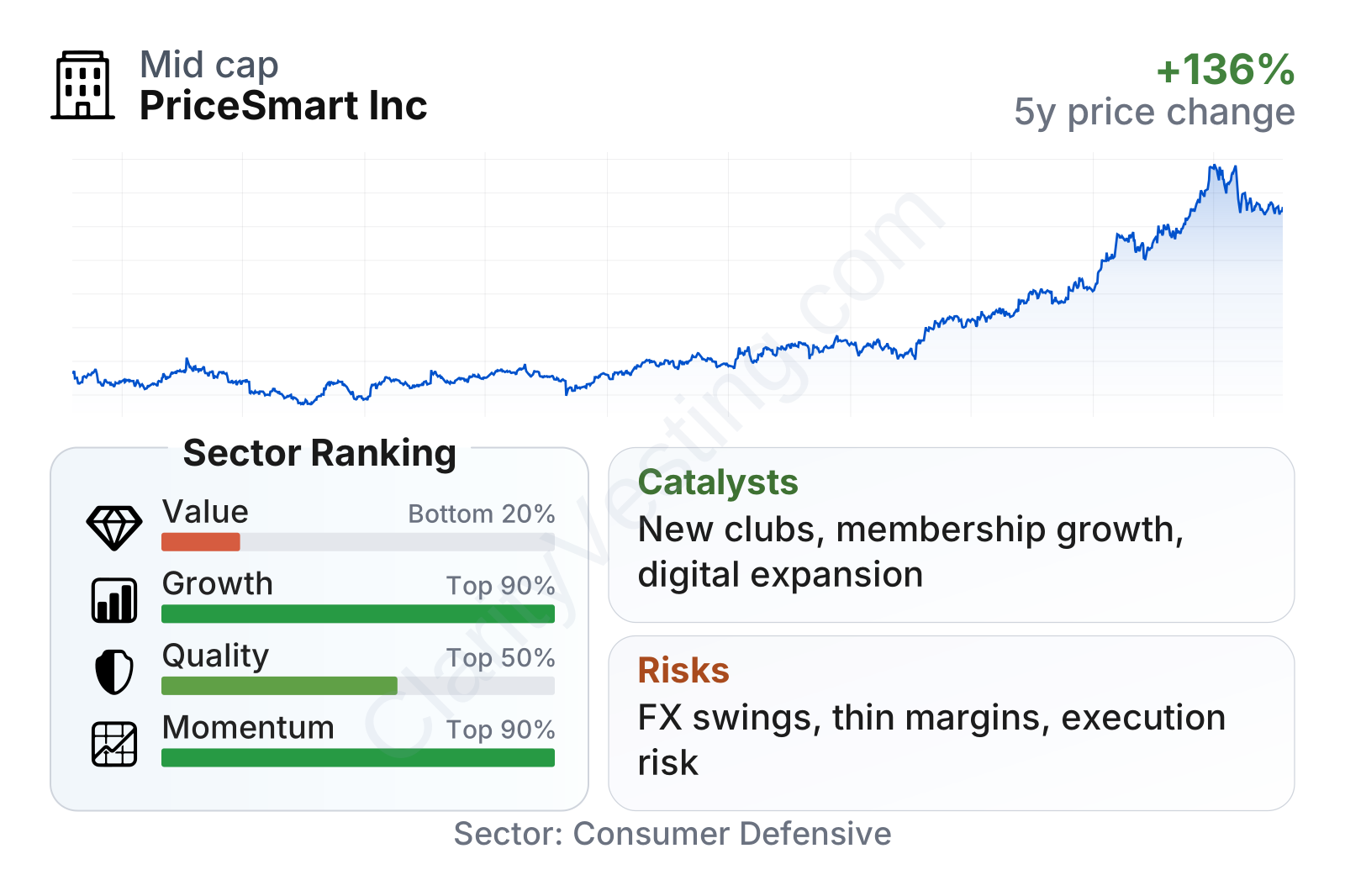
PriceSmart is a mid-sized consumer defensive company with a stock that has recently performed far better than most peers in its sector. The broader metric profile is mixed in an understandable way: growth and market momentum rank very high, balance-sheet quality looks solid, but traditional valuation measures are notably richer than the sector median. That combination usually signals a business the market is rewarding for consistency and expansion potential rather than for cheapness.
Growth
PriceSmart operates in a part of retail that still has room to develop. In many of its markets, modern warehouse club penetration is far lower than in the U.S., and the company benefits from a format that appeals to both households and small businesses seeking low unit costs. That does not make the sector immune to economic cycles, but it does support a long runway if execution remains disciplined.
The recent growth profile has been strong. Revenue growth has generally stayed in a high-single-digit to low-teens range, which is well above the sector median. Over five years, revenue per share has compounded at roughly 10%, and earnings per share have also trended upward. This matters because it suggests growth has not come only from opening more clubs, but also from improving the economics of the existing base.
Strategy also appears coherent. PriceSmart continues to expand its club network, invest in distribution capabilities, build out digital features such as click-and-collect and delivery partnerships, and broaden private-label penetration. In warehouse retail, scale matters: larger purchasing volumes can improve pricing, while denser logistics can support margins and service levels. If the company keeps adding clubs without overextending, those investments can strengthen the model over time.
Cash generation adds support to the growth case. Free cash flow turned positive after an earlier investment-heavy period and has remained positive, with a generally improving trend. That gives the company more flexibility to fund expansion, maintain its dividend, and absorb periodic swings in working capital that are common in retail.
A meaningful catalyst in recent periods has been the combination of new warehouse openings, membership growth, and continued demand resilience in staple categories. Another positive signal is that the company has been able to grow while keeping leverage low, which leaves room for continued investment without putting unusual strain on the balance sheet.
Risks
This article is for informational purposes only and does not constitute financial advice. Some content is AI-generated. See Disclaimer


