Stock Analysis · Persimmon PLC (PSMMF)
Overview
Persimmon PLC is a large U.K. homebuilder focused on building and selling new residential properties. The group operates primarily through the Persimmon, Charles Church, and Westbury Partnerships brands, covering a wide range of price points and customer types. Its business is straightforward: it acquires land, develops housing sites, builds homes, and sells them to buyers, with a meaningful share of demand supported by the U.K. need for more housing.
Revenue is overwhelmingly tied to homebuilding. Based on the company’s reporting structure and recent annual disclosures, the business is dominated by private and affordable housing completions, while a smaller contribution comes from related activities such as land sales and partnership-led developments.
- Open market housing sales: approximately 70% to 80% of revenue in a typical year. This is the sale of newly built homes to individual buyers.
- Affordable housing sales: approximately 15% to 25%. These homes are generally sold to housing associations or similar counterparties.
- Other revenue, including land and related items: usually 0% to 10%. This can include land disposals and smaller ancillary streams.
For a long-term reader, the most important point is that Persimmon is not a diversified conglomerate. It is mainly a direct play on the U.K. housing market, construction costs, mortgage affordability, and the company’s own ability to control land buying and build efficiently.
The profit flow over recent years shows how cyclical this business is. Revenue and earnings were exceptionally strong in 2021 and 2022, weakened sharply in 2023 as the housing market slowed, and then began to recover in 2024 and 2025. Even so, costs have taken a larger share of sales than they did at the peak, which means the rebound in revenue has not fully restored earlier profitability.
Key Figures
| Metric | Value | Sector ⓘ |
|---|---|---|
| Date | Oct 03, 2026 | |
| Context | ||
| Sector | Consumer Cyclical | |
| Industry | Residential Construction | |
| Market Cap ⓘ | $5.12B | |
| Beta ⓘ | 1.40 | |
Value (Cheapness) | ||
| P/E Ratio ⓘ | 12.76 | 17.04 |
| P/B Ratio ⓘ | 1.37 | 1.61 |
| FCF Yield ⓘ | -3.67% | 9.02% |
| Dividend Yield ⓘ | 3.17% | 2.75% |
| EBIT / EV ⓘ | N/A | 6.69% |
| PEG ⓘ | 0.69 | |
Growth (Business expansion) | ||
| Revenue Growth ⓘ | 14.90% | 5.60% |
| RPS Growth (5Y CAGR) ⓘ | 0.68% | 9.04% |
| EPS Growth (5Y CAGR) ⓘ | -12.52% | -17.44% |
| BVPS Growth (5Y CAGR) ⓘ | -0.36% | 5.73% |
| Margin Growth (5Y Trend) ⓘ | -15.47% | -0.26% |
| FCF Growth (5Y CAGR) ⓘ | N/A | 4.91% |
| DPS Growth (5Y CAGR) ⓘ | -29.05% | 10.48% |
Quality (Business durability) | ||
| ROIC (Latest) ⓘ | 16.58% | 12.38% |
| ROA (Latest) ⓘ | 10.88% | 5.54% |
| ROIC (5Y Median) ⓘ | 15.04% | 10.63% |
| ROA (5Y Median) ⓘ | 5.63% | 5.44% |
| Net Debt / EBIT (Latest) ⓘ | 0.22 | 2.16 |
| Net Debt / EBIT (5Y Median) ⓘ | -0.52 | 2.31 |
| Net Debt / EBITDA (Latest) ⓘ | 0.21 | 1.52 |
| Net Debt / Assets ⓘ | 3.30% | 21.74% |
| EBITDA / Interest ⓘ | 12.67 | 9.06 |
| Operating Margin (Latest) ⓘ | 11.30% | 9.12% |
| Operating Margin (5Y Median) ⓘ | 13.22% | 9.56% |
| Debt to Equity (Latest) ⓘ | 8.02% | 76.18% |
| Profit Margin (Latest) ⓘ | 7.68% | 5.30% |
| Free Cash Flow (Latest) ⓘ | -$188.02M | |
Momentum (Price trend) | ||
| 3Y Return ⓘ | +33.68% | +11.77% |
| 12M Return (excl. last month) ⓘ | +10.90% | +0.61% |
| 6M Return ⓘ | -7.30% | +1.32% |
| Price vs. 200-Day MA ⓘ | +2.82% | -3.47% |
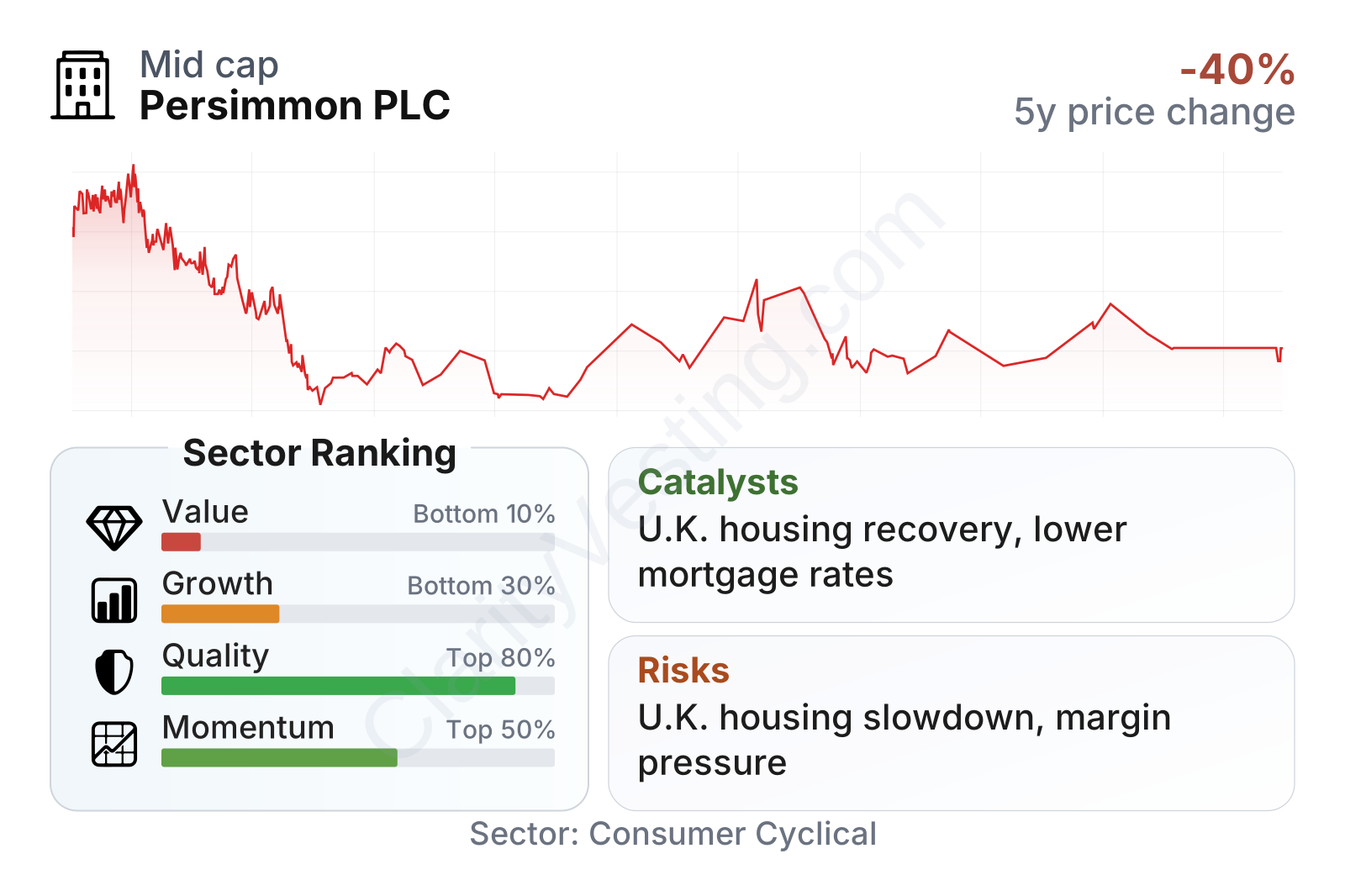
Persimmon is a mid-to-large sized listed homebuilder with a market value around the mid-single-digit billions of dollars and a share price history that reflects the housing cycle more than any single short-term event. The stock remains well below its 2021 high, which matches the sector-wide reset that followed higher interest rates and weaker affordability.
The overall financial profile is mixed. Profitability and balance-sheet strength stand out positively versus much of the residential construction sector: returns on capital are above sector norms, operating and net margins remain ahead of the median, and leverage is very low. On the other hand, growth metrics are less impressive over a multi-year view because the company is still climbing out of the recent housing downturn. Valuation multiples look lower than the sector median on earnings and book value, but free cash flow has recently been negative, which tempers how attractive those multiples appear.
Growth
Persimmon operates in a sector with clear long-term underlying demand. The U.K. has faced a persistent housing shortage for years, and that creates a structural need for new homes. For builders, however, demand does not move in a straight line. It is highly sensitive to mortgage rates, buyer confidence, employment conditions, and government housing policy. That means the long-term backdrop is supportive, but the path can be uneven.
The company’s strategy remains sensible for that environment. Persimmon has long emphasized disciplined land investment, a relatively standardized build model, and scale in volume housing. This approach can be effective when the market stabilizes because it supports cost control and helps the company turn demand recovery into improved volumes. Recent trading and annual reporting indicate that completions and revenue have started to recover from the low point seen in 2023.
Recent revenue growth has been strong on a year-over-year basis, clearly ahead of the sector median, which suggests the company is participating in an industry rebound rather than standing still. Still, the longer view is less exciting: five-year revenue per share growth has been modest, and margins have not returned to earlier peak levels. In simple terms, Persimmon is recovering, but it is not yet back to the earnings power it showed during the boom years.
A meaningful catalyst is any sustained easing in mortgage affordability pressure. If interest rates continue to normalize and consumer confidence improves, reservation rates, selling prices, and site activity could all benefit. Another support factor is the policy backdrop in the U.K., where housing supply remains a national issue. Builders with land, scale, and delivery capacity are well placed if planning and housing initiatives become more supportive. Persimmon’s affordability-focused exposure could also help it capture demand sooner than more premium-focused peers if first-time buyers regain confidence.
Recent company updates have pointed to improved sales trends and a stronger level of forward activity compared with the weakest part of the downturn. That does not remove cyclical risk, but it does suggest the company is moving from contraction toward recovery.
Risks
This article is for informational purposes only and does not constitute financial advice. Some content is AI-generated. See Disclaimer