Stock Analysis · Power Solutions International Inc (PSIX)
Overview
Power Solutions International Inc designs and manufactures engines and power systems for industrial uses. In simple terms, the company builds engines and related components that are used in equipment such as power generators, industrial machines, forklifts, agricultural equipment, construction equipment, and certain on-road commercial vehicles. A major part of its positioning is its ability to offer engines that can run on different fuels, including natural gas, propane, gasoline, and diesel, while also meeting emissions requirements in the markets it serves.
Its business is generally organized around engine applications rather than a consumer brand. That matters for long-term analysis because demand depends less on retail trends and more on equipment production cycles, energy infrastructure spending, backup power demand, and fleet or industrial customers replacing older systems.
Based on recent company filings, revenue comes primarily from product sales to original equipment manufacturers and other industrial customers. The company’s largest end markets are typically power systems and industrial applications, with transportation representing a smaller but still meaningful share. Exact percentages can shift year to year, but the mix is broadly concentrated in a few areas:
- Power systems: the largest revenue source, driven by engines used in standby and prime power generation equipment, including systems tied to data centers, distributed generation, and backup power needs.
- Industrial: engines for forklifts, construction, agriculture, arbor care, turf, and other off-road equipment.
- Transportation: engines for selected on-road commercial vehicle uses, including buses and trucks in niche fuel configurations.
- Parts and service-related sales: a smaller contribution, but helpful for recurring revenue and installed-base support.
One of the most important business developments in recent years is that PSI has become far more profitable even before becoming a very large company. Revenue expanded strongly in 2025, while gross profit and operating income improved faster than sales, showing that its product mix and cost structure have been getting better at the same time.
The multiyear earnings pattern shows a notable turnaround. Revenue moved from roughly $456 million in 2021 to more than $720 million in 2025, while net income swung from a large loss to well above $100 million. Just as important, interest expense fell materially over that period, which means more of the operating profit now reaches the bottom line.
Key Figures
| Metric | Value | Sector ⓘ |
|---|---|---|
| Date | Oct 17, 2026 | |
| Context | ||
| Sector | Industrials | |
| Industry | Specialty Industrial Machinery | |
| Market Cap ⓘ | $1.07B | |
| Beta ⓘ | 2.01 | |
Value (Cheapness) | ||
| P/E Ratio ⓘ | 15.85 | 22.10 |
| P/B Ratio ⓘ | 5.30 | 1.97 |
| FCF Yield ⓘ | 6.24% | 6.38% |
| Dividend Yield ⓘ | N/A | 1.94% |
| EBIT / EV ⓘ | 7.69% | 4.79% |
| PEG ⓘ | 0.82 | |
Growth (Business expansion) | ||
| Revenue Growth ⓘ | -20.50% | 9.30% |
| RPS Growth (5Y CAGR) ⓘ | 11.98% | 7.81% |
| EPS Growth (5Y CAGR) ⓘ | 13.80% | -13.06% |
| BVPS Growth (5Y CAGR) ⓘ | N/A | 6.14% |
| Margin Growth (5Y Trend) ⓘ | 24.35% | 0.88% |
| FCF Growth (5Y CAGR) ⓘ | N/A | 11.01% |
| DPS Growth (5Y CAGR) ⓘ | N/A | 9.48% |
Quality (Business durability) | ||
| ROIC (Latest) ⓘ | 26.70% | 10.84% |
| ROA (Latest) ⓘ | 14.88% | 5.41% |
| ROIC (5Y Median) ⓘ | 26.63% | 9.38% |
| ROA (5Y Median) ⓘ | 8.71% | 4.95% |
| Net Debt / EBIT (Latest) ⓘ | 0.73 | 2.08 |
| Net Debt / EBIT (5Y Median) ⓘ | 2.27 | 2.27 |
| Net Debt / EBITDA (Latest) ⓘ | 0.69 | 1.39 |
| Net Debt / Assets ⓘ | 14.26% | 19.28% |
| EBITDA / Interest ⓘ | 14.40 | 9.58 |
| Operating Margin (Latest) ⓘ | 13.04% | 10.50% |
| Operating Margin (5Y Median) ⓘ | 9.65% | 10.29% |
| Debt to Equity (Latest) ⓘ | 66.35% | 65.48% |
| Profit Margin (Latest) ⓘ | 10.04% | 6.67% |
| Free Cash Flow (Latest) ⓘ | $67.09M | |
Momentum (Price trend) | ||
| 3Y Return ⓘ | +1403.39% | +61.68% |
| 12M Return (excl. last month) ⓘ | -58.20% | +12.58% |
| 6M Return ⓘ | -45.43% | 0.00% |
| Price vs. 200-Day MA ⓘ | -13.76% | +0.02% |
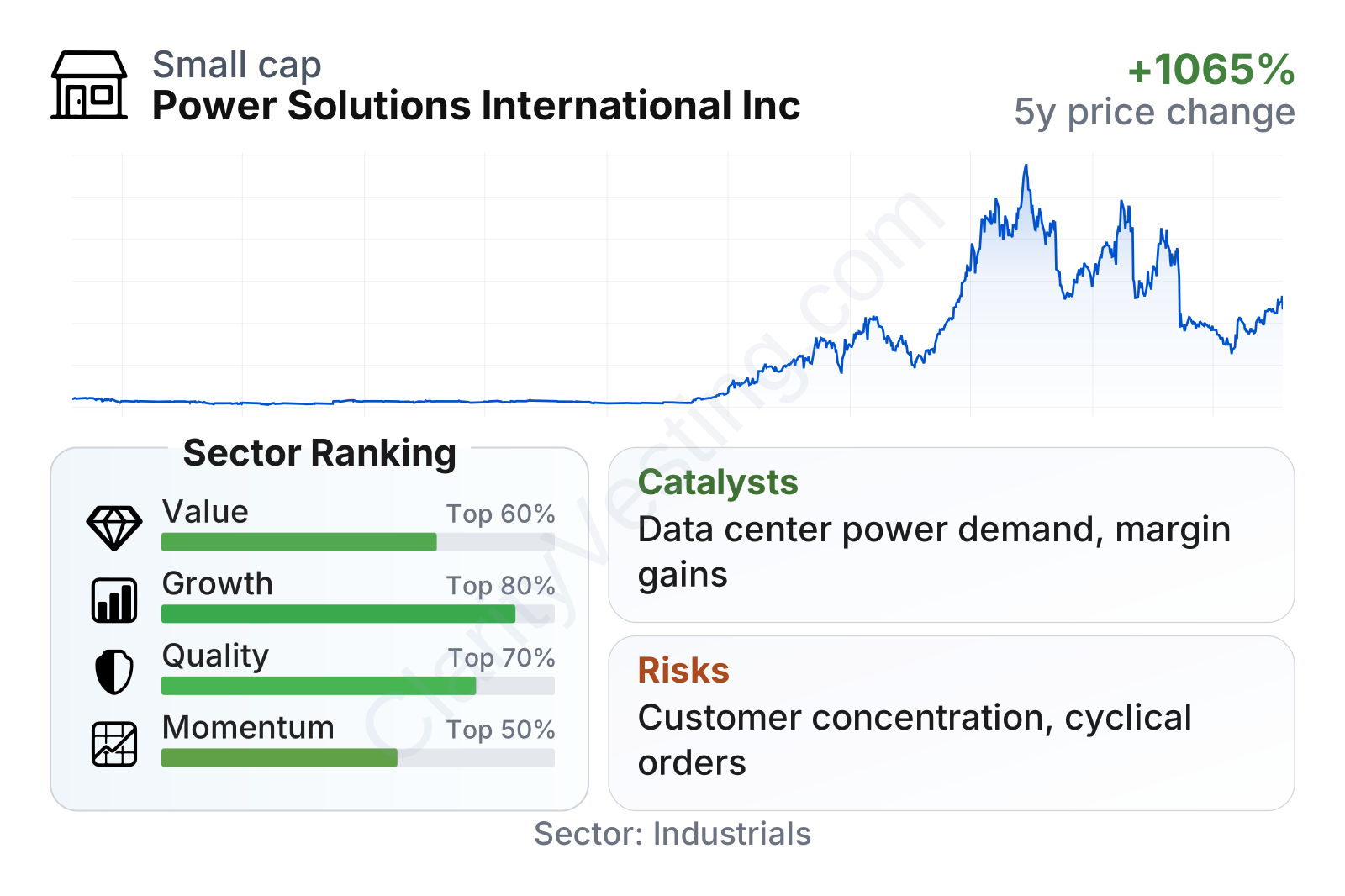
PSI is still a relatively small industrial company by market value, but it now screens better than many peers on profitability and capital efficiency. Returns on invested capital and assets are well above sector medians, and free cash flow remains positive. Valuation looks mixed: the earnings multiple is below the sector median, but the price-to-book ratio is much higher, which suggests the market is giving significant credit to the improvement in earnings power rather than to the balance sheet alone.
The stock’s behavior has been extremely volatile. After trading near micro-cap levels a few years ago, the shares surged dramatically and then pulled back sharply in 2026. That pattern usually signals that the market is reassessing how durable the recent earnings improvement really is.
Growth
PSI operates in several areas that have credible long-term demand drivers. The most attractive one is power generation. Rising electricity needs, grid reliability concerns, and the buildout of data-center infrastructure can all support demand for engines used in backup and distributed power systems. Natural gas and other alternative-fuel engines also remain relevant where customers need dispatchable power, lower emissions than traditional diesel in some use cases, or fuel flexibility.
The company’s strategy also makes industrial sense. Rather than competing directly as a giant diversified machinery manufacturer, PSI focuses on niche engine platforms and fuel-system know-how that can be adapted across multiple end markets. That can support growth without requiring the same scale as the industry’s largest players.
Recent growth has not been smooth. Revenue growth accelerated sharply through much of 2025, but the more recent year-over-year trend turned negative again by the first half of 2026. That does not erase the broader turnaround, but it does show that PSI remains exposed to uneven customer ordering patterns and possibly tougher comparisons after a very strong prior year.
Cash generation is another important part of the growth picture. Free cash flow improved dramatically from deeply negative levels in 2022 to clearly positive territory later on, though the most recent trailing figure is below the peak reached earlier. For a company in PSI’s position, this matters because sustained positive cash flow gives it more room to fund product development, support working capital, and reduce reliance on debt.
A meaningful catalyst has been the company’s stronger execution in power systems and improved profitability across the income statement. Public company communications have also highlighted demand tied to data-center and power-generation applications, which is one of the more significant opportunities in the current market backdrop. If that demand proves durable, PSI could continue benefiting from favorable mix and better factory utilization.
Risks
This article is for informational purposes only and does not constitute financial advice. Some content is AI-generated. See Disclaimer


