Stock Analysis · Public Storage (PSA)
Overview
Public Storage is one of the largest self-storage real estate companies in the United States. It owns, operates, and develops storage facilities where individuals and businesses rent space to store furniture, household goods, inventory, vehicles, and other belongings. The business is organized as a real estate investment trust, or REIT, which means real estate income and property performance are central to the company’s results.
The company’s revenue comes mainly from renting self-storage units. It also earns smaller amounts from tenant insurance-related programs, management and other property-related fees, and from commercial space at some locations. Based on recent annual disclosures, the mix is heavily concentrated in self-storage operations, with a smaller contribution from ancillary services.
- Self-storage rental revenue: about 93% to 95% of total revenue. This is the monthly rent paid by customers for storage units across the company’s owned facilities.
- Tenant reinsurance and merchandise sales: about 3% to 4%. This includes insurance-related income tied to tenant protection programs and sales of packing supplies.
- Management fees and other property income: about 1% to 3%. This includes fees from managing properties and other smaller real estate-related income streams.
That concentration is important for long-term analysis: Public Storage is not a diversified real estate platform in the broad sense. It is primarily a focused self-storage operator, and its results depend mostly on rental rates, occupancy, operating efficiency, and disciplined property expansion.
The business model is relatively straightforward. Facilities require ongoing maintenance, local marketing, and staffing, but they are generally less labor-intensive than many other real estate categories. This tends to support strong margins and cash generation when occupancy remains healthy and pricing is managed well.
Over the last several years, revenue has generally moved upward, while profitability has remained strong despite higher interest expense. One distorted year includes unusually large tax effects, so the cleaner takeaway is that Public Storage has preserved a high share of operating profit even as financing costs have risen.
Key Figures
| Metric | Value | Sector ⓘ |
|---|---|---|
| Date | Oct 24, 2026 | |
| Context | ||
| Sector | Real Estate | |
| Industry | REIT - Industrial | |
| Market Cap ⓘ | $55.74B | |
| Beta ⓘ | 0.93 | |
Value (Cheapness) | ||
| P/E Ratio ⓘ | 28.49 | 17.85 |
| P/B Ratio ⓘ | 6.00 | 0.87 |
| FCF Yield ⓘ | 5.71% | 7.30% |
| Dividend Yield ⓘ | 3.98% | 4.83% |
| EBIT / EV ⓘ | 3.24% | 3.78% |
| PEG ⓘ | 3.88 | |
Growth (Business expansion) | ||
| Revenue Growth ⓘ | 3.30% | 5.35% |
| RPS Growth (5Y CAGR) ⓘ | 8.96% | 6.02% |
| EPS Growth (5Y CAGR) ⓘ | -13.47% | -10.65% |
| BVPS Growth (5Y CAGR) ⓘ | 14.57% | 0.43% |
| Margin Growth (5Y Trend) ⓘ | -16.98% | -0.69% |
| FCF Growth (5Y CAGR) ⓘ | 6.25% | 5.40% |
| DPS Growth (5Y CAGR) ⓘ | 9.68% | 5.07% |
Quality (Business durability) | ||
| ROIC (Latest) ⓘ | 14.82% | 5.69% |
| ROE (Latest) ⓘ | 21.24% | 7.37% |
| ROA (Latest) ⓘ | 10.16% | 2.85% |
| ROIC (5Y Median) ⓘ | 16.09% | 4.26% |
| ROE (5Y Median) ⓘ | 24.92% | 6.04% |
| ROA (5Y Median) ⓘ | 11.50% | 2.45% |
| Net Debt / EBIT (Latest) ⓘ | 4.47 | 7.55 |
| Net Debt / EBIT (5Y Median) ⓘ | 3.68 | 8.26 |
| Net Debt / EBITDA (Latest) ⓘ | 2.93 | 5.26 |
| Net Debt / Assets ⓘ | 49.31% | 37.45% |
| EBITDA / Interest ⓘ | 10.38 | 4.11 |
| Operating Margin (Latest) ⓘ | 45.33% | 33.86% |
| Operating Margin (5Y Median) ⓘ | 52.51% | 37.49% |
| Debt to Equity (Latest) ⓘ | 110.77% | 88.76% |
| Profit Margin (Latest) ⓘ | 41.63% | 18.94% |
| Free Cash Flow (Latest) ⓘ | $3.19B | |
Momentum (Price trend) | ||
| 3Y Return ⓘ | +40.70% | +36.33% |
| 12M Return (excl. last month) ⓘ | +7.88% | +4.32% |
| 6M Return ⓘ | +3.41% | -1.74% |
| Price vs. 200-Day MA ⓘ | +4.09% | -1.42% |
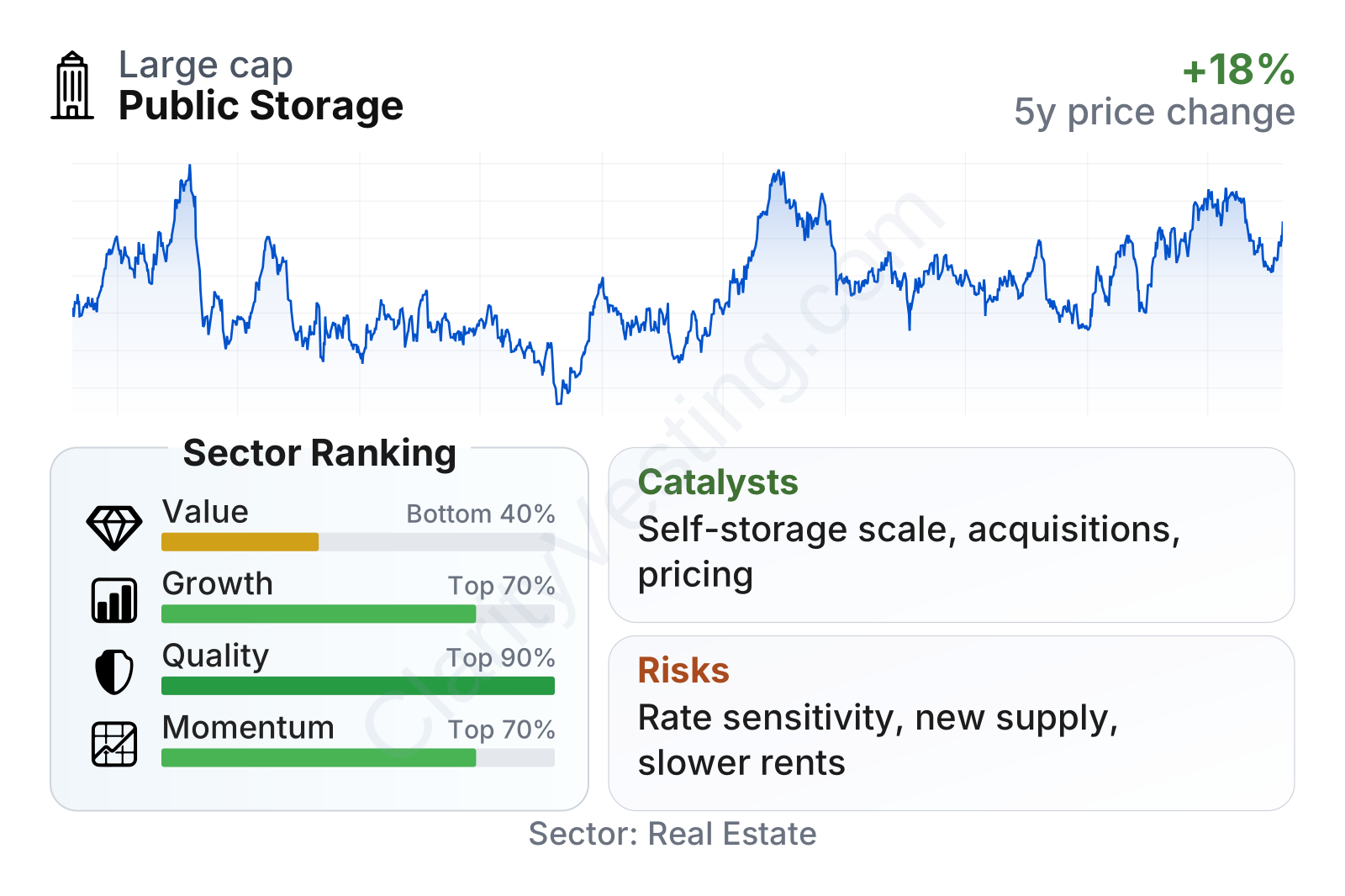
Public Storage stands out on business quality more than on cheapness. Profitability and returns on capital are well above sector medians, and leverage remains lower than many real estate peers on an earnings basis. Growth is mixed: longer-term revenue per share, free cash flow, and dividend growth have been solid, but recent year-over-year revenue growth has been modest and valuation multiples remain above the sector.
The stock’s recent trading pattern shows that it has recovered from weaker periods tied to interest-rate pressure. Over the last year, momentum has been better than much of the sector, although the longer multi-year price return has not clearly separated it from the broader real estate group.
Growth
Self-storage remains an attractive real estate niche for long-term observation because demand is supported by recurring life events rather than by a single economic theme. Moving, marriage, divorce, death, downsizing, business inventory needs, and urban space constraints all create storage demand. This does not make the sector immune to downturns, but it does make demand more durable than in some property categories that rely heavily on office usage or discretionary retail traffic.
Public Storage’s strategy for growth is sensible and consistent with the structure of the industry. The company expands through a combination of rent increases at existing facilities, acquisitions, redevelopment, and new developments. Scale matters here: a larger operator can spread technology, advertising, and operating systems across more properties, while also benefiting from brand recognition and denser local networks.
The revenue-per-share trend has been favorable over the past five years, rising at a pace above the sector median. That matters because it suggests growth has not relied only on issuing more shares or on financial engineering; on a per-share basis, the business has still expanded.
The dividend record shows a business that has produced enough cash to support substantial distributions, although the year-to-year pattern includes special dividends and is therefore less smooth than a typical industrial company’s payout trend. Even so, the broader direction over five years has been upward, which fits the company’s strong cash flow profile.
Another positive factor is the company’s balance between internal and external growth. Public Storage can still improve revenue at existing locations through pricing and occupancy management, but it also has room to add properties in a fragmented market where many facilities are still owned by smaller operators. Industry fragmentation creates ongoing consolidation opportunities for scaled players.
Recent company updates have also pointed to continued acquisition and development activity, as well as investment in digital capabilities that make renting easier online. In self-storage, smoother online search, reservations, and move-in can directly support occupancy and pricing. That is not a flashy catalyst, but it is a practical one in a business driven by local conversion and customer convenience.
Risks
This article is for informational purposes only and does not constitute financial advice. Some content is AI-generated. See Disclaimer


