Stock Analysis · Premier Foods Plc (PRRFY)
Overview
Premier Foods is a U.K.-based packaged food company focused on grocery staples and sweet treats sold mainly in the United Kingdom, with a growing international business. Its best-known brands include Mr Kipling, Ambrosia, Oxo, Bisto, Sharwood’s, Loyd Grossman, Batchelors, and Nissin noodles distributed under partnership arrangements. The business is built around products that are bought repeatedly, sold through major supermarkets, convenience channels, and foodservice, which gives it a relatively defensive profile compared with more discretionary consumer categories.
The company reports revenue primarily through two operating segments. Based on the latest annual reporting, the mix is approximately:
- Grocery: about 70% to 75% of revenue. This includes cooking aids and flavorings, meal solutions, soups, noodles, sauces, gravies, stocks, desserts, and branded ambient grocery products such as Bisto, Oxo, Sharwood’s, Batchelors, Loyd Grossman, Ambrosia, and Paxo.
- Sweet Treats: about 25% to 30% of revenue. This segment includes cakes, cake bars, hot desserts, and related products, led by brands such as Mr Kipling and Cadbury cake under license.
Geographically, the business is still heavily concentrated in the U.K., while international sales remain a smaller but strategically important contributor. Management has also been expanding revenue through branded partnerships and licensing, which can broaden distribution without requiring the company to build entirely new brands from scratch.
Over the last several years, sales have risen steadily, while operating profit has improved faster than revenue. That points to a business that has not only grown its top line but also become more efficient and more profitable.
The overall flow from sales to profit shows a favorable pattern: revenue has moved up consistently since 2022, gross profit has expanded, and operating income has improved meaningfully. Cost of goods has risen as well, but profit conversion has still strengthened, which suggests pricing discipline, mix improvement, and tight cost control.
Key Figures
| Metric | Value | Sector ⓘ |
|---|---|---|
| Date | Oct 17, 2026 | |
| Context | ||
| Sector | Consumer Defensive | |
| Industry | Packaged Foods | |
| Market Cap ⓘ | $2.28B | |
| Beta ⓘ | 0.59 | |
Value (Cheapness) | ||
| P/E Ratio ⓘ | 12.71 | 17.88 |
| P/B Ratio ⓘ | 1.65 | 1.29 |
| FCF Yield ⓘ | 12.66% | 12.39% |
| Dividend Yield ⓘ | 1.69% | 2.85% |
| EBIT / EV ⓘ | N/A | 6.43% |
| PEG ⓘ | N/A | |
Growth (Business expansion) | ||
| Revenue Growth ⓘ | 3.90% | 4.10% |
| RPS Growth (5Y CAGR) ⓘ | 7.13% | 6.18% |
| EPS Growth (5Y CAGR) ⓘ | N/A | -13.59% |
| BVPS Growth (5Y CAGR) ⓘ | -1.82% | 3.20% |
| Margin Growth (5Y Trend) ⓘ | 3.69% | -0.15% |
| FCF Growth (5Y CAGR) ⓘ | 21.91% | 4.10% |
| DPS Growth (5Y CAGR) ⓘ | 30.18% | 6.79% |
Quality (Business durability) | ||
| ROIC (Latest) ⓘ | N/A | 12.34% |
| ROA (Latest) ⓘ | N/A | 6.30% |
| ROIC (5Y Median) ⓘ | 7.90% | 10.49% |
| ROA (5Y Median) ⓘ | 4.75% | 5.44% |
| Net Debt / EBIT (Latest) ⓘ | 0.26 | 1.96 |
| Net Debt / EBIT (5Y Median) ⓘ | 1.31 | 2.35 |
| Net Debt / EBITDA (Latest) ⓘ | 0.21 | 1.38 |
| Net Debt / Assets ⓘ | 4.37% | 21.51% |
| EBITDA / Interest ⓘ | 12.82 | 9.46 |
| Operating Margin (Latest) ⓘ | 17.61% | 8.87% |
| Operating Margin (5Y Median) ⓘ | 15.82% | 9.53% |
| Debt to Equity (Latest) ⓘ | 24.06% | 72.35% |
| Profit Margin (Latest) ⓘ | 11.62% | 5.40% |
| Free Cash Flow (Latest) ⓘ | $288.02M | |
Momentum (Price trend) | ||
| 3Y Return ⓘ | +98.23% | +20.92% |
| 12M Return (excl. last month) ⓘ | +6.89% | +2.13% |
| 6M Return ⓘ | +9.21% | +1.26% |
| Price vs. 200-Day MA ⓘ | +8.39% | +1.39% |
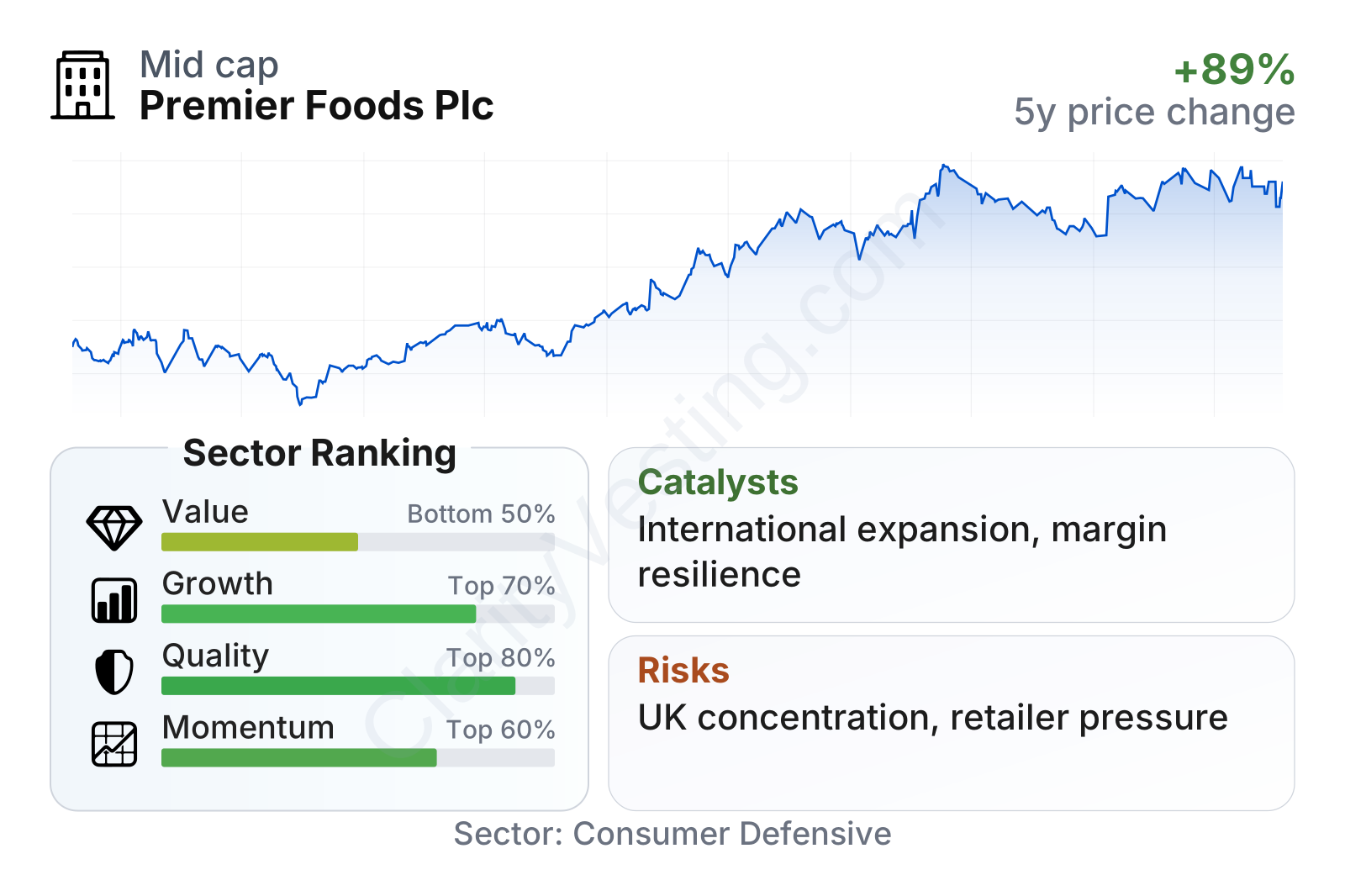
Premier Foods is a mid-sized consumer staples company with relatively low share-price volatility, reflected in a beta well below 1. The quality profile stands out most: operating margin, profit margin, cash generation, and balance-sheet leverage all compare well with sector norms. Growth metrics are also better than average overall, especially over a multi-year period, even though recent revenue expansion has slowed. On valuation, the picture is more mixed: the earnings multiple has historically been below the sector median, but the stock is no longer deeply discounted after a strong multi-year share price rise.
Growth
Packaged foods is not a high-growth industry in the way software or semiconductors can be, but it is a resilient one. Demand for sauces, gravies, desserts, cakes, and meal solutions tends to hold up reasonably well because these are everyday purchases. For a long-term business, that matters: steady categories can produce attractive results when paired with strong brands, disciplined pricing, and efficient operations.
Premier Foods’ strategy appears coherent for this kind of sector. Management has focused on three practical growth levers: strengthening core brands, extending them into adjacent products, and expanding internationally. This makes sense because the company already owns established U.K. brands with household recognition, so growth does not depend entirely on inventing new consumption habits. It can instead come from gaining shelf space, launching line extensions, and exporting proven brands into selected overseas markets.
Revenue growth was very strong in 2023, then moderated sharply as the company lapped a period of heavy price-led expansion. More recently, sales growth has been close to flat. That slowdown does not automatically signal a broken business, but it does show that the next phase likely needs to come more from volume gains, mix, innovation, and international progress rather than inflation-driven price increases.
Cash generation has been a clear strength. Free cash flow has climbed strongly over the last few years, and the latest trailing figure points to another step up. That is important because cash gives management more flexibility to reduce debt, support dividends, invest in brand building, and pursue bolt-on opportunities without stretching the balance sheet.
A meaningful catalyst is the international business. Premier Foods has been increasing focus on markets outside the U.K., including through distribution partnerships. While international revenue is still modest relative to the group, it offers a longer runway than the mature domestic market. Another catalyst is margin resilience: if the company can continue converting stable sales into higher operating profit, earnings can keep growing even without rapid revenue acceleration.
Recent company updates have also highlighted continued branded momentum and a strong financial position, which supports ongoing investment in advertising, innovation, and category expansion. For a consumer staples company, these are often the building blocks that matter more than headline disruption.
Risks
This article is for informational purposes only and does not constitute financial advice. Some content is AI-generated. See Disclaimer


