Stock Analysis · Pernod Ricard SA (PRNDY)
Overview
Pernod Ricard is a global spirits and wine company best known for owning premium alcohol brands across whiskey, cognac, vodka, gin, rum, tequila, champagne, and aperitifs. Its portfolio includes names such as Jameson, Absolut, Chivas Regal, Ballantine’s, Martell, Havana Club, Malibu, Beefeater, Mumm, Perrier-Jouët, and Lillet. The group sells through a wide international distribution network and focuses heavily on premium and prestige categories, where pricing power and brand loyalty tend to be stronger than in mass-market beverages.
The business is diversified by both geography and product type, which helps reduce dependence on any single market. Based on recent annual reporting, revenue is mainly generated by region rather than by a single product line, and the company also highlights its major “strategic international brands” as the core of the portfolio. Approximate revenue mix can be summarized as follows:
- Americas: about 29% to 31% of revenue. This includes the United States, which is one of the group’s most important profit contributors, along with Canada and Latin America.
- Asia and Rest of World: about 28% to 30% of revenue. This includes China, India, travel retail, and a broad set of emerging markets.
- Europe: about 27% to 29% of revenue. This covers major Western and Southern European markets.
- Global Travel Retail: generally reported within broader regional activity but strategically important because it supports premium brand visibility with international consumers.
By brand families, the largest contributions usually come from whiskey, vodka, cognac, champagne, and rum/liqueurs, with Jameson, Absolut, Martell, and Chivas among the best-known earnings drivers. The portfolio structure matters because premium spirits typically carry higher margins than many other consumer staples categories.
Over the last several years, the business has remained highly profitable even as sales slowed. Revenue rose strongly through 2023, then weakened through 2024 to 2026, while operating income and net income also moved down. Even so, gross profitability stayed solid, showing that the company still converts a large share of sales into gross profit despite softer demand.
The longer-term picture is a premium branded drinks group with resilient margins, but one currently working through a cyclical slowdown in volumes, softer demand in parts of Asia, and a more cautious consumer backdrop.
Key Figures
| Metric | Value | Sector ⓘ |
|---|---|---|
| Date | Oct 31, 2026 | |
| Context | ||
| Sector | Consumer Defensive | |
| Industry | Beverages - Wineries & Distilleries | |
| Market Cap ⓘ | $18.61B | |
| Beta ⓘ | 0.52 | |
Value (Cheapness) | ||
| P/E Ratio ⓘ | 12.96 | 18.67 |
| P/B Ratio ⓘ | 1.29 | 1.15 |
| FCF Yield ⓘ | 12.44% | 12.26% |
| Dividend Yield ⓘ | 7.29% | 2.71% |
| EBIT / EV ⓘ | N/A | 6.07% |
| PEG ⓘ | 1.44 | |
Growth (Business expansion) | ||
| Revenue Growth ⓘ | -13.20% | 4.10% |
| RPS Growth (5Y CAGR) ⓘ | -2.48% | 6.22% |
| EPS Growth (5Y CAGR) ⓘ | N/A | -13.75% |
| BVPS Growth (5Y CAGR) ⓘ | -1.71% | 3.26% |
| Margin Growth (5Y Trend) ⓘ | -1.81% | -0.17% |
| FCF Growth (5Y CAGR) ⓘ | -9.72% | 4.88% |
| DPS Growth (5Y CAGR) ⓘ | 10.97% | 6.57% |
Quality (Business durability) | ||
| ROIC (Latest) ⓘ | 13.75% | 11.83% |
| ROA (Latest) ⓘ | 7.32% | 6.19% |
| ROIC (5Y Median) ⓘ | 8.04% | 10.49% |
| ROA (5Y Median) ⓘ | 4.26% | 5.44% |
| Net Debt / EBIT (Latest) ⓘ | 1.99 | 1.95 |
| Net Debt / EBIT (5Y Median) ⓘ | 3.48 | 2.32 |
| Net Debt / EBITDA (Latest) ⓘ | 1.72 | 1.38 |
| Net Debt / Assets ⓘ | 28.65% | 20.45% |
| EBITDA / Interest ⓘ | N/A | 9.66 |
| Operating Margin (Latest) ⓘ | 26.37% | 8.88% |
| Operating Margin (5Y Median) ⓘ | 25.77% | 9.61% |
| Debt to Equity (Latest) ⓘ | 81.79% | 70.87% |
| Profit Margin (Latest) ⓘ | 12.79% | 5.40% |
| Free Cash Flow (Latest) ⓘ | $2.32B | |
Momentum (Price trend) | ||
| 3Y Return ⓘ | -50.88% | +21.77% |
| 12M Return (excl. last month) ⓘ | -26.12% | +2.99% |
| 6M Return ⓘ | +1.26% | +1.77% |
| Price vs. 200-Day MA ⓘ | -2.52% | +2.67% |
Pernod Ricard stands out for profitability and cash generation more than for current growth. Profit margin and operating margin are well above the sector median, and return on invested capital is also ahead of the typical peer. Free cash flow remains strong in absolute terms, and the trailing cash flow yield is roughly in line with the sector despite the weaker operating environment.
On valuation measures, the earnings multiple is below the sector median, which suggests the market is assigning a discount to the shares. That lower multiple appears tied to weak recent growth and poor price momentum rather than to a collapse in profitability. The dividend yield is notably above the sector median, reflecting both the company’s shareholder payout policy and the stock’s large decline over the last few years.
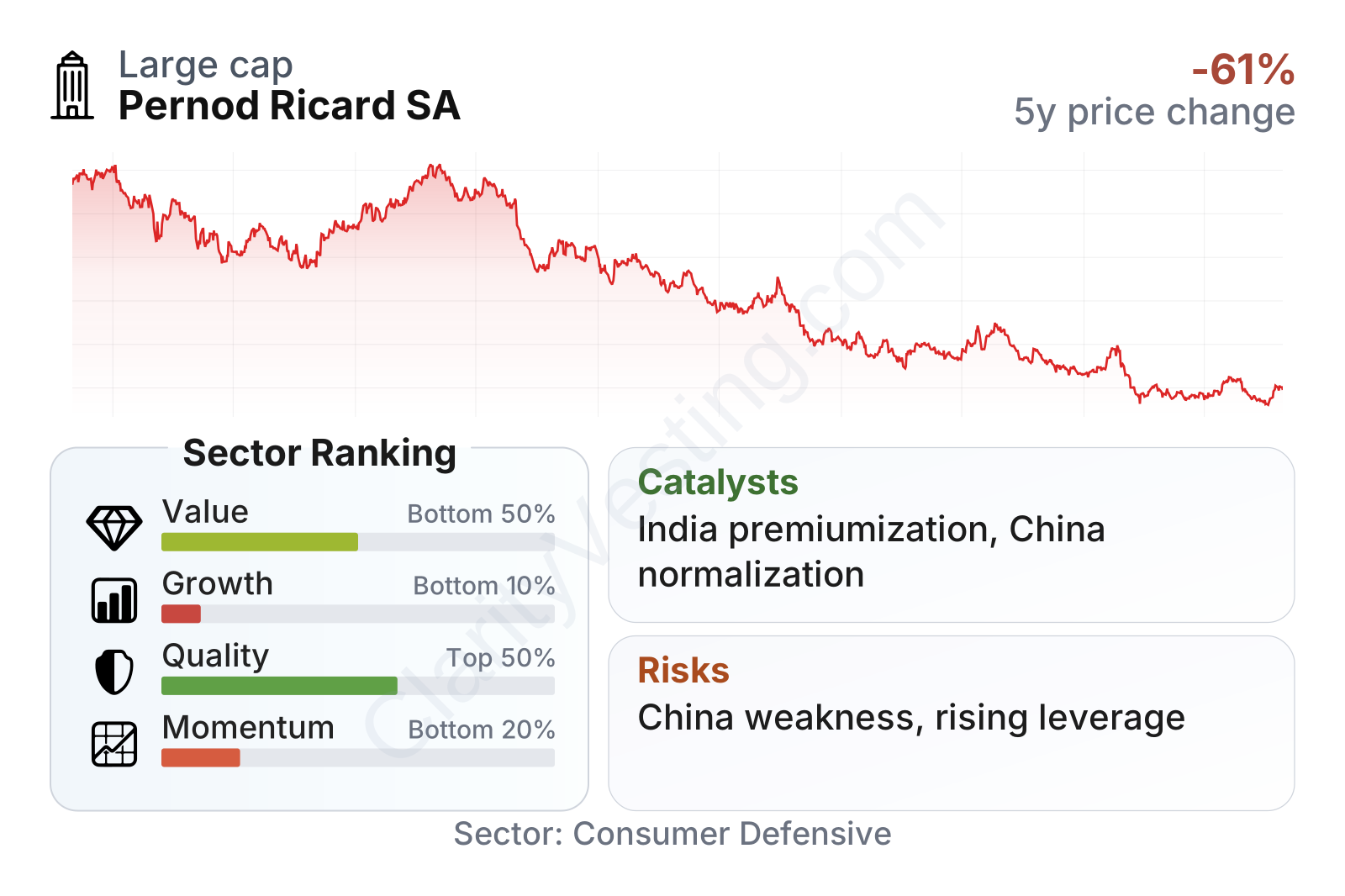
The share price trend has been difficult. The stock has lost substantial ground since 2021, and momentum remains in the weaker end of the sector. That decline shows investors have become much more cautious about near-term demand, especially after several years of softer revenue trends.
Growth
The spirits industry is not a fast-growth sector in the same way as software or semiconductors, but it has historically offered attractive long-term characteristics: global brands, repeat purchases, pricing power, and premiumization. Pernod Ricard’s strategy is built around these strengths. Management has emphasized premium and prestige products, geographic breadth, digital consumer engagement, and selective innovation rather than chasing volume at any price.
That strategy still makes industrial sense. Premium alcohol brands can grow through price mix, expansion in emerging markets, and category shifts toward higher-end products. India remains one of the most important structural opportunities for the group because of rising income levels, a large legal-age population, and the company’s strong presence there. The company has also continued to invest in premium whiskey, agave-based spirits, and direct consumer-facing brand building, which are logical areas for long-term value creation.
The challenge is that current growth has clearly turned negative. Revenue growth was strong coming out of the pandemic recovery, then slowed sharply and moved below zero. That pattern suggests Pernod Ricard is in a reset period rather than a steady expansion phase. Inventory normalization in parts of the distribution chain, weaker discretionary spending, and pressure in China have all contributed to the slowdown.
One meaningful catalyst is any normalization in Asian demand, especially China and travel retail. Another is continued momentum in India, where premium spirits consumption has favorable long-term demographics. A third is margin support from cost discipline: even with lower sales, Pernod Ricard has preserved a high operating margin by controlling expenses and leaning on premium brands.
Recent company updates have also shown active portfolio management, including acquisitions and partnerships in premium categories and ongoing focus on efficiency. Those steps do not remove the current slowdown, but they do support the idea that management is trying to protect long-term brand strength rather than maximize short-term volume.
Risks
This article is for informational purposes only and does not constitute financial advice. Some content is AI-generated. See Disclaimer


